


Unraveling bitter peptides in wheat protein hydrolysates
- PMID: 40524877
- PMCID: PMC12167818
- DOI: 10.1016/j.fochms.2025.100263
Unraveling bitter peptides in wheat protein hydrolysates
Abstract
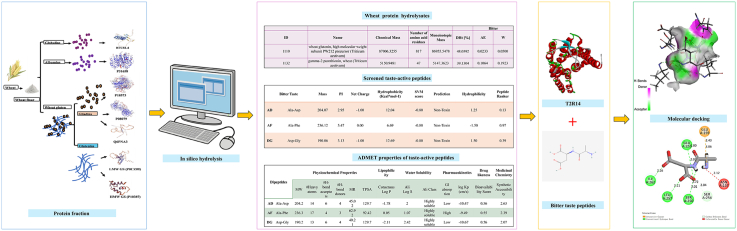
Wheat protein hydrolysates (WPHs) hold promise for functional food applications, but papain (EC 3.4.22.2)-mediated hydrolysis often results in undesirable bitterness and low yields of small peptides. To address this, we employed in silico strategies to systematically characterize bitter peptides in papain-derived WPHs and elucidate their molecular interactions with the human bitter taste receptor TAS2R14. Enzymatic hydrolysis of wheat proteins was simulated using the BIOPEP-UWM database, identifying 36 potential bitter peptides. Molecular docking studies revealed four critical binding residues (Asn157, Ile262, Trp89, and Phe247) on TAS2R14 that mediate bitterness perception. Notably, peptides rich in proline (Pro), phenylalanine (Phe), and tryptophan (Trp) exhibited heightened bitterness, while glycine (Gly)- and glutamic acid (Glu)-containing peptides were associated with reduced bitterness. These findings provide a mechanistic basis for mitigating bitterness in WPHs through selective enrichment or exclusion of peptides with specific amino acid profiles. By enabling targeted design of hydrolysis processes, this work advances the application of WPHs as palatable, bioactive ingredients in the food industry.
Keywords: ADMET; Bitterness; In silico; Molecular docking; TAS2R14; ToxinPred.
© 2025 The Authors.
Conflict of interest statement
The authors declare that they have no known competing financial interests or personal relationships that could have appeared to influence the work reported in this paper.
Figures


References
-
- Aluko R.E. Bitterness: Perception, chemistry and food processing. 2017. Structural characteristics of food protein-derived bitter peptides; pp. 105–129.
-
- Bakchi B., Krishna A.D., Sreecharan E., Ganesh V.B.J., Niharika M., Maharshi S., Shaik A.B. An overview on applications of SwissADME web tool in the design and development of anticancer, antitubercular and antimicrobial agents: A medicinal chemist’s perspective. Journal of Molecular Structure. 2022;1259
-
- Charoenkwan P., Yana J., Schaduangrat N., Nantasenamat C., Hasan M.M., Shoombuatong W. iBitter-SCM: Identification and characterization of bitter peptides using a scoring card method with propensity scores of dipeptides. Genomics. 2020;112(4):2813–2822. - PubMed
-
- Chen T., Zhang F., Chen S., Zhao Y., Huang X., Huang F., Li C. Improvement mechanism of umami peptides in oyster juice by cooperative enzymolysis of alcalase and trypsin based on peptidomics and molecular docking. Journal of Food Composition and Analysis. 2024;132
LinkOut - more resources
Full Text Sources
Research Materials
