The role of learned song in the evolution and speciation of Eastern and Spotted towhees
- PMID: 40526780
- PMCID: PMC12204620
- DOI: 10.1371/journal.pcbi.1013135
The role of learned song in the evolution and speciation of Eastern and Spotted towhees
Abstract
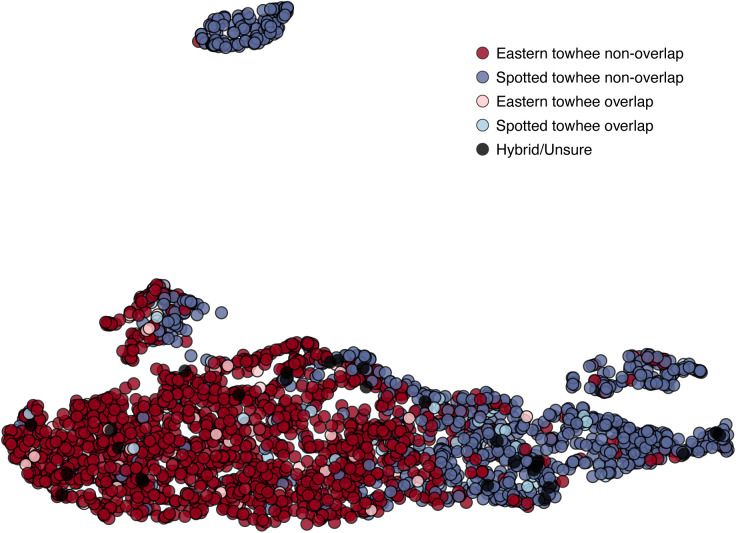
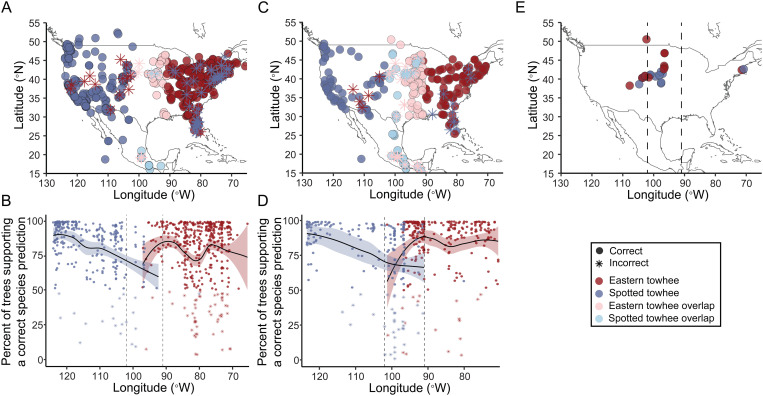
Oscine songbirds learn vocalizations that function in mate attraction and territory defense; sexual selection pressures on these learned songs could thus accelerate speciation. The Eastern and Spotted towhees are recently diverged sister species that now have partially overlapping ranges with evidence of some hybridization. Widespread community-science recordings of these species, including songs within their zone of overlap and from potential hybrids, enable us to investigate whether song differentiation might facilitate their reproductive isolation. Here, we quantify 16 song features to analyze geographic variation in Spotted and Eastern towhee songs and assess species-level differences. We then use several machine learning models to measure how accurately their songs can be classified by species. While no single song feature reliably distinguishes the two species, machine learning models classified songs with relatively high accuracy (random forest: 89.5%, deep learning: 90%, gradient boosting machine: 88%, convolutional neural network: 88%); interestingly, species classification was less accurate in their zone of overlap. Finally, our analysis of the limited publicly available genetic data from each species supports the hypothesis that the species are reproductively isolated. Together, our results suggest that small variations in multiple features may contribute to these sister species' ability to recognize their species-specific songs.
Copyright: © 2025 León Du’Mottuchi, Creanza. This is an open access article distributed under the terms of the Creative Commons Attribution License, which permits unrestricted use, distribution, and reproduction in any medium, provided the original author and source are credited.
Conflict of interest statement
The authors have declared that no competing interests exist.
Figures
References
-
- Catchpole CK, Slater PJB. Bird song: biological themes and variations. Cambridge University Press. 1995.
-
- Searfoss AM, Liu WC, Creanza N. Geographically well-distributed citizen science data reveals range-wide variation in the chipping sparrow’s simple song. Anim Behav. 2020;161:63–76.
-
- Podos J, Warren PS. The Evolution of Geographic Variation in Birdsong. Advances in the Study of Behavior. Academic Press. 2007. p. 403–58.
-
- Rivera‐Gutierrez HF, Matthysen E, Adriaensen F, Slabbekoorn H. Repertoire sharing and song similarity between great tit males decline with distance between forest fragments. Ethology. 2010;116(10):951–60. doi: 10.1111/j.1439-0310.2010.01813.x - DOI
-
- Price T. Speciation in Birds. 1st ed. W. H. Freeman. 2007.
MeSH terms
LinkOut - more resources
Full Text Sources