. 2025 Jun 17:9:e69801.
doi: 10.2196/69801.

Safety Evaluation in Healthy Adults of Motion-Based Virtual Reality Dichoptic Training for Pediatric Patients With Amblyopia: Prospective Intervention Study

Affiliations

Safety Evaluation in Healthy Adults of Motion-Based Virtual Reality Dichoptic Training for Pediatric Patients With Amblyopia: Prospective Intervention Study

Masakazu Hirota et al. JMIR Form Res. .

Abstract

Background: Amblyopia, a unilateral or bilateral visual disorder, affects up to 5% of the general population and is a leading cause of childhood visual impairment. Current treatments, such as patching therapy, aim to improve amblyopia by temporarily occluding the unaffected eye, thereby promoting the use of the amblyopic eye. However, adherence to patch therapy can be challenging, as the forced use of the amblyopic eye can be stressful for children. Moreover, despite improvements in visual acuity by patch therapy, children with amblyopia often face difficulties with hand-eye coordination; therefore, a treatment that reduces stress for them while simultaneously improving hand-eye coordination could address the limitations of existing amblyopia therapies.

Objective: This study investigated the safety of our motion-based virtual reality (VR) dichoptic training app using Japanese Kendama in healthy adult participants, which was designed to improve hand-eye coordination in pediatric patients with amblyopia.

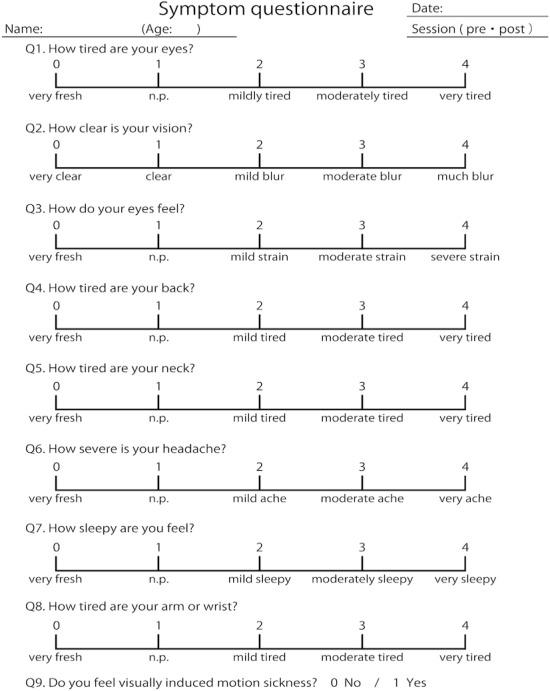
Methods: This prospective intervention study involved 20 healthy young adults (median age 21, IQR 21-28.3 y), including 16 women. The participants played the motion-based VR dichoptic training app for 30 minutes and then completed a subjective symptom questionnaire, which comprised 9 questions (Q1-Q9) with each item scored on a 4-point scale, except Q9, which was assessed on a binary scale. Q1-Q3 focused on subjective eye symptoms, Q4-Q7 evaluated physical and mental discomfort, Q8 assessed the degree of VR session-induced arm fatigue, and Q9 assessed the severity of visually induced motion sickness.

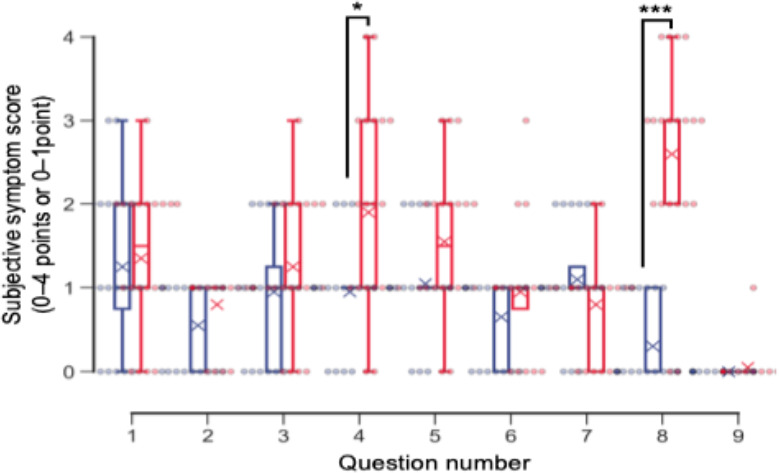
Results: No significant differences were observed in the reported ocular symptoms before and after the VR session, including eye fatigue (mean before vs after: 1.25, SD 0.94 points vs 1.35, SD 0.85 points), blurred vision (0.55, SD 0.50 points vs 0.80, SD 0.40 points), eye dryness (0.95, SD 0.74 points vs 1.25, SD 0.83 points), and visually induced motion sickness (0.00, SD 0.00 points vs 0.05, SD 0.22 points). These results suggested that the motion-based VR dichoptic training did not induce significant adverse ocular effects.

Conclusions: The motion-based VR dichoptic training app demonstrated minimal adverse ocular effects in healthy adult participants, suggesting that it is safe for use in this population. These findings demonstrate the feasibility and good tolerability of this VR-based intervention in healthy adults. Further studies, including clinical studies in adult and pediatric patients with amblyopia, are warranted to evaluate its applicability and therapeutic effects.

Keywords: adherence; amblyopia; dichoptic training; digital health; digital therapeutics; safety evaluation; strabismus; virtual reality; visually induced motion sickness.


Conflict of interest statement

Conflicts of Interest: MH and KN received personal fees from InnoJin, Inc, Tokyo, Japan. YO and TI are the owners of InnoJin, which developed the motion-based virtual reality (VR)–dichoptic training app. SN received consulting fees from Chugai Pharmaceutical Co, Ltd; Kowa Company, Ltd, Novartis Pharma KK, and Riverfield Inc; and travel reimbursements and speaker fees from Alcon Inc, Boehringer Ingelheim Co, Ltd, Bayer Yakuhin Ltd, Canon Inc, JFC Sales Plan Co, Ltd, Kowa Company, Ltd, Mitsubishi Tanabe Pharma Corporation, Machida Holdings Inc, MSD KK, Novartis Pharma KK, Novo Nordisk Pharma Ltd, Otsuka Pharmaceutical Co, Ltd, Santen Pharmaceutical Co, Ltd, Senju Pharmaceutical Co, Ltd, and Wakamoto Pharmaceutical Co, Ltd, not related to the submitted work. TI received nonfinancial support from Lion Corporation and Sony Network Communications Inc; grants from Johnson & Johnson Vision Care Inc, Yuimedi Inc, ROHTO Pharmaceutical Co Ltd, Kobayashi Pharmaceutical Co Ltd, Kandenko Co Ltd, and Fukoku Co Ltd; and personal fees from InnoJin Inc, related to the submitted work, and from Santen Pharmaceutical Co Ltd and Ono Pharmaceutical Co, Ltd, not related to the submitted work.

Figures

Figure 1.
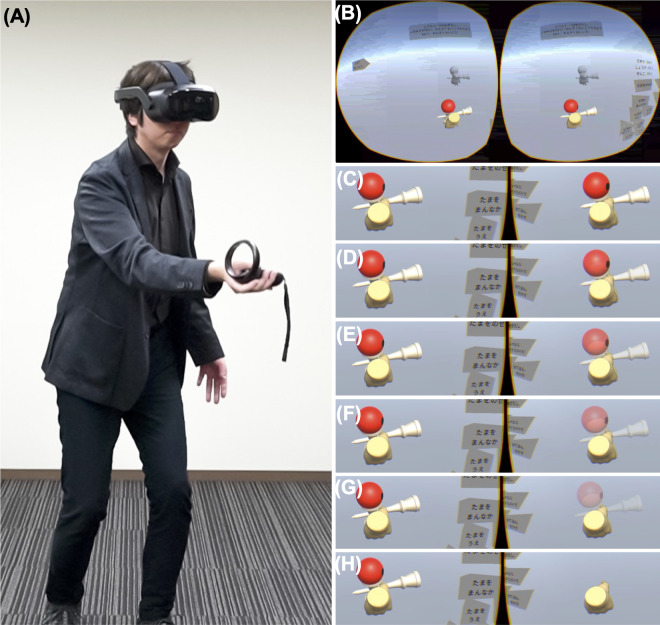
Figure 1.. Images of the VR-based dichoptic training app. (A) The VR HMD is worn by the participant. The right-hand controller is linked to the ken (handle). (B) Screenshot of the VR-based dichoptic training app using Japanese Kendama, while watching the ideal Kendama movement in grayscale. (C-H) Transmittance of one eye (dominant eye) can be changed from 100% to 0% in 20% decrements (C: 100%; D: 80%; E: 60%; F: 40%; G: 20%; and H: 0%). HMD: head-mounted display; VR: virtual reality.
Figure 2.
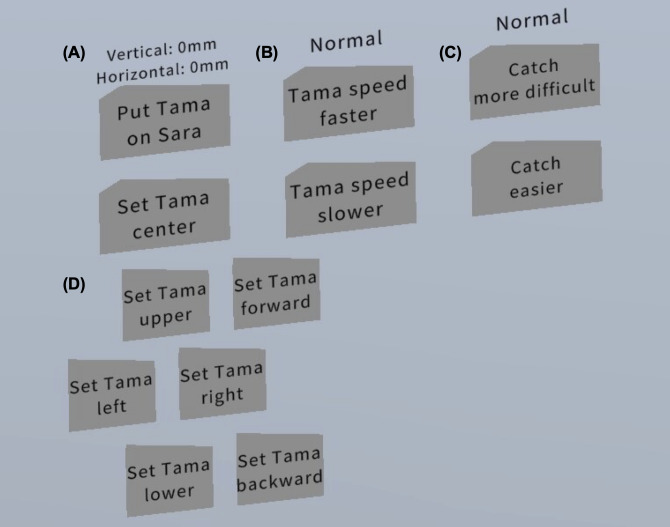
Figure 2.. Screenshots of the setting panels for the VR-based dichoptic training app. (A) Restart function. If the waza fails and the tama falls to the ground, the participants touch “Put Tama on Sara.” (B) Speed adjustment function. The ball speed can be changed by touching “Tama speed faster” or “Tama speed slower” in 3 levels: “slow,” “normal,” and “fast.” (C) Difficulty adjustment function. When participants try to play waza, it can be determined whether the tama is regarded as a success even if it slightly deviates from the sara or whether it is played at the same difficulty level as real Kendama (“difficult”) by touching the “Catch more difficult” or “Catch easier” in 3 levels: “easy,” “normal,” and “difficult.” (D) Position alignment function. In VR, the binocular disparity may be larger than in real space because images are presented with a disparity between the left and right eyes. For some participants, the tama may not be aligned on the sara, so the offset of the balls is adjusted by touching the “Set Tama upper, lower, left, right, forward, and backward” panel. VR: virtual reality.
Figure 3.
Figure 3.. Subjective symptom questionnaire. Q1-Q3 assess subjective eye symptoms; Q4-Q7 assess physical and mental discomfort; Q8 evaluates the degree of VR session–induced arm fatigue; and Q9 evaluates VIMS. n.p.: no problem; VIMS: visually induced motion sickness; VR: virtual reality.
Figure 4.
Figure 4.. Subjective symptom scores before and after using the VR-based dichoptic training app. Box plots illustrating subjective symptom scores before (blue) and after (red) using the VR-based dichoptic training app in all participants (n=20). Dots represent individual data points. Significant increases were observed in back discomfort (Q4) and arm fatigue (Q8) after the task. *P=.03, Wilcoxon signed rank test with Holm correction. ***P<.001, Wilcoxon signed rank test with Holm correction. VR: virtual reality.

Similar articles

References

    1. Attebo K, Mitchell P, Cumming R, Smith W, Jolly N, Sparkes R. Prevalence and causes of amblyopia in an adult population. Ophthalmology. 1998 Jan;105(1):154–159. doi: 10.1016/s0161-6420(98)91862-0. doi. Medline. - DOI - PubMed
    1. Faghihi M, Hashemi H, Nabovati P, et al. The prevalence of amblyopia and its determinants in a population-based study. Strabismus. 2017 Dec;25(4):176–183. doi: 10.1080/09273972.2017.1391849. doi. Medline. - DOI - PubMed
    1. Wu C, Hunter DG. Amblyopia: diagnostic and therapeutic options. Am J Ophthalmol. 2006 Jan;141(1):175–184. doi: 10.1016/j.ajo.2005.07.060. doi. Medline. - DOI - PubMed
    1. Liang YB, Friedman DS, Wong TY, et al. Prevalence and causes of low vision and blindness in a rural chinese adult population: the Handan Eye Study. Ophthalmology. 2008 Nov;115(11):1965–1972. doi: 10.1016/j.ophtha.2008.05.030. doi. Medline. - DOI - PubMed
    1. de Zárate BR, Tejedor J. Current concepts in the management of amblyopia. Clin Ophthalmol. 2007 Dec;1(4):403–414. Medline. - PMC - PubMed

LinkOut - more resources