


Synthesis and Biological Assessment of Cyanopyridine-Based 1,3,4-Oxadiazole Derivatives: Anticancer Potential, Antioxidant Activity, Molecular Docking, and DFT Calculations
- PMID: 40528497
- PMCID: PMC12174895
- DOI: 10.1002/jbt.70346
Synthesis and Biological Assessment of Cyanopyridine-Based 1,3,4-Oxadiazole Derivatives: Anticancer Potential, Antioxidant Activity, Molecular Docking, and DFT Calculations
Abstract
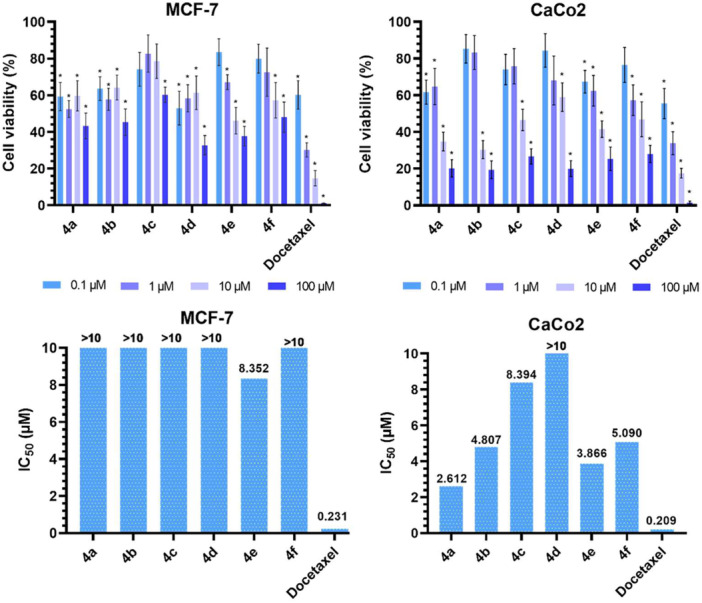
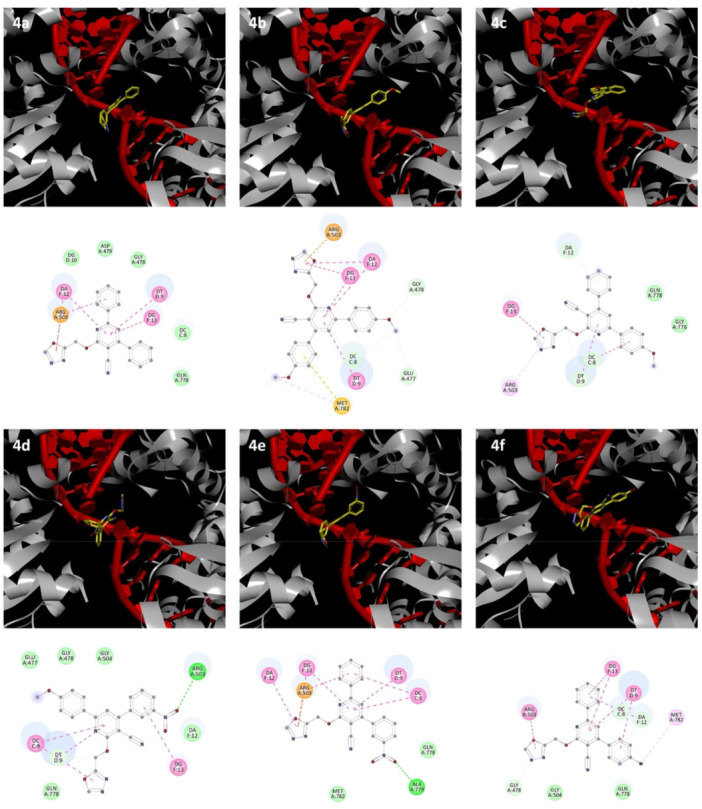
A series of six novel cyanopyridine derivatives bearing a 1,3,4-oxadiazole ring have been synthesized and characterized by FTIR, 13C NMR, 1H NMR, and elemental analysis. DFT calculations were carried out to determine their molecular geometries, electronic properties, and chemical reactivity. Their cytotoxicity has been evaluated against MCF-7 and CaCo-2 human cancer cell lines using the MTT assay. Most compounds displayed poor cytotoxic activity against the MCF-7 cell line except for compound 4e, which showed potent activity with IC50 = 8.352 µM. However, the CaCo-2 cell line was highly sensitive toward most tested compounds with an IC50 range from 2.612 µM to 8.394 µM except for compound 4 d. Molecular docking studies targeting human topoisomerase-IIβ revealed that all compounds exhibited excellent binding affinity within the enzyme's active site, with binding energies ranging from -7.33 to -8.28 kcal/mol. These findings suggest a potential anticancer mechanism underlying the observed cytotoxic activities. All tested compounds revealed low antioxidant activity in the DPPH assay. However, compounds 5b and 5 d presented moderate metal chelating activity. These findings underscore the potential anticancer properties of the synthesized cyanopyridine derivatives.
Keywords: 1,3,4‐oxadiazole; CaCo‐2; DFT calculations; MCF‐7; antioxidant activity; cyanopyridine; molecular docking.
© 2025 The Author(s). Journal of Biochemical and Molecular Toxicology published by Wiley Periodicals LLC.
Conflict of interest statement
The authors declare no conflicts of interest.
Figures
References
-
- Meanwell N. A., “A Synopsis of the Properties and Applications of Heteroaromatic Rings in Medicinal Chemistry,” Advances in Heterocyclic Chemistry 123 (2017): 245–361, 10.1016/BS.AIHCH.2016.11.002. - DOI
-
- Ainsworth C., “1,3,4‐Oxadiazole,” Journal of the American Chemical Society 87 (1965): 5800–5801, 10.1021/ja00952a056. - DOI
-
- Hutt M. P., Elslager E. F., and Werbel L. M., “2‐Phenyl‐5‐(trichloromethyl)‐1,3,4‐oxadiazoles, A New Class of Antimalarial Substances,” Journal of Heterocyclic Chemistry 7 (1970): 511–518, 10.1002/jhet.5570070308. - DOI
MeSH terms
Substances
LinkOut - more resources
Full Text Sources
Medical
