


Utilizing Intercostal Nerve Autografts for Nipple Neurotization: A Novel Approach to Restore Sensation
- PMID: 40529217
- PMCID: PMC12173318
- DOI: 10.1097/GOX.0000000000006898
Utilizing Intercostal Nerve Autografts for Nipple Neurotization: A Novel Approach to Restore Sensation
Abstract
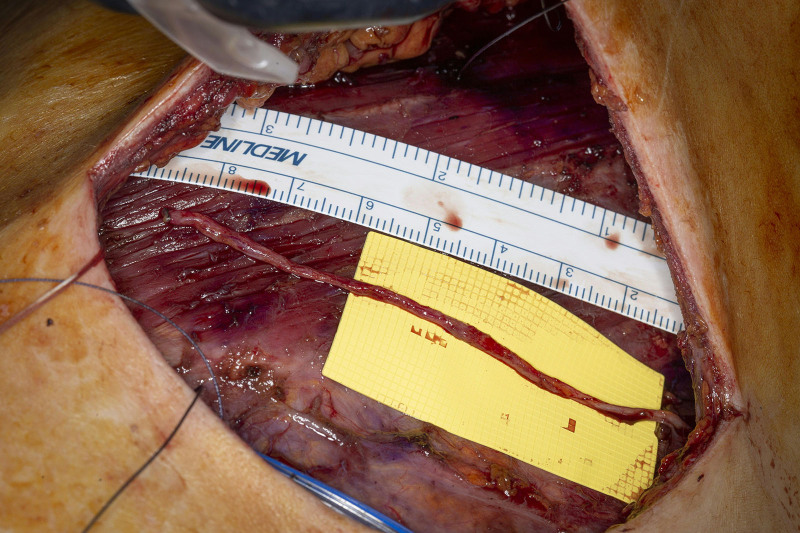
Breast cancer is a common malignancy, and treatment often involves mastectomy. For oncological safety, the anterior and lateral cutaneous branches of the third through fifth intercostal nerves are routinely resected during nipple-sparing mastectomies, leading to loss of nipple sensation. The current gold standard for nipple neurotization uses nerve allografts to connect the nipple with a remaining stump of an intercostal nerve. Despite the convenience of off-the-shelf solutions, this study explored a novel approach using intercostal nerves as autografts or for direct repair to restore nipple sensation. Six patients underwent nipple-sparing mastectomy and opted for nipple neurotization. Three patients underwent neurotization with an intercostal nerve autograft, whereas in 3 patients, long intercostal nerves allowed nipple neurotization directly without the need for an autograft. Meticulous dissection of the intercostal nerves enabled a length of approximately 9 cm (±1.5) per nerve. The acquired nerve length allowed tension-free coaptation of direct nipple neurotization in 3 patients and utilization as an autograft in the other 3 patients. No postoperative complications were observed, whereas sensory outcomes are yet to be evaluated. The study highlighted the feasibility of using intercostal nerves either as autologous intercostal nerve grafts or for direct neurotization. Using an intercostal nerve as an autograft is a cost-effective and time-efficient strategy to avoid the need for an allograft without additional donor-site morbidity. This technique offers a practical and globally accessible solution for improving patient access to state-of-the-art postmastectomy breast reconstruction.
Copyright © 2025 The Authors. Published by Wolters Kluwer Health, Inc. on behalf of The American Society of Plastic Surgeons.
Conflict of interest statement
The authors have no financial interest to declare in relation to the content of this article.
Figures


References
-
- Knackstedt R, Gatherwright J, Cakmakoglu C, et al. Predictable location of breast sensory nerves for breast reinnervation. Plast Reconstr Surg. 2019;143:393–396. - PubMed
-
- Yueh JH, Houlihan MJ, Slavin SA, et al. Nipple-sparing mastectomy: evaluation of patient satisfaction, aesthetic results, and sensation. Ann Plast Surg. 2009;62:586–590. - PubMed
-
- Djohan R, Knackstedt R, Scomacao I, et al. A novel approach to sensory re-innervation to the nipple areolar complex after mastectomy with implant-based reconstruction: anatomic and technical considerations. J Plast Reconstr Aesthet Surg. 2020;73:983–1007. - PubMed
-
- Rbia N, Shin AY. The role of nerve graft substitutes in motor and mixed motor/sensory peripheral nerve injuries. J Hand Surg Am. 2017;42:367–377. - PubMed
-
- Boriani F, Fazio N, Bolognesi F, et al. Noncellular modification of acellular nerve allografts for peripheral nerve reconstruction: a systematic critical review of the animal literature. World Neurosurg. 2019;122:692–703.e2. - PubMed
LinkOut - more resources
Full Text Sources