


Effectiveness of nulliparous women's different childbirth positions during the second stage of labor: A systematic review and network meta-analysis
- PMID: 40529452
- PMCID: PMC12168456
- DOI: 10.1016/j.ijnss.2025.04.006
Effectiveness of nulliparous women's different childbirth positions during the second stage of labor: A systematic review and network meta-analysis
Abstract
Objectives: A systematic review and network meta-analysis was conducted to evaluate the effectiveness of different childbirth positions in reducing the duration of the second stage of labor, providing evidence-based insights for obstetric institutions to guide interventions related to childbirth positions.
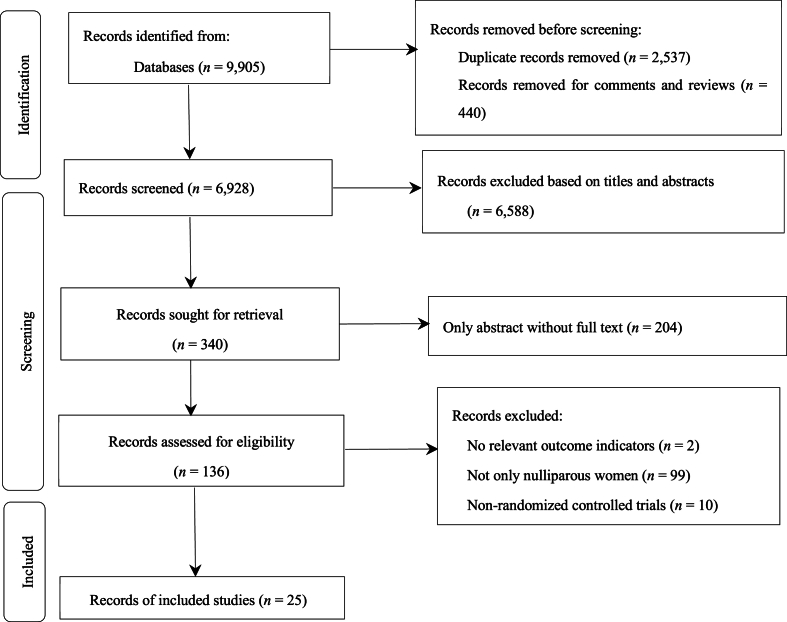
Methods: A comprehensive literature search was conducted in databases, including PubMed, Web of Science, the Cochrane Library, Embase, Wanfang Databases, China National Knowledge Infrastructure Databases (CNKI), China Science and Technology Journal Database (CSTJ), and China Biology Medicine disc (CBMdisc) to identify studies on the effectiveness of different childbirth positions in reducing the duration of the second stage of labor. The search included randomized controlled trials published from database inception to September 30, 2024. The Cochrane risk-of-bias tool was used to assess the quality of the studies. Two independent reviewers screened the literature, extracted data, and evaluated study quality. Subsequently, a network meta-analysis was performed using STATA software. The study protocol has been registered in PROSPERO (CRD42023428217).
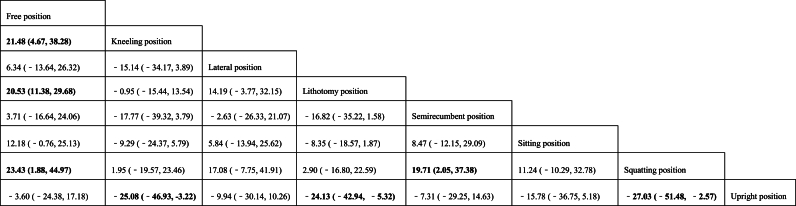
Results: This study analyzed data from 25 randomized controlled trials involving 9,844 women. The findings indicated that in comparison to lithotomy position, free position (MD = 20.53, 95 %CI [11.38, 29.68]) and upright position (MD = -24.13, 95 %CI [-42.94, -5.32]) were found to be superior in reducing the duration of the second stage of labor. Free position outperformed kneeling position (MD = 21.48, 95 %CI [4.67, 38.28]) and squatting position (MD = 23.43, 95 %CI [1.88, 44.97]); upright position was superior to kneeling position (MD = -25.08, 95 %CI [-46.93, -3.22]); semirecumbent position surpassed squatting position (MD = 19.71, 95 %CI [2.05, 37.38]); and upright position was also superior to squatting position (MD = -27.03, 95 %CI [-51.48, -2.57]). According to the surface under the cumulative ranking curve (SUCRA), the upright position emerged as the most effective for reducing the duration of the second stage of labor (87.4 %), followed by free position (81.1 %), semirecumbent position (70.0 %), and lateral position (62.3 %).
Conclusion: These findings offer valuable insights for midwifery practice and help inform future research directions. Considering the limitations of this review, more larger-scale, multicenter randomized controlled trials are warranted to further evaluate the relative effectiveness of different childbirth positions in reducing the duration of the second stage of labor.
Keywords: Childbirth; Network meta-analysis; Nulliparous women; Position; Second stage of labor.
© 2025 The Authors.
Conflict of interest statement
The authors have declared no conflict of interest.
Figures
References
-
- International Confederation of Midwives Keeping birth normal. 2019. https://internationalmidwives.org/resources/keeping-birth-normal/ [Accessed 2 Nov 2024]
-
- World Health Organization . World Health Organization; Geneva: 2018. WHO recommendations: intrapartum care for a positive childbirth experience.https://pubmed.ncbi.nlm.nih.gov/30070803/ [Accessed 2 Nov 2024] - PubMed
-
- He J., Chen L. Maternal position during labor. Chin J Pract Gynecol Obstet. 2015;31(2):112–116. doi: 10.7504/862015010104. - DOI
Publication types
LinkOut - more resources
Full Text Sources
