


Identifying the key influencing factors of psychological birth trauma in primiparous women with interpretable machine learning
- PMID: 40529457
- PMCID: PMC12168461
- DOI: 10.1016/j.ijnss.2025.04.008
Identifying the key influencing factors of psychological birth trauma in primiparous women with interpretable machine learning
Abstract
Objective: Accurately identifying the key influencing factors of psychological birth trauma in primiparous women is crucial for implementing effective preventive and intervention measures. This study aimed to develop and validate an interpretable machine learning prediction model for identifying the key influencing factors of psychological birth trauma in primiparous women.
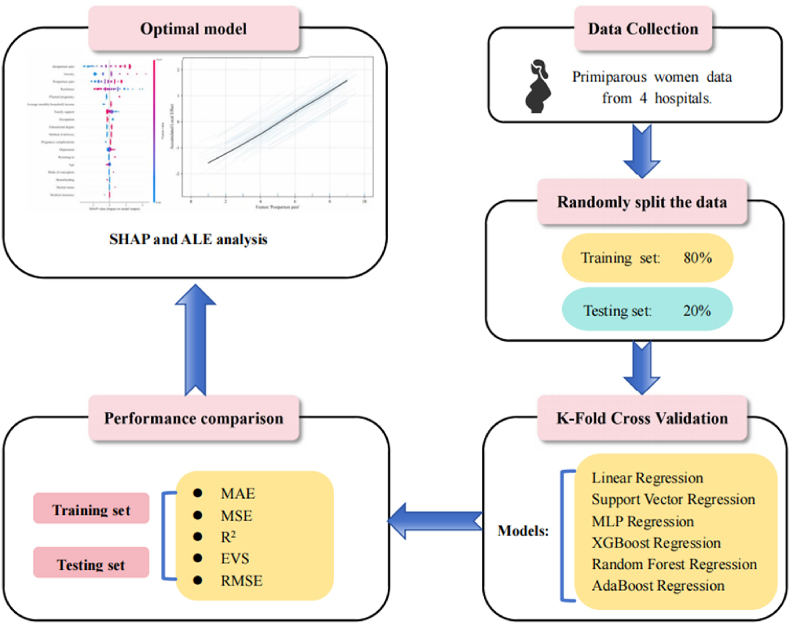
Methods: A multicenter cross-sectional study was conducted on primiparous women in four tertiary hospitals in Sichuan Province, southwestern China, from December 2023 to March 2024. The Childbirth Trauma Index was used in assessing psychological birth trauma in primiparous women. Data were collected and randomly divided into a training set (80 %, n = 289) and a testing set (20 %, n = 73). Six different machine learning models were trained and tested. Training and prediction were conducted using six machine learning models included Linear Regression, Support Vector Regression, Multilayer Perceptron Regression, eXtreme Gradient Boosting Regression, Random Forest Regression, and Adaptive Boosting Regression. The optimal model was selected based on various performance metrics, and its predictive results were interpreted using SHapley Additive exPlanations (SHAP) and accumulated local effects (ALE).
Results: Among the six machine learning models, the Multilayer Perceptron Regression model exhibited the best overall performance in the testing set (MAE = 3.977, MSE = 24.832, R 2 = 0.507, EVS = 0.524, RMSE = 4.983). In the testing set, the R 2 and EVS of the Multilayer Perceptron Regression model increased by 8.3 % and 1.2 %, respectively, compared to the traditional linear regression model. Meanwhile, the MAE, MSE, and RMSE decreased by 0.4 %, 7.3 %, and 3.7 %, respectively, compared to the traditional linear regression model. The SHAP analysis indicated that intrapartum pain, anxiety, postpartum pain, resilience, and planned pregnancy are the most critical influencing factors of psychological birth trauma in primiparous women. The ALE analysis indicated that higher intrapartum pain, anxiety, and postpartum pain scores are risk factors, while higher resilience scores are protective factors.
Conclusions: Interpretable machine learning prediction models can identify the key influencing factors of psychological birth trauma in primiparous women. SHAP and ALE analyses based on the Multilayer Perceptron Regression model can help healthcare providers understand the complex decision-making logic within a prediction model. This study provides a scientific basis for the early prevention and personalized intervention of psychological birth trauma in primiparous women.
Keywords: Influencing factor; Machine learning; Primiparous women; Psychological birth trauma.
© 2025 The Authors.
Conflict of interest statement
The authors declare there is no conflict of interest.
Figures
References
-
- Ayers S., Horsch A., Garthus-Niegel S., Nieuwenhuijze M., Bogaerts A., Hart Mann K., et al. Traumatic birth and childbirth-related post-traumatic stress disorder: international expert consensus recommendations for practice, policy, and research. Women Birth. 2024;37(2):362–367. doi: 10.1016/j.wombi.2023.11.006. - DOI - PubMed
LinkOut - more resources
Full Text Sources
