


The Otago Exercise Program's effect on fall prevention: a systematic review and meta-analysis
- PMID: 40529705
- PMCID: PMC12172654
- DOI: 10.3389/fpubh.2025.1522952
The Otago Exercise Program's effect on fall prevention: a systematic review and meta-analysis
Abstract
Objectives: This study aims to compare the effectiveness of the Otago Exercise Program (OEP) in fall prevention between generally healthy older adults and those with compromised health conditions, assessing which group benefits more from the intervention.
Design: This meta-analysis evaluated the effectiveness of the OEP in fall prevention among general older adults and older adults with compromised health, including individuals at high risk of falls, cognitive impairment, musculoskeletal disorders, or frailty syndrome.
Methods: A comprehensive search was conducted in Web of Science, PubMed, Scopus, Cochrane Library, and Embase, following strict eligibility criteria. Data extraction, risk of bias assessment, and meta-analysis were conducted to evaluate the effectiveness of the intervention.
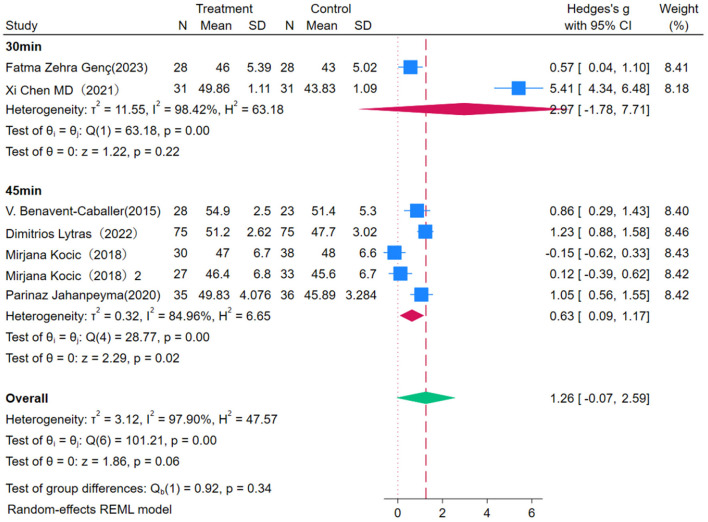
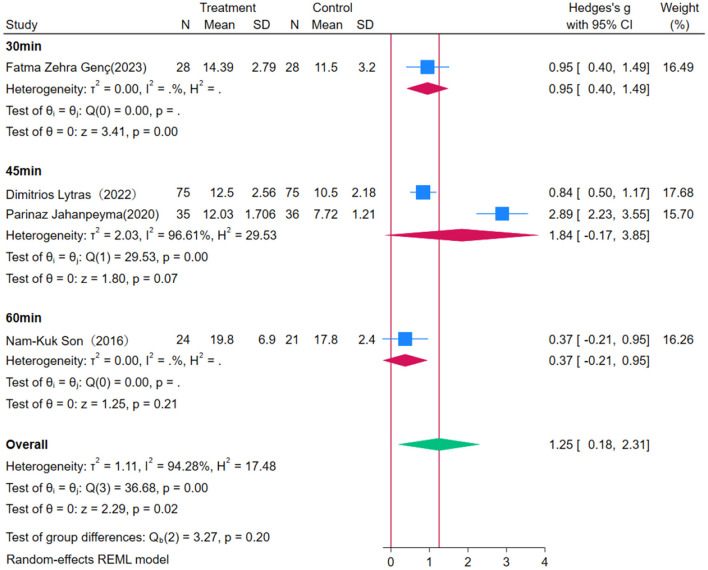
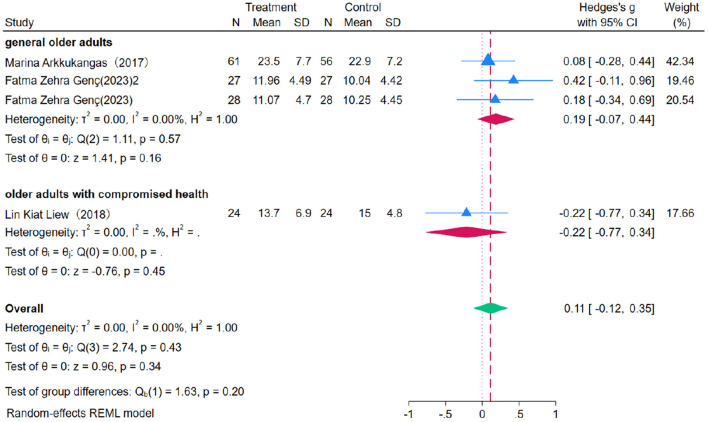
Results: Fifteen studies with 1,278 participants were included. The OEP significantly improved balance (WMD = 0.15, 95% CI [-0.05, 0.35]), gait (WMD = 0.49, 95% CI [0.18, 0.80]), and lower limb strength (WMD = 0.84, 95% CI [0.61, 1.07]) in general older adults. The effects were more pronounced in older adults with compromised health, particularly in gait, particularly in gait (WMD = 0.92, 95% CI [0.13, 1.72]) and lower limb strength (WMD = 2.24, 95% CI [1.04, 3.45]). However, the OEP did not significantly improve physical function or upper limb strength in either group.
Conclusion: The OEP effectively improves balance, gait, and lower limb strength, especially in older adults with compromised health. However, it does not significantly impact physical function or upper limb strength. This study has limitations, including potential bias, study heterogeneity, and variations in interventions, which may affect result reliability. A cautious interpretation is needed, and future research should focus on analyzing diverse populations and ensuring adequately sized samples to enhance the reliability of the findings.
Systematic review registration: PROSPERO (CRD42024549302), https://www.crd.york.ac.uk/PROSPERO/view/CRD42024549302.
Keywords: Otago exercise; fall; meta-analysis; older adult; prevention.
Copyright © 2025 Wang and Kim.
Conflict of interest statement
The authors declare that the research was conducted in the absence of any commercial or financial relationships that could be construed as a potential conflict of interest.
Figures






References
-
- Noohu M, Dey A, Hussain M. Relevance of balance measurement tools and balance training for fall prevention in older adults. J Clin Gerontol Geriatr. (2014) 5:31–5. 10.1016/j.jcgg.2013.05.002 - DOI
-
- Organisation WH . Ageing and Health. (2024). Available online at: https://www.who.int/news-room/fact-sheets/detail/ageing-and-health (accessed March 15, 2025).
-
- Mgbeojedo UG, Akosile CO, Okoye EC, Ani KU, Ekechukwu EN, Okezue OC, et al. Effects of otago exercise program on physical and psychosocial functions among community-dwelling and institutionalized older adults: a scoping review. Inquiry. (2023) 60:469580231165858. 10.1177/00469580231165858 - DOI - PMC - PubMed
-
- Liston M, Genna G, Maurer C, Kikidis D, Gatsios D, Fotiadis D, et al. Investigating the feasibility and acceptability of the HOLOBalance system compared with standard care in older adults at risk for falls: study protocol for an assessor blinded pilot randomised controlled study. BMJ Open. (2021) 11:e039254. 10.1136/bmjopen-2020-039254 - DOI - PMC - PubMed
Publication types
MeSH terms
LinkOut - more resources
Full Text Sources
Medical
