


Effect of Locoregional Vs General Anesthesia on Incidence of Delayed Neurocognitive Recovery in Patients Undergoing Hip Fracture Surgery: A Randomized Controlled Trial
- PMID: 40530400
- PMCID: PMC12170814
- DOI: 10.2147/JPR.S523812
Effect of Locoregional Vs General Anesthesia on Incidence of Delayed Neurocognitive Recovery in Patients Undergoing Hip Fracture Surgery: A Randomized Controlled Trial
Abstract
Purpose: Delayed neurocognitive recovery is common in elderly patients undergoing major surgery under general anesthesia. We conducted a randomized controlled trial to examine whether continuous femoral nerve block plus sacral plexus block reduces the rate of delayed neurocognitive recovery in patients undergoing hip surgery.
Methods: This is a single-centre, randomized controlled trial. Patients undergoing hip surgery were randomized (1:1 ratio) to undergo surgery under either continuous femoral nerve block plus sacral plexus block or general anesthesia. The primary end point was delayed neurocognitive recovery, as assessed using a battery of neuropsychological tests at 7 days after the surgery (Z score ≤-1.96 in at least 2 tests, and/or combined Z score ≤-1.96), in a modified intent-to-treat population. Secondary end points included postoperative complications, moderate/severe postoperative pain (visual analogue scale ≥4), use of opioids within 48 hours, and 6-month all-cause mortality.
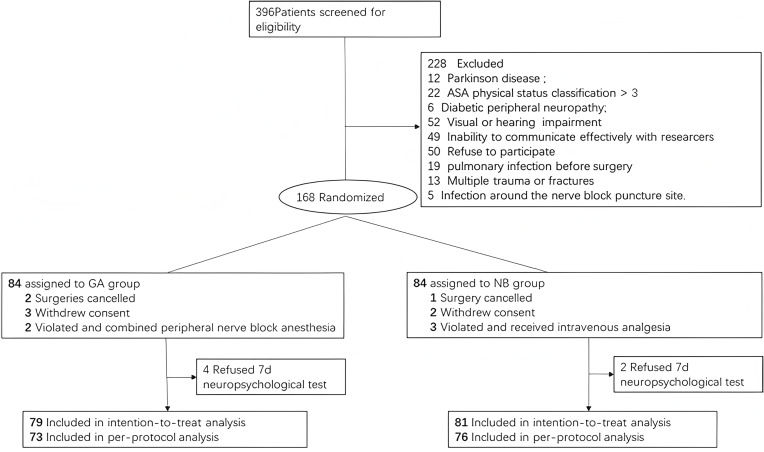
Results: A total of 168 patients were enrolled from January 2018 to May 2021. One hundred and sixty were included in the analysis (81 and 79 in the nerve block and general anesthesia, respectively). The rate of delayed neurocognitive recovery was 7.4% (6/81) in the continuous femoral nerve block plus sacral plexus block group versus 21.5% (17/79) in the general anesthesia group (odds ratio: 0.34, 95% CI: 0.14-0.83; P = 0.01). The rate of postoperative pulmonary infection was 1.2% (1/81) in the nerve block group versus 10.1% (8/79) in the general anesthesia group OR 0.12 (95% CI 0.02,0.95; P = 0. 02). No patient died within 6 months after surgery.
Conclusion: When compared with general anesthesia, continuous nerve block anesthesia might decrease the incidence of delayed neurocognitive recover in patients undergoing hip fracture surgery. The locoregional anesthesia technique for patients undergoing hip surgery offers a safer alternative that lowers the risk of complications.
Keywords: delayed neurocognitive recovery; hip surgery; nerve block.
© 2025 Xie et al.
Conflict of interest statement
The authors report no conflicts of interest in this work.
Figures
References
-
- Boulton C, Bunning T, Johansen A, et al. National hip fracture database annual report 2017.
Publication types
LinkOut - more resources
Full Text Sources
