


The neurobiological foundation of effective repetitive transcranial magnetic brain stimulation in Alzheimer's disease
- PMID: 40530618
- PMCID: PMC12175030
- DOI: 10.1002/alz.70337
The neurobiological foundation of effective repetitive transcranial magnetic brain stimulation in Alzheimer's disease
Abstract
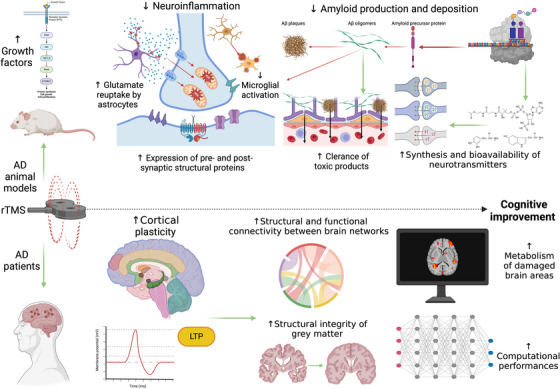
Noninvasive brain stimulation (NIBS) techniques, such as repetitive transcranial magnetic stimulation (rTMS), are promising candidate therapeutics for Alzheimer's disease (AD). We review the evidence supporting the fundamental mechanisms of action of rTMS treatments in AD. rTMS exerts profound effects at different neurobiological and systems neurophysiological levels. By engaging distinct pre- and postsynaptic structures within the stimulated neural network, it directly or indirectly influences various cellular and molecular components. In AD, rTMS influences synaptic plasticity, inducing lasting structural changes and broad reorganization of functional and structural connectivity at the macroscale level. Importantly, it modulates neurotransmitter circuits characteristically disrupted in AD and restores the excitation/inhibition balance by targeting glutamatergic and γ-aminobutyric acid (GABA)ergic pathways. Moreover, rTMS increases neurotrophic factors, counteracts amyloid and tau accumulation, and mitigates neuroinflammation by reducing microglial activation and pro-inflammatory cytokines release. Therefore, maturing preclinical evidence could guide future precision medicine therapeutic strategies based on personalized NIBS in AD patients. HIGHLIGHTS: Noninvasive brain stimulation (NIBS) techniques, such as repetitive transcranial magnetic stimulation (rTMS), are promising candidate therapeutics for Alzheimer's disease (AD). rTMS modulates neuroplasticity, neurotransmission, and neuroinflammation. Preclinical research shows disease-specific neurobiological effects of rTMS in AD. Promising data from AD patients suggest the translatability of animal model results. Preclinical data may guide precision medicine strategies through personalized NIBS.
Keywords: Alzheimer's disease (AD); animal models; noninvasive brain stimulation (NIBS); pathological cascade; plasticity; preclinical research; repetitive transcranial magnetic stimulation (rTMS); transcranial magnetic stimulation (TMS).
© 2025 The Author(s). Alzheimer's & Dementia published by Wiley Periodicals LLC on behalf of Alzheimer's Association.
Conflict of interest statement
Annibale Antonioni declares no conflicts of interest related to this manuscript. Giacomo Koch is scientific co‐founder and holds stocks of Sinaptica Therapeutics. Giacomo Koch has received payment or honoraria for lectures, presentations, speakers’ bureaus, manuscript writing, or educational events from Epitech, Roche, Novo Nordisk. Giacomo Koch and Alessandro Martorana have the following patent issued: Combination drug formulations including rotigotine and an acetylcholinesterase inhibitor for the treatment of neurodegenerative diseases (n. 20230381512); Giacomo Koch and Emiliano Santarnecchi have the following patent issued: Systems and methods for providing personalized targeted non‐invasive stimulation to a brain network (n. 11998740). GK reports grants from BrighFocus Foundation, Epitech, Alzheimer's Drug Discovery Foundation (ADDF), Italian Ministry of Health and non‐financial support from UCB Pharma outside the submitted work. Alessandro Martorana reports grants from Alzheimer's Drug Discovery Foundation, BrighFocus Foundation, Italian Ministry of Health and non‐financial support from UCB Pharma outside the submitted work.
Harald Hampel is an employee of Eisai Inc.; however, this article does not represent the opinion of Eisai. His contribution to this article reflects only and exclusively his academic and scientific expertise and was initiated during an academic appointment at Sorbonne University, Paris, France. He serves as a Reviewing Editor and previously as Senior Associate Editor for the journal Alzheimer's & Dementia, the journal of the Alzheimer's Association.
Harald Hampel is inventor of 11 patents and has received no royalties:
1. In Vitro Multiparameter Determination Method for The Diagnosis and Early Diagnosis of Neurodegenerative Disorders Patent Number: 8916388
2. In Vitro Procedure for Diagnosis and Early Diagnosis of Neurodegenerative Diseases Patent Number: 8298784
3. Neurodegenerative Markers for Psychiatric Conditions Publication Number: 20120196300
4. In Vitro Multiparameter Determination Method for The Diagnosis and Early Diagnosis of Neurodegenerative Disorders Publication Number: 20100062463
5. In Vitro Method for The Diagnosis and Early Diagnosis of Neurodegenerative Disorders Publication Number: 20100035286
6. In Vitro Procedure for Diagnosis and Early Diagnosis of Neurodegenerative Diseases Publication Number: 20090263822
7. In Vitro Method for The Diagnosis of Neurodegenerative Diseases Patent Number: 7547553
8. CSF Diagnostic in Vitro Method for Diagnosis of Dementias and Neuroinflammatory Diseases Publication Number: 20080206797
9. In Vitro Method for The Diagnosis of Neurodegenerative Diseases Publication Number: 20080199966
10. Neurodegenerative Markers for Psychiatric Conditions Publication Number: 20080131921
11. Method for diagnosis of dementias and neuroinflammatory diseases based on an increased level of procalcitonin in cerebrospinal fluid: Publication number: United States Patent 10921330. Author disclosures are available in the Supporting Information.
Figures
References
Publication types
MeSH terms
LinkOut - more resources
Full Text Sources
Medical
