


Pain characteristics and psychological factors that mediate the association between obesity and outcomes of interdisciplinary pain rehabilitation: a registry-based cohort study
- PMID: 40530797
- PMCID: PMC12180319
- DOI: 10.1080/07853890.2025.2517816
Pain characteristics and psychological factors that mediate the association between obesity and outcomes of interdisciplinary pain rehabilitation: a registry-based cohort study
Abstract
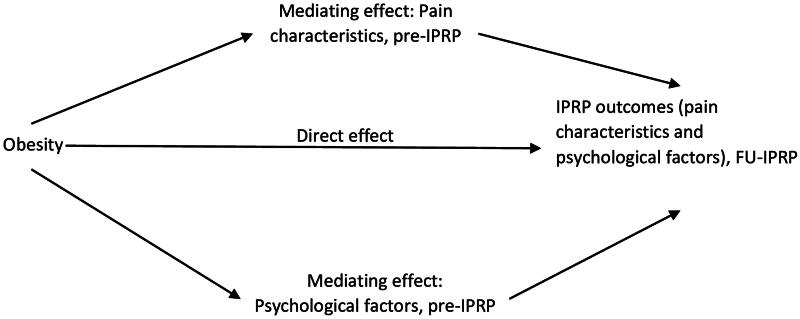
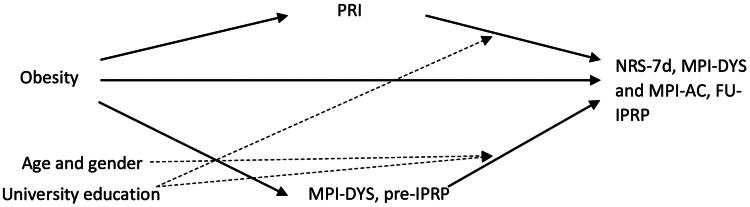
Background: Obesity is a common comorbidity with chronic pain and is closely related to functional and psychological complications of pain, which are also the main outcomes of interdisciplinary pain rehabilitation programmes (IPRP). How obesity influences IPRP outcomes is poorly understood. This study aims to investigate the role of pain characteristics and psychological factors before IPRP as mediators of the association between obesity and IPRP outcomes (i.e. pain intensity and psychological functioning).
Methods: Sociodemographic variables, pain characteristics and psychological factors were retrieved from the Swedish Quality Registry for Pain Rehabilitation (SQRP). Data at baseline (pre-IPRP) and 1-year follow-up (FU-IPRP) were used in mediation analysis.
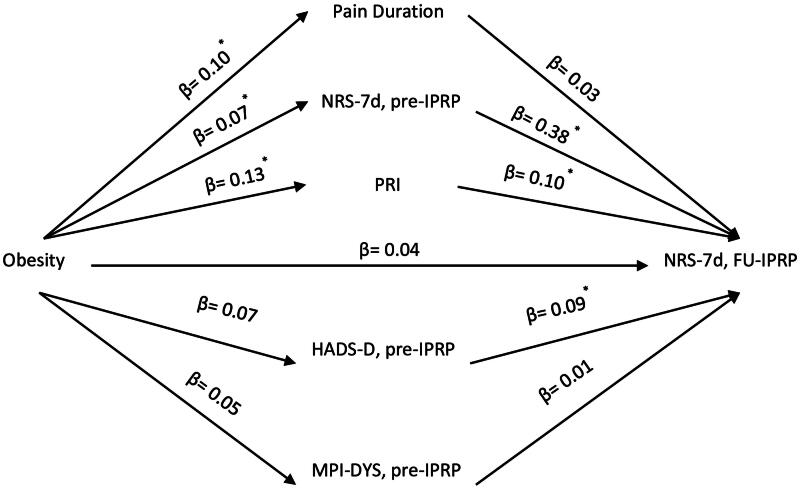
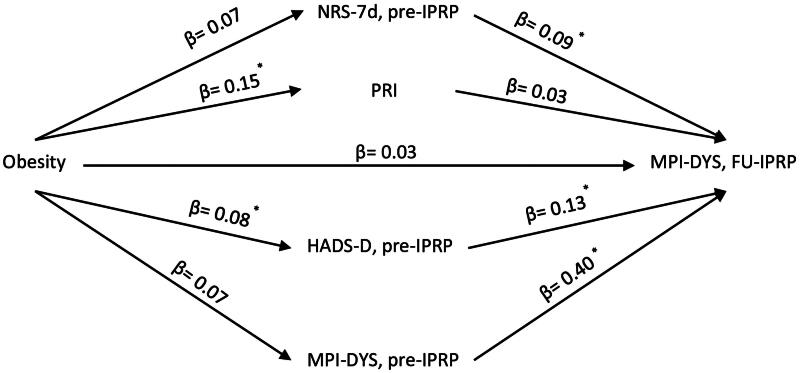
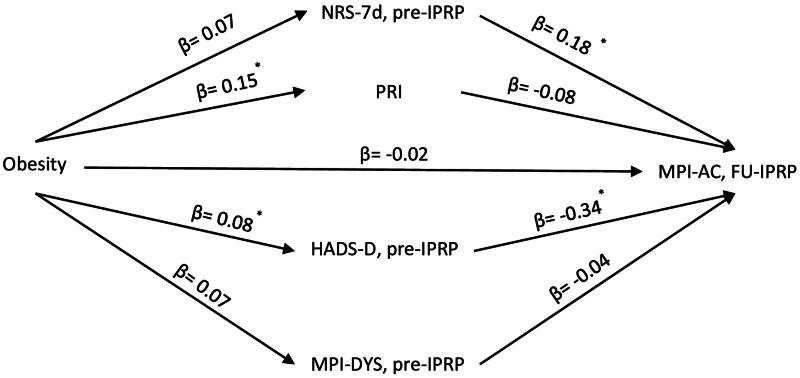
Results: Of the 872 patients (mean age 45.8 ± 10.5 years, 80.3% female), 232 (26.6%) were obese (body mass index [BMI] ≥ 30 kg/m2). Patients with obesity reported higher pain intensity (p = 0.02), a higher number of pain locations (p < 0.001), and longer pain duration (p = 0.002) compared to non-obese patients. Significant improvements at FU-IPRP were found in pain intensity and psychological functioning for both obese and non-obese groups. Mediation analysis revealed that pain intensity, pain radiation and depressive symptoms at pre-IPRP reduced the improvement of pain intensity at FU-IPRP among the patients with obesity. Depressive symptoms and pain intensity (or pain radiation) also mediated changes in two psychometric outcomes of IPRP (dysfunctional scale and adaptive coper scale).
Conclusion: At FU-IPRP, patients with obesity experienced improvements in pain and psychological well-being, which were mediated by pain intensity, pain radiation, and depression. The roles of these mediators need to be specifically addressed when designing a tailored IPRP for pain patients with comorbid obesity.
Keywords: Chronic pain; depression; obesity; rehabilitation.
Plain language summary
Patients with chronic pain and comorbid obesity had worse pain characteristics than non-obese peers before participating in a pain rehabilitation program.Pain intensity, pain radiation and depression mediated the improvements of rehabilitation for patients with chronic pain and comorbid obesity.
Conflict of interest statement
The authors report no conflict of interest.
Figures
Similar articles
-
Health-related measures and subjective prognosis of gainful employment among patients with non-specific chronic low back pain in multidisciplinary orthopedic rehabilitation.Rehabilitation (Stuttg). 2025 Jun;64(3):146-156. doi: 10.1055/a-2549-6350. Epub 2025 Jun 10. Rehabilitation (Stuttg). 2025. PMID: 40494372 Free PMC article.
-
Surveillance for Violent Deaths - National Violent Death Reporting System, 50 States, the District of Columbia, and Puerto Rico, 2022.MMWR Surveill Summ. 2025 Jun 12;74(5):1-42. doi: 10.15585/mmwr.ss7405a1. MMWR Surveill Summ. 2025. PMID: 40493548 Free PMC article.
-
CALCULATION OF TOTAL ENERGY EXPENDITURE IN ADULTS WITH CROHN'S DISEASE BY INDIRECT CALORIMETRY AND SIMPLE WEIGHT-BASED EQUATIONS: A COMPARATIVE STUDY.Arq Gastroenterol. 2025 Jun 16;62:e24122. doi: 10.1590/S0004-2803.24612024-122. eCollection 2025. Arq Gastroenterol. 2025. PMID: 40531684 Free PMC article.
-
Prenatal administration of progestogens for preventing spontaneous preterm birth in women with a multiple pregnancy.Cochrane Database Syst Rev. 2019 Nov 20;2019(11):CD012024. doi: 10.1002/14651858.CD012024.pub3. Cochrane Database Syst Rev. 2019. PMID: 31745984 Free PMC article.
-
Prevalence and odds of anxiety and depression in cutaneous malignant melanoma: a proportional meta-analysis and regression.Br J Dermatol. 2024 Jun 20;191(1):24-35. doi: 10.1093/bjd/ljae011. Br J Dermatol. 2024. PMID: 38197404
References
-
- Garcia MM, Corrales P, Huerta MÁ, et al. Adults with excess weight or obesity, but not with overweight, report greater pain intensities than individuals with normal weight: a systematic review and meta-analysis. Front Endocrinol (Lausanne). 2024;15:1340465. doi: 10.3389/fendo.2024.1340465. - DOI - PMC - PubMed
MeSH terms
LinkOut - more resources
Full Text Sources
Other Literature Sources
Medical
