. 2025 Jul 10;68(13):13728-13749.
doi: 10.1021/acs.jmedchem.5c00552. Epub 2025 Jun 18.

Structure-Based Design of PROTACS for the Degradation of Soluble Epoxide Hydrolase

Affiliations

Structure-Based Design of PROTACS for the Degradation of Soluble Epoxide Hydrolase

Julia Schönfeld et al. J Med Chem. .

Abstract

The bifunctional soluble epoxide hydrolase (sEH) represents a promising target for inflammation-related diseases. Although potent inhibitors targeting each domain are available, sEH-PROTACs offer the unique ability to simultaneously block both enzymatic functions, mimicking the sEH knockout phenotype, which has been associated with reducing inflammation, including neuroinflammation, and delaying the progression of Alzheimer's disease. Herein, we report the structure-based development of a potent sEH-PROTAC as a useful pharmacological tool. In order to facilitate a rapid testing of the PROTACs, a cell-based sEH degradation assay was developed utilizing HiBiT technology. We designed and synthesized 24 PROTACs. Furthermore, cocrystallization of sEH with two selected PROTACs allowed us to explore the binding mode and rationalize the most optimal linker length. After comprehensive biological and physicochemical characterization of this series, the most optimal PROTAC 23 was identified in primary human and murine cells, highlighting the potential of using 23 in disease-relevant cell and tissue models.


Figures
1
1
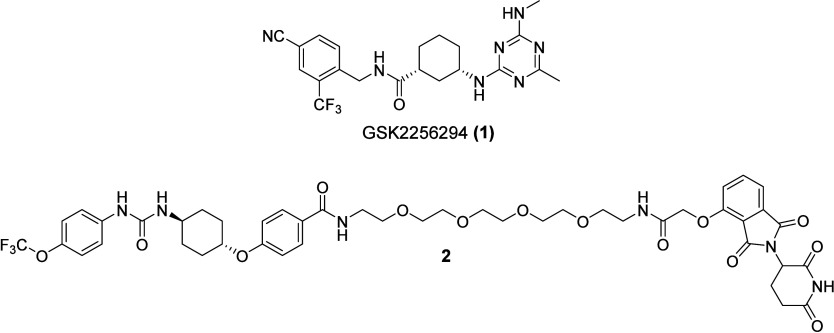
Structures of the potent sEH-H inhibitor and clinical candidate GSK2256294A (1) as well as the first-in-class sEH PROTAC 2.
2
2
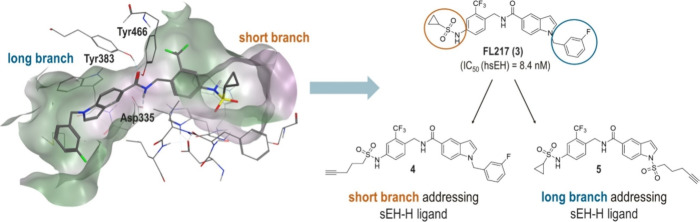
Structure-based design of sEH PROTACs. Left: Crystal structure of sEH-H, cocrystallized with sEH-H inhibitor FL217 (3) (PDB: 7P4K). Right: Two sEH-H ligands were developed from sEH-H inhibitor FL217, each bearing a terminal alkyne group for further functionalization.
1
1. Synthetic Route for sEH-H Ligand 4 Addressing the Short Branch of the Binding Pocket
2
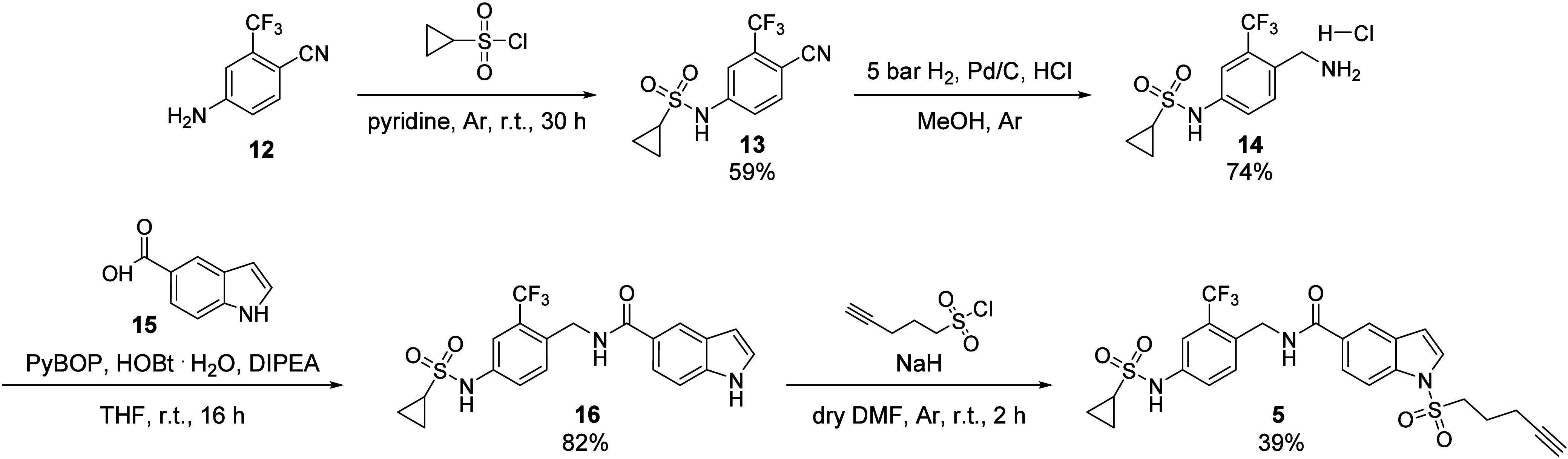
2. Synthetic Route for sEH-H Ligand 5 Addressing the Long Branch of the Binding Pocket
3
3. Preparation of PROTACs with Alkyne Linkers
4
4. Preparation of PROTACs with PEG Linkers
3
3
Overlaid cocrystal X-ray structures of 21b (orange) and 22b (blue) with human sEH-H (PDB codes: 8S76, 8S77). Left: Protein surface of hsEH-H labeled with both exits of the binding pocket. As predicted, 21b addressed the exit of the short branch of the binding pocket, while 22b addresses the exit of the long branch. Right: 21b and 22b interact with asparagine 335 from the catalytic triad and tyrosine 446 and tyrosine 383. The PEG2-linkers and CRBN ligands were not resolved.
4
4
Development of a cellular HiBiT-based sEH degradation assay and testing of the synthesized PROTACs. A: HiBiT assay principle. The figure was prepared using BioRender.com. B and C: Results for short branch addressing sEH PROTACs 21e with a PEG5 linker (Graph B) and 21f with a PEG6 linker (Graph C). The best result within this series of PROTACs was obtained for 21e with D max = 35%.
5
5. Synthetic Routes for the Synthesis of sEH PROTACs 23 and 24
5
5
Biochemical characterization of optimized PROTACs 23 and 24. A: degradation curves of triazole-based PROTAC 23 for different incubation times (N = 3). B: Degradation curves of amide-based PROTAC 24 for different incubation times (N = 3). C: Control experiments for PROTAC 23 (N = 3). HeLasEH-HiBiT were cotreated with 23 [300 nM] and sEH-H inhibitor GSK2256294 [3 μM] or CRBN ligand Pomalidomide [3 μM] or proteasome inhibitor MG 132 [3 μM] or lysosome inhibitor Bafylomicin A1 [50 nM] for 18 h. D: Evaluation of metabolic stability of PROTACs 23 and 24 in rat liver microsomes.
6
6
A: Conversion of 14(15)-, 11(12)- and 8(9)-EpETre to the corresponding sEH products (i) 14,15-, (ii) 11,12-, and (iii) 8,9-DiHETrE). The enzyme assay was carried out using cell homogenates of HeLasEH-HiBiT cells (n = 3) incubated with 0.5% DMSO or 3 μM of the PROTACs 23 or 31) for 3 h at 37 °C. The cell homogenates (0.5–1.3 mg protein/mL) were incubated for 30 min with a mixture of 14(15)-, 11(12)-, and 8(9)-EpETre (20–70 μM). − To distinguish nonenzymatic hydrolysis and sEH conversion the hydrolysis occurring after addition of sEHi TPPU (1 μM) was subtracted from the product formation. Shown is the conversion rate as % of the DSMO control (mean ± SD, n = 3). B: sEH concentration in the cells determined by LC-MS/MS based targeted proteomics analysis. Shown is the concentration per mg cellular protein (mean ± SD, n = 3). Statistical analysis was performed using unpaired Students t test comparing each treatment with DMSO control (*: p < 0.05; **: p < 0.01; ****: p < 0.0001).
7
7
Immunofluorescence staining experiments of sEH in human primary M1 macrophages treated with 300 nM 23 or negative control compound 31 or untreated (DMSO). A: Cell nuclei were marked with Hoechst 33342 (λex: 325–375 nm, λem: 435–485 nm), sEH was stained via immunocytochemistry (Alexa633, λex: 590–650 nm, λem: 662–738 nm). Cell nuclei and sEH were visualized by fluorescence microscopy at 63× magnification. Representative experiment is shown. Scale bar: 25 μm. n = 3. B: Data are expressed as mean ± standard error. Statistical calculations were carried out using GraphPad Prism software. Statistical significance was determined by one-way ANOVA with Tukey’s posthoc test. ns not significant, **p < 0.01, ****: p < 0.0001).
8
8
Immunoblotting of sEH in different primary cells and tissues. A: For immunoblotting primary murine hepatocytes were treated 18 h with either DMSO (0.5%), PROTACs 23 and 24, or negative control compounds 31 and 32 (300 nM). Data are expressed as means ± SE (n = 3–4). Statistical analysis was performed using the ordinary one-way ANOVA function in Prism10 comparing each treatment with the DMSO vehicle (**: p < 0.01; ***: p < 0.001, ****: p < 0.0001). B: human PCLS were cultivated in media (DMEM-F12; control) or treated with 23 and 31 (300 nM) for 18 h (n = 3). For immunoblotting, duplicate measurements were assessed and statistical analysis was performed using the ordinary one-way ANOVA function in Prism10 (ns = not significant; *: p < 0.05 ***: p < 0.001).

References

    1. Morisseau C., Hammock B. D.. Epoxide hydrolases: mechanisms, inhibitor designs, and biological roles. Annu. Rev. Pharmacol. Toxicol. 2005;45:311–333. doi: 10.1146/annurev.pharmtox.45.120403.095920. - DOI - PubMed
    1. Gomez G. A., Morisseau C., Hammock B. D., Christianson D. W.. Structure of human epoxide hydrolase reveals mechanistic inferences on bifunctional catalysis in epoxide and phosphate ester hydrolysis. Biochemistry. 2004;43(16):4716–4723. doi: 10.1021/bi036189j. - DOI - PubMed
    1. Harris T. R., Hammock B. D.. Soluble epoxide hydrolase: gene structure, expression and deletion. Gene. 2013;526(2):61–74. doi: 10.1016/j.gene.2013.05.008. - DOI - PMC - PubMed
    1. Morisseau C., Hammock B. D.. Impact of soluble epoxide hydrolase and epoxyeicosanoids on human health. Annu. Rev. Pharmacol. Toxicol. 2013;53:37–58. doi: 10.1146/annurev-pharmtox-011112-140244. - DOI - PMC - PubMed
    1. Obeme-Nmom J. I., Udenigwe C. C.. Soluble epoxide hydrolase: an emerging target for nutraceuticals against inflammation and oxidative stress. Curr. Opin. Food Sci. 2024;57:101174. doi: 10.1016/j.cofs.2024.101174. - DOI

LinkOut - more resources