


Type 2 Diabetes Mellitus-Related Mortality in the United States, 1999 to 2023
- PMID: 40532451
- PMCID: PMC12212274
- DOI: 10.1016/j.jacadv.2025.101882
Type 2 Diabetes Mellitus-Related Mortality in the United States, 1999 to 2023
Abstract
Background: The prevalence of type 2 diabetes mellitus (T2DM) has increased in the United States, contributing significantly to morbidity and mortality.
Objectives: This study analyzes trends in T2DM-related mortality focusing on demographic and regional disparities.
Methods: The Centers for Disease Control and Prevention Wide-Ranging Online Data for Epidemiologic Research database was utilized to extract death certificate data for adults aged 25 and older from 1999 to 2023. Age-adjusted mortality rates (AAMRs) per 100,000 persons were calculated. Temporal trends were assessed by calculating the annual percent change using Joinpoint regression analysis.
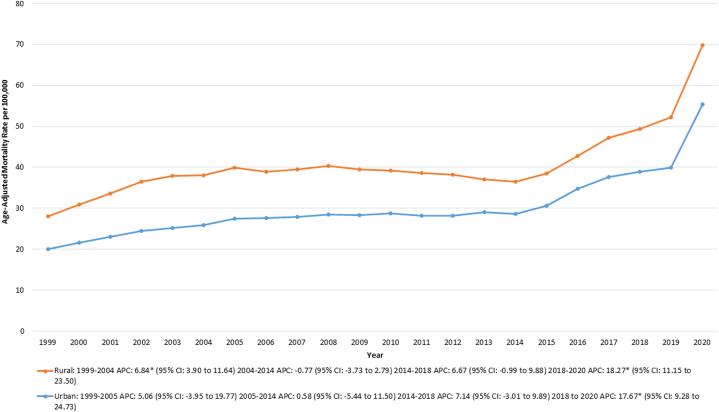
Results: From 1999 to 2023, a total of 2,031,626 deaths were attributed to T2DM in the United States. The AAMR more than doubled from 21.54 per 100,000 in 1999 to 53.95 per 100,000 in 2023 with a pronounced increase between 2018 and 2021 (AAMR: 62.7 in 2021, annual percent change: 16.06%; 95% CI: 11.84-19.66). Males had considerably higher AAMR than females (68.82 vs 42.48 in 2023). Among racial and ethnic groups, Hispanic or Latino populations had the highest AAMR in 2023 (69.69), followed by non-Hispanic Black or African American (65.45), non-Hispanic other populations (53.7), and non-Hispanic White group (49.98). The Western region of the United States showed the highest AAMR (78.29), and rural areas consistently had higher mortality rates compared to urban areas (69.88 vs 55.32 in 2020). From 1999 to 2023, cardiovascular disease accounted for 626,706 deaths among adults with T2DM.
Conclusions: T2DM-related mortality has increased substantially over the time in the United States, with a peak observed between 2018 and 2021, emphasizing the need for targeted interventions.
Keywords: CDC WONDER; cardiovascular; mortality; type 2 diabetes mellitus.
Copyright © 2025 The Authors. Published by Elsevier Inc. All rights reserved.
Conflict of interest statement
Funding support and author disclosures Dr Fonarow has received personal fees from Abbott, Amgen, AstraZeneca, Bayer, Boehringer Ingelheim, Cytokinetics, Eli Lilly, Johnson & Johnson, Medtronic, Merck, Novartis, and Pfizer outside the submitted work. Dr Fudim has received personal fees from Alleviant, Ajax, Alio Health, Alleviant, Artha, Audicor, Axon Therapies, Bayer, Bodyguide, Bodyport, Boston Scientific, Broadview, Cadence, Cardioflow, Cardionomics, Coridea, CVRx, Daxor, Deerfield Catalyst, Edwards Lifesciences, Echosens, EKO, Feldschuh Foundation, Fire1, FutureCardia, Galvani, Gradient, Hatteras, HemodynamiQ, Impulse Dynamics, Intershunt, Medtronic, Merck, NIMedical, NovoNordisk, NucleusRx, NXT Biomedical, Orchestra, Pharmacosmos, PreHealth, Presidio, Procyreon, ReCor, Rockley, SCPharma, Shifamed, Splendo, Summacor, SyMap, Verily, Vironix, Viscardia, and Zoll; and has received grants from the National Institutes of Health, Doris Duke, outside the submitted work. Dr Mentz has received research support and honoraria from Abbott, American Regent, Amgen, AstraZeneca, Bayer, Boehringer Ingelheim, Boston Scientific, Cytokinetics, Fast BioMedical, Gilead, Innolife, Eli Lilly, Medtronic, Medable, Merck, Novartis, Novo Nordisk, Pfizer, Pharmacosmos, Relypsa, Respicardia, Roche, Rocket Pharmaceuticals, Sanofi, Verily, Vifor, Windtree Therapeutics, and Zoll. Dr Greene has received research support from the Duke University Department of Medicine Chair's Research Award, American Heart Association, Amgen, AstraZeneca, Boehringer Ingelheim, Bristol Myers Squibb, Cytokinetics, Merck, Novartis, Otsuka, Pfizer, and Sanofi; has served on advisory boards or as consultant for Amgen, AstraZeneca, Bayer, Boehringer Ingelheim, Bristol Myers Squibb, Corcept, Corteria Pharmaceuticals, CSL Vifor, Cytokinetics, Eli Lilly, Lexicon, Merck, Novo Nordisk, Otsuka, Roche Diagnostics, Sanofi, scPharmaceuticals, Tricog Health, and Urovant Pharmaceuticals; and has received speaker fees from AstraZeneca, Bayer, Boehringer Ingelheim, Cytokinetics, Lexicon, and Roche Diagnostics. All other authors have reported that they have no relationships relevant to the contents of this paper to disclose.
Figures



References
-
- Fox C.S., Pencina M.J., Meigs J.B., Vasan R.S., Levitzky Y.S., D'Agostino R.B. Trends in the incidence of type 2 diabetes mellitus from the 1970s to the 1990s: the Framingham Heart Study. Circulation. 2006;113(25):2914–2918. - PubMed
LinkOut - more resources
Full Text Sources
