


Diurnal Effects on the Fraction of Fetal Cell-Free DNA in Maternal Plasma
- PMID: 40533246
- PMCID: PMC12254438
- DOI: 10.1002/pd.6836
Diurnal Effects on the Fraction of Fetal Cell-Free DNA in Maternal Plasma
Abstract
Objective: The discovery of fetal cell-free DNA (cfDNA) has revolutionized prenatal diagnostics through non-invasive prenatal testing (NIPT), which depends on accurately measuring the fetal fraction (FF) in maternal plasma. While FF is known to be influenced by maternal and fetal factors, the impact of intraday rhythms remains unclear. This study investigated whether FF varies based on blood draw timing.
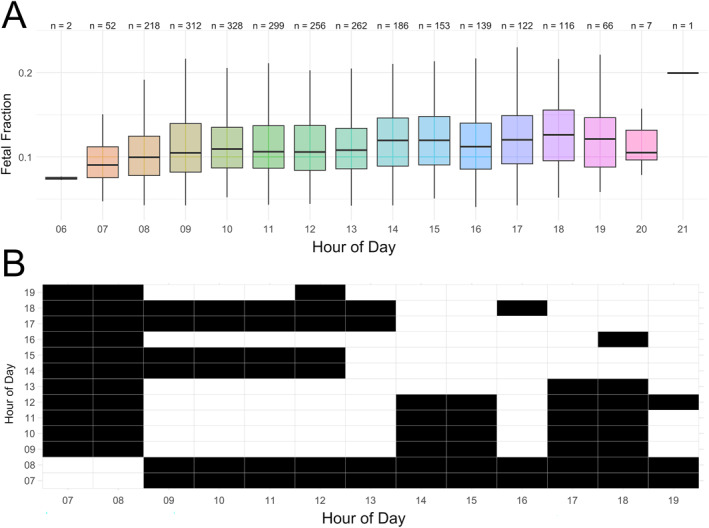
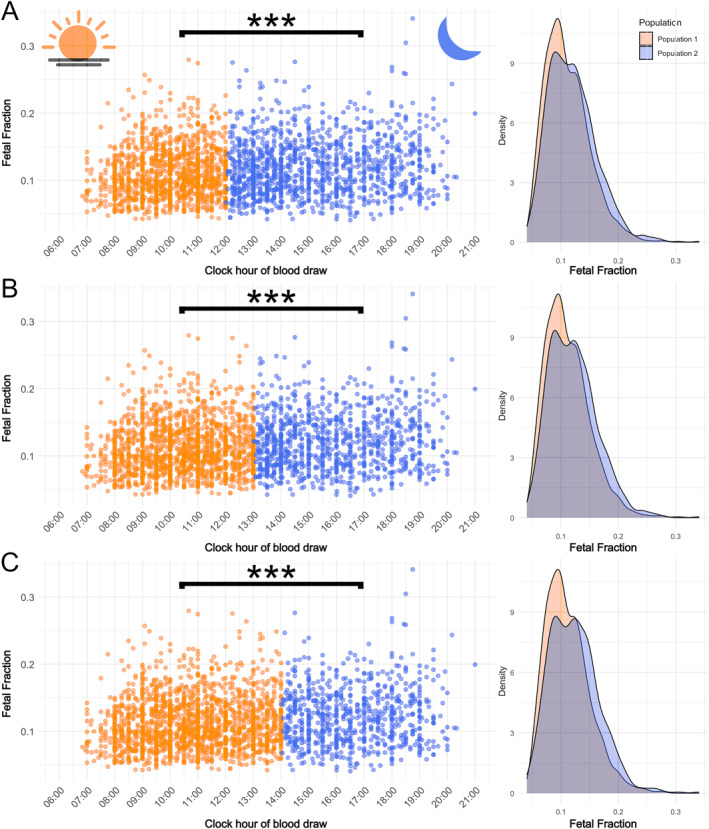
Methods: Data from 2519 euploid singleton pregnancies undergoing NIPT were analyzed. Key variables included maternal age, BMI, gestational age, fetal sex, and blood draw timing (06:50-21:00). FF was measured using the Harmony Prenatal IVD Test. Multiple linear regression identified independent predictors of FF, while intraday variation was assessed using Mann-Whitney U tests and boxplots.
Results: FF showed a significant positive relationship with blood draw timing (β = 0.00176 per hour, p < 0.005), with afternoon values approximately 10% higher than morning values (∼0.01 difference). Other predictors included BMI (negative), gestational age (positive), and fetal sex (higher in females). Blood draw timing appeared to be a stronger predictor of FF than gestational age or fetal sex, second only to BMI.
Conclusion: This novel finding demonstrates diurnal variation in FF, suggesting that optimizing blood draw timing could improve NIPT accuracy, particularly in borderline cases. Further research is needed to confirm the clinical implications.
© 2025 The Author(s). Prenatal Diagnosis published by John Wiley & Sons Ltd.
Conflict of interest statement
The authors declare no conflicts of interest.
Figures
References
-
- Moufarrej M. N., Bianchi D. W., Shaw G. M., Stevenson D. K., and Quake S. R., “Noninvasive Prenatal Testing Using Circulating DNA and RNA: Advances, Challenges, and Possibilities,” Annual Review of Biomedical Data Science 6, no. 1 (2023): 397–418, 10.1146/annurev-biodatasci-020722-094144. - DOI - PMC - PubMed
-
- Forgacova N., Gazdarica J., Budis J., Kucharik M., Sekelska M., and Szemes T., “Non‐Intuitive Trends of Fetal Fraction Development Related to Gestational Age and Fetal Gender, and Their Practical Implications for Non‐Invasive Prenatal Testing,” Molecular and Cellular Probes 66 (2022): 101870, 10.1016/j.mcp.2022.101870. - DOI - PubMed
MeSH terms
Substances
LinkOut - more resources
Full Text Sources
