


Blocking XIAP:CASP7-p19 selectively induces apoptosis of CASP3/DR malignancies by a novel reversible small molecule
- PMID: 40533441
- PMCID: PMC12177060
- DOI: 10.1038/s41419-025-07774-y
Blocking XIAP:CASP7-p19 selectively induces apoptosis of CASP3/DR malignancies by a novel reversible small molecule
Abstract
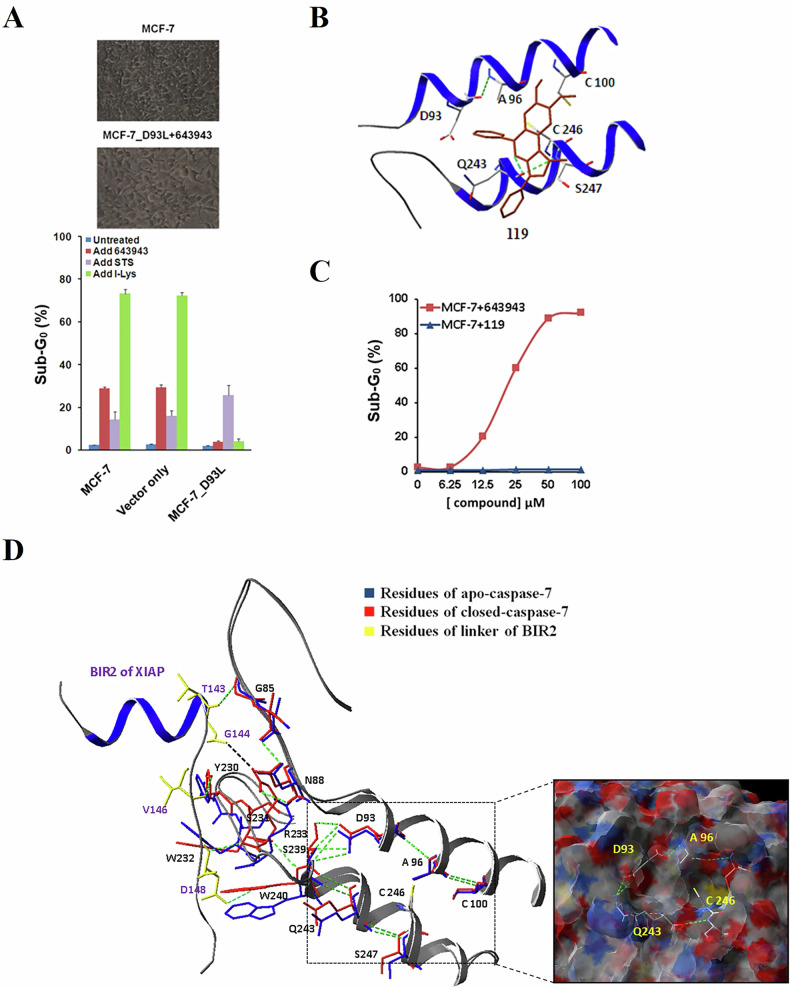
X-linked inhibitor of apoptosis (XIAP) inhibits caspases 3, 7, and 9, thereby preventing cell apoptosis. Endogenous Second mitochondria-derived activator of caspase (Smac) competes out the binding of caspases with XIAP and causes apoptosis, so that Smac mimetics are under clinical trials for anti-cancer chemotherapy. We demonstrated by selectively alkylating caspase 7 (CASP7) to release the active CASP7 for killing the drug-resistant cancer cells with accumulated XIAP:CASP7 resulted from caspase-3 down-regulation (CASP3/DR). However, finding a reversible inhibitor of the protein-protein interaction (PPI) poses a significant challenge. Here, we identified a reversible XIAP:CASP7 inhibitor, 643943, through a multiple-mode virtual screening strategy. In vitro experiments revealed that 643943 bound to CASP7, released the linker-BIR2 domain of XIAP, and activated the caspase. Removing an essential hydroxyl group on 643943 or replacing the OH-interacting Asp93 on CASP7 caused loss of 643943 cytotoxicity, revealing the binding mode. This compound thus selectively killed MCF-7 and other CASP3/DR triple-negative breast cancer cell lines, but not the cancer and normal cell lines expressing higher levels of CASP3 in vitro and in vivo. Moreover, 643943 overcame chemoresistance via down-regulating β-catenin and its associated ABC transporters in paclitaxel-resistant MCF-7 cells. Our studies not only serve as a proof-of-concept for using XIAP:CASP7 as a drug target, but also provide the first reversible XIAP:CASP7 inhibitor for cancer therapy of CASP3/DR malignancies.
© 2025. The Author(s).
Conflict of interest statement
Competing interests: The authors declare no competing interests. Ethics approval and consent to participate: All animal studies complied with relevant ethical regulations for animal testing and research, and all procedures were approved by the Institutional Animal Care and Use Committee of Academia Sinica and National Taiwan University.
Figures




References
-
- Winter RN, Kramer A, Borkowski A, Kyprianou N. Loss of caspase-1 and caspase-3 protein expression in human prostate cancer. Cancer Res. 2001;61:1227–32. - PubMed
-
- Volm M, Koomagi R. Prognostic relevance of c-Myc and caspase-3 for patients with non-small cell lung cancer. Oncol Rep. 2000;7:95–8. - PubMed
MeSH terms
Substances
LinkOut - more resources
Full Text Sources
Research Materials
