


Childhood cardiovascular disease risk profiles based on movement phenotypes:a longitudinal cohort study
- PMID: 40533632
- PMCID: PMC12176961
- DOI: 10.1007/s00431-025-06269-4
Childhood cardiovascular disease risk profiles based on movement phenotypes:a longitudinal cohort study
Abstract
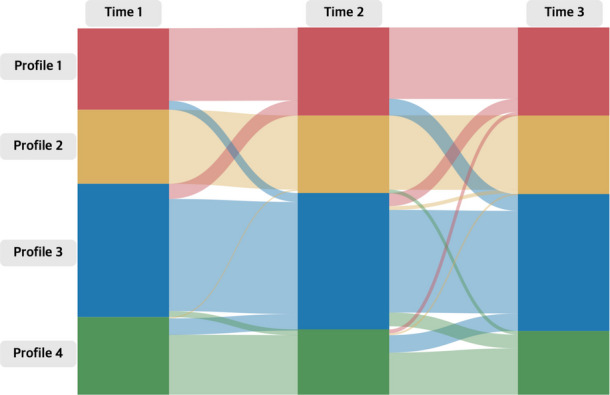
Cardiovascular disease (CVD) remains a significant global health concern, with many risk factors emerging in adolescence. This period is critical for prevention, as physical and behavioral patterns established during these years often persist into adulthood. Movement phenotypes, encompassing motor competence, physical capacity, and physical activity behaviours, are linked to cardiometabolic health as low competence and fitness levels in youth are associated with poor body composition and increased CVD risk. This longitudinal study aimed to (1) identify latent clusters of adolescents' movement phenotype-related CVD risk factors and (2) examine the stability of these profiles over four years. Latent profile and transition analysis were used to identify movement phenotype profiles and transitions of cluster membership across time among 1,147 adolescents (Mage: 11.27 ± .32). A four-cluster solution was identified as the most suitable. Profile 1 (23%) had the lowest motor competence, cardiovascular and muscular fitness, and moderate-to-vigorous physical activity (MVPA), along with the highest standardized body mass index (BMIz). Profile 2 (20%), predominantly girls, had below-average motor competence, cardiovascular and muscular fitness. The largest group, Profile 3 (36%), showed healthy indicators, with above-average values across all variables. Profile 4 (20%) had the highest levels of motor competence, cardiovascular and muscular fitness, and MVPA, as well as healthy BMIz (-2 ≤ BMIz ≤ 1). Cluster memberships remained remarkably stable over four years, except for a notable transition of over 20% from Profile 4 to 3. Conclusion: This study identifies distinct adolescent movement patterns associated with CVD risk and demonstrates how these change over time. The findings support the development of targeted interventions and early preventive strategies to support long-term cardiovascular health in adulthood. What is Known - What is New • Childhood movement phenotypes, i.e., motor competence, physical capacity, and behaviors, were highly stable over four years of adolescence, with nearly 50% of participants displaying elevated cardiovascular disease risk factors. • Additionally, 25% of our sample belonged to a cluster characterized by the poorest cardiovascular disease risk profile, marked by low motor competence, poor cardiovascular and muscle fitness, and low levels of moderate-to-vigorous physical activity. Most participants in this cluster also exhibited unhealthy body composition.
Keywords: Adolescents; Latent profile; Motor competence; Obesity; Physical activity; Physical fitness.
© 2025. The Author(s).
Conflict of interest statement
Declarations. Competing interests: The authors declare no competing interests.
Figures

Comment in
-
A broader lens: expanding movement phenotypes to lifestyle clusters in youth cardiovascular risk.Eur J Pediatr. 2025 Aug 22;184(9):573. doi: 10.1007/s00431-025-06429-6. Eur J Pediatr. 2025. PMID: 40847008 No abstract available.
References
MeSH terms
LinkOut - more resources
Full Text Sources
Medical
