


Ensemble perception requires attention
- PMID: 40533716
- PMCID: PMC12331843
- DOI: 10.3758/s13414-025-03111-9
Ensemble perception requires attention
Abstract
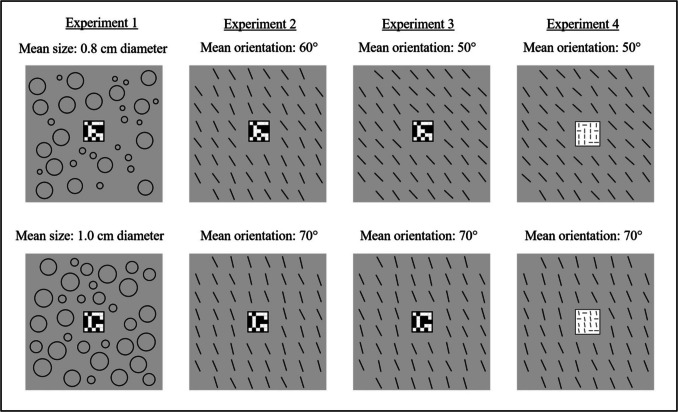
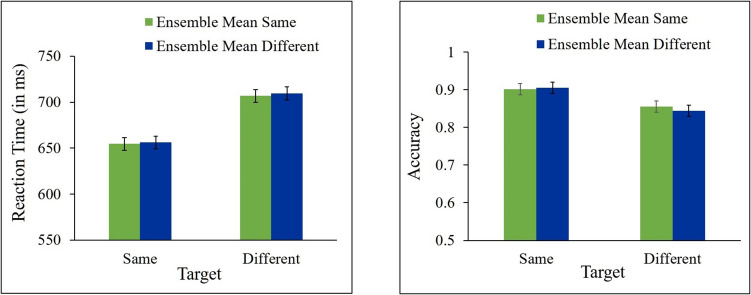
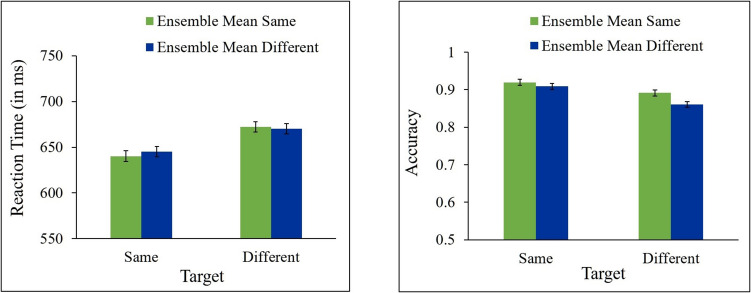
The question of whether ensemble perception can take place without attention is unresolved. We examined this issue in four experiments, using an inattention paradigm that provides an on-line, indirect measure of processing of unattended stimuli. Participants performed an attention-demanding change-detection task on a small matrix presented on a background of task-irrelevant ensemble consisting of circles of different size (Experiment 1) or oriented lines (Experiments 2-4). Independently of any change in the matrix, the ensemble mean changed or stayed the same between successive displays on each trial. We hypothesized that if ensemble mean is extracted under inattention, changes in the ensemble mean would produce congruency effects on the speed or accuracy of performance in the matrix change judgments, such that performance is faster or more accurate on congruent than incongruent trials. The results showed that changes in the ensemble mean size or mean orientation produced no congruency effects on performance of the target change-detection task. Also, participants could not report, when probed with surprise questions, whether or not the ensemble mean changed. When participants attended to the ensemble, their accuracy of explicit reports about a change were significantly above chance. These results are seen to suggest that ensemble perception requires attention. The differences between the present study and previous ones, concerning the conditions and definition of unattended and their implication for understanding the relation between ensemble perception and attention, are discussed.
Keywords: Attention; Automatic processing; Ensemble perception; Implicit processing; Unattended processing.
© 2025. The Author(s).
Conflict of interest statement
Declarations. Ethics approval: The study protocol was approved by the ethics committee of the University of Haifa (437/23). Consent to participate: Written informed consent was obtained from all participants prior to participation. Consent for publication: All participants gave prior informed consent for anonymized data to be used in publications. Conflict of interest: All authors declare that they have no conflicts of interest. Open practices statement: The data of all experiments are available via the Open Science Framework at https://osf.io/p78yu/ . Program code is available upon request.
Figures



References
-
- Alvarez, G. A. (2011). Representing multiple objects as an ensemble enhances visual cognition. Trends in Cognitive Sciences, 15(3). 10.1016/j.tics.2011.01.003 - PubMed
-
- Ariely, D. (2001). Seeing sets: Representation by statistical properties. Psychological Science, 12(2). 10.1111/1467-9280.00327 - PubMed
-
- Baek, J., & Chong, S. C. (2020). Distributed attention model of perceptual averaging. Attention, Perception, & Psychophysics, 82(1). 10.3758/s13414-019-01827-z - PubMed
MeSH terms
Grants and funding
LinkOut - more resources
Full Text Sources
