


Evolving trends in psychiatric emergency services in Southern China: a seven-year retrospective analysis
- PMID: 40533733
- PMCID: PMC12177968
- DOI: 10.1186/s12245-025-00904-5
Evolving trends in psychiatric emergency services in Southern China: a seven-year retrospective analysis
Abstract
Background: The Affiliated Brain Hospital, Guangzhou Medical University is an important provider of psychiatric emergency services (PES) in southern China. Revealing the evolution trend of the psychiatric emergency services of this hospital can help decision-makers formulate relevant policies. However, at present, there is a lack of large-scale, long-term retrospective studies.
Methods: A retrospective analysis was conducted on patient records from the psychiatric emergency room (PER) of the Affiliated Brain Hospital, Guangzhou Medical University. Data included demographic and clinical variables were aggregated annually and described using percentages from 2018 to 2024. Chi-square and Fisher's exact test were used to confirm significance of the trends.
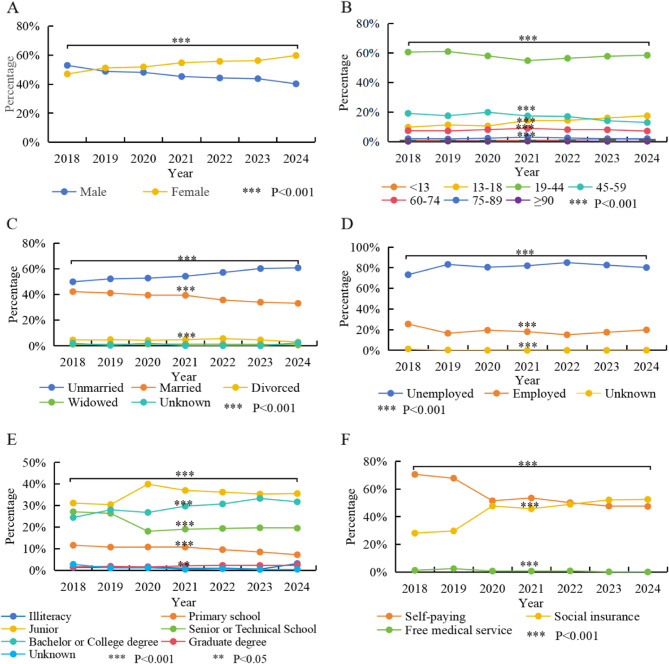
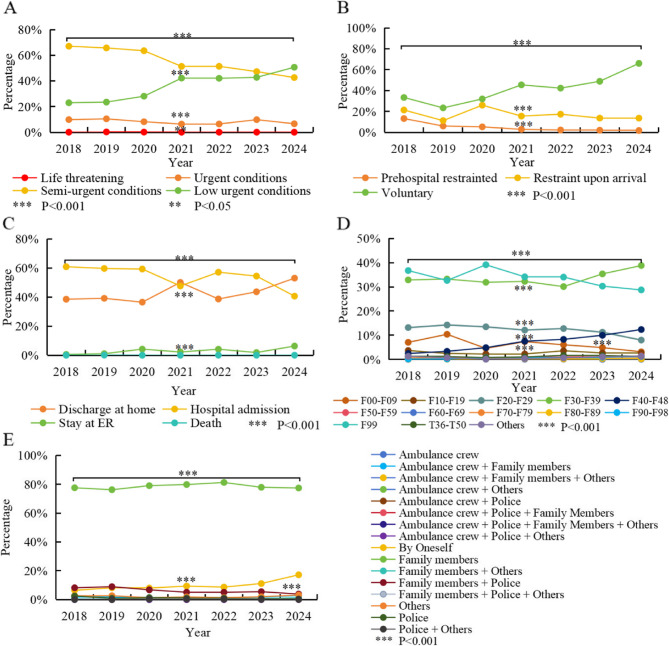
Results: More voluntary health-seeking behaviors, broader medical insurance coverage, more cautious use of restraint measures, and more precise diagnoses were observed from 2018 to 2024. Besides, there were an increasing number of younger, highly educated, unmarried, and unemployed visitors. We also found that the gender gap is widening and medical resources are increasingly strained. There are differences between judicial and medical personnel in making compulsory decisions. During Covid-19, the demographic and clinical variables show significant changes.
Conclusions: PES in southern China have developed to a certain extent, but they are also confronted with obstacles at the same time. These trends underscore the need for enhanced referral systems, expanded community-based psychiatric care, ethical guidelines for managing coercive measures and strengthening the response strategies for public event crises.
Keywords: China; Evolving trends; Mental health services; Psychiatric emergency services; Retrospective analysis.
© 2025. The Author(s).
Conflict of interest statement
Declarations. Ethics approval and consent to participate: This study was approved by the Ethics Committee of the Affiliated Brain Hospital, Guangzhou Medical University (Approval No.: 202420). All aspects of patient confidentiality, including retrospective data handling, were rigorously addressed. Data were anonymized and de-identified prior to analysis, with access restricted to authorized researchers to ensure compliance with ethical standards (e.g., Declaration of Helsinki) and local data protection regulations. Informed consent was waived by the ethics committee due to the retrospective nature of the study and the use of anonymized patient data. Consent for publication: All the authors have reviewed and approved the final version of the manuscript. We agree to submit the manuscript to International Journal of Emergency Medicine for publication. We accept the journal’s copyright and licensing policies (e.g., transfer copyright to the publisher or publish under a Creative Commons license if applicable). Corresponding author Miaoling Jiang are authorized to communicate with the journal on behalf of all authors. Competing interests: The authors declare no competing interests.
Figures
References
-
- World Health Organization. World mental health report: Transforming mental health for all. Geneva: World Health Organization. 2022. Available from: https://www.who.int/publications/i/item/9789240049338.
-
- The Standing Committee of the National People’s Congress. Mental Health Law of the People’s Republic of China 2012 [updated 2012-10-27; cited 2025 01–25]. Available from: http://www.npc.gov.cn/zgrdw/huiyi/cwh/1129/2012-10/27/content_1741177.htm.
-
- Veeckman S, Hubloue I, Lauwaert D, et al. Psychiatric applications at the emergency department of the Brussels university hospital between 2003 and 2012. Tijdschr Psychiatr. 2015;57(5):323–31. PMID: 26028012. - PubMed
Grants and funding
- No.: Finance(2023) 33/the National Clinical Key specialty construction project
- No.: Finance(2023) 33/the National Clinical Key specialty construction project
- 20241A010047/Guangzhou Health Commission of Science and Technique Program
- 20241A010047/Guangzhou Health Commission of Science and Technique Program
- 20241A010047/Guangzhou Health Commission of Science and Technique Program
LinkOut - more resources
Full Text Sources
Miscellaneous
