


Associations of different insulin resistance-related indices with the incidence and progression trajectory of cardiometabolic multimorbidity: a prospective cohort study from UK biobank
- PMID: 40533754
- PMCID: PMC12175334
- DOI: 10.1186/s12933-025-02819-0
Associations of different insulin resistance-related indices with the incidence and progression trajectory of cardiometabolic multimorbidity: a prospective cohort study from UK biobank
Abstract
Background: Despite established associations between insulin resistance (IR)-related indices and cardiometabolic diseases (CMDs), most studies are limited to single CMD outcomes. The study aimed to examine the influence of IR-related indices on the incidence, predictive value, and progression trajectory of cardiometabolic multimorbidity (CMM), as well as potential biological mechanisms.
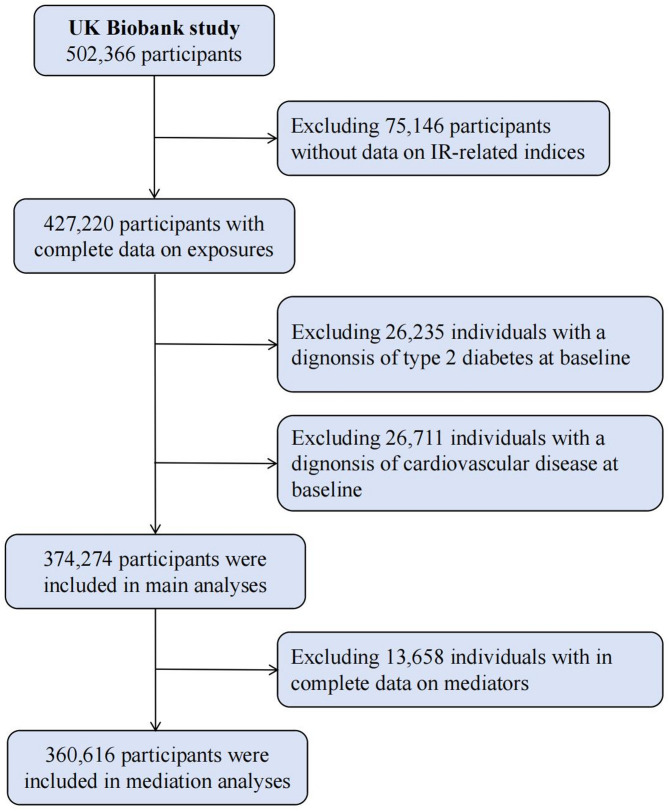
Methods: This prospective study included 374,274 individuals from the UK Biobank who were free of CMDs at baseline. CMM was defined as the presence of two or more CMDs, including type 2 diabetes (T2D), coronary heart disease (CHD), and stroke. Five indices were developed to assess IR levels: triglyceride-glucose (TyG) index, TyG-body mass index (TyG-BMI), TyG-waist circumference (TyG-WC), TyG-waist-height ratio (TyG-WHtR), and triglyceride to high-density lipoprotein cholesterol (TG/HDL-C) ratio. Cox proportional hazards and multi-state models were utilized to examine the associations between IR-related indices and CMM incidence and transition, respectively, with results expressed as hazard ratios (HRs) and 95% confidence intervals (CIs). The predictive utility of these indices was assessed using the net reclassification index (NRI) and integrated discrimination improvement index (IDI). Mediation analyses were conducted to quantify the potential mediating roles of biomarkers.
Results: During a mean follow-up period of 13.7 years, 5048 (1.3%) individuals developed CMM. Elevated baseline IR-related indices were associated with higher risks of incident CMM. The HRs (95% CIs) for each 1-standard deviation increase were as follows: 1.30 (1.26-1.34) for the TyG index, 1.42 (1.39-1.46) for the TyG-BMI, 1.54 (1.49-1.59) for the TyG-WC, 1.52 (1.48-1.57) for the TyG-WHtR, and 1.19 (1.17-1.21) for the TG/HDL-C ratio. Besides, TyG-WHtR and TyG-WC exhibited significantly higher NRI and IDI, indicating superior predictive performance for CMM risk. These indices played critical yet distinct roles in the progression of CMM. For transitions from being free of CMDs to single CMDs, these indices had the strongest impact on T2D (all P < 0.001). Participants initially diagnosed with CHD were more likely to progress to CMM when exposed to higher IR-related indices (all P < 0.001). The effect sizes for TyG-WC and TyG-WHtR were greater than those of other indices across all transitions. Mediation analyses revealed that biomarkers associated with liver function, renal function, and inflammation collectively mediated approximately one-third of the associations of the TyG-WHtR and TyG-WC indices with incident CMM.
Conclusions: Our findings highlight the critical role of IR-related indices, particularly TyG-WHtR and TyG-WC, in the incidence, progression, and prevention of CMM. The mediation effects of biomarkers indicate the potential for targeted interventions to reduce CMM risk in high-IR individuals.
Keywords: Cardiometabolic multimorbidity; Disease trajectory; Insulin resistance; Mediation; Triglyceride-glucose index.
© 2025. The Author(s).
Conflict of interest statement
Declarations. Ethics approval and consent to participate: The Northwest Multi-center Research Ethics Committee (MREC reference: 21/NW/0157) provided ethical approval for the UK Biobank project. All participants gave informed consent before being recruited. Consent for publication: Not applicable. Competing interests: The authors declare no competing interests.
Figures


References
-
- Zhao Y, Atun R, Oldenburg B, McPake B, Tang S, Mercer SW, Cowling TE, Sum G, Qin VM, Lee JT. Physical multimorbidity, health service use, and catastrophic health expenditure by socioeconomic groups in China: an analysis of population-based panel data. Lancet Glob Health. 2020;8(6):e840–9. - PMC - PubMed
-
- Marengoni A, Angleman S, Melis R, Mangialasche F, Karp A, Garmen A, Meinow B, Fratiglioni L. Aging with multimorbidity: a systematic review of the literature. Ageing Res Rev. 2011;10(4):430–9. - PubMed
-
- Busija L, Lim K, Szoeke C, Sanders KM, McCabe MP. Do replicable profiles of multimorbidity exist? Systematic review and synthesis. Eur J Epidemiol. 2019;34(11):1025–53. - PubMed
MeSH terms
Substances
Grants and funding
- 2023M742120/China Postdoctoral Science Foundation
- 2023M742124/China Postdoctoral Science Foundation
- SDBX202302031/Shandong Provincial Postdoctoral Innovation Talents Support Program
- 82400415/National Natural Science Foundation of China
- BX20230210/China Postdoctoral Innovation Talents Support Program
LinkOut - more resources
Full Text Sources
Medical
Miscellaneous
