


The microbiota, the malarial parasite, and the mice-a three-sided relationship
- PMID: 40535009
- PMCID: PMC12174054
- DOI: 10.3389/fmicb.2025.1615846
The microbiota, the malarial parasite, and the mice-a three-sided relationship
Abstract
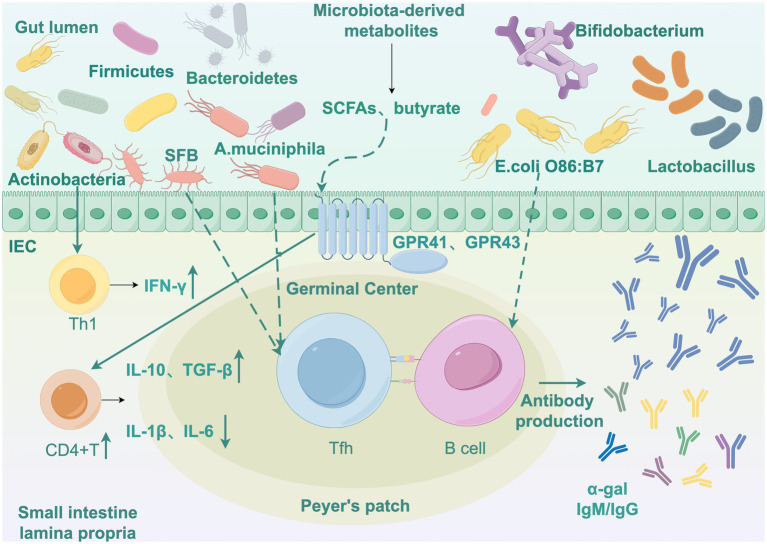
In recent years, the role of gut microbiota in modulating malaria susceptibility and infection progression has emerged as a pivotal focus in interdisciplinary research. While existing reviews have delineated mechanisms by which mosquito-associated gut microbiota regulate Plasmodium development, a systematic synthesis of the tripartite interplay among host gut microbiota, Plasmodium and host immunometabolic networks remains absent. Compared with previous studies predominantly focusing on single species or unitary mechanisms, this review fills the gap in cross-species integrated analysis of host-microbiota-pathogen interactions. By consolidating metagenomic, metabolomic, and immunological data, this review transitions from unitary mechanistic explanations to multi-omics-driven systematic analyses, demonstrating that murine microbiota suppresses Plasmodium proliferation through adaptive immune activation and metabolic product regulation. Meanwhile, Plasmodium infection induces decreased microbial diversity and functional pathway deviation in murine microbiota, exacerbating host immunometabolic imbalance. These advancements not only elucidate core biological principles governing "microbiota-host-pathogen" interactions but also transcend traditional pathogen-centric perspectives by pioneering precise intervention strategies based on microbiota homeostasis restoration. This provides theoretical foundation for developing microbiome-targeted precision prevention approaches, which will continue to make substantial contributions to malaria research.
Keywords: Plasmodium; gut microbiota; immune response; malaria; metabolic regulation; mice.
Copyright © 2025 He and Qi.
Conflict of interest statement
The authors declare that the research was conducted in the absence of any commercial or financial relationships that could be construed as a potential conflict of interest.
Figures
References
-
- Agus A., Denizot J., Thévenot J., Martinez-Medina M., Massier S., Sauvanet P., et al. (2016). Western diet induces a shift in microbiota composition enhancing susceptibility to adherent-Invasive E. coli infection and intestinal inflammation. Sci. Rep. 6:19032. doi: 10.1038/srep19032, PMID: - DOI - PMC - PubMed
Publication types
LinkOut - more resources
Full Text Sources
Miscellaneous
