


Enhancing mu-ERD through combined robotic assistance and motor imagery: a novel approach for upper limb rehabilitation
- PMID: 40535307
- PMCID: PMC12174066
- DOI: 10.3389/fnhum.2025.1571386
Enhancing mu-ERD through combined robotic assistance and motor imagery: a novel approach for upper limb rehabilitation
Abstract
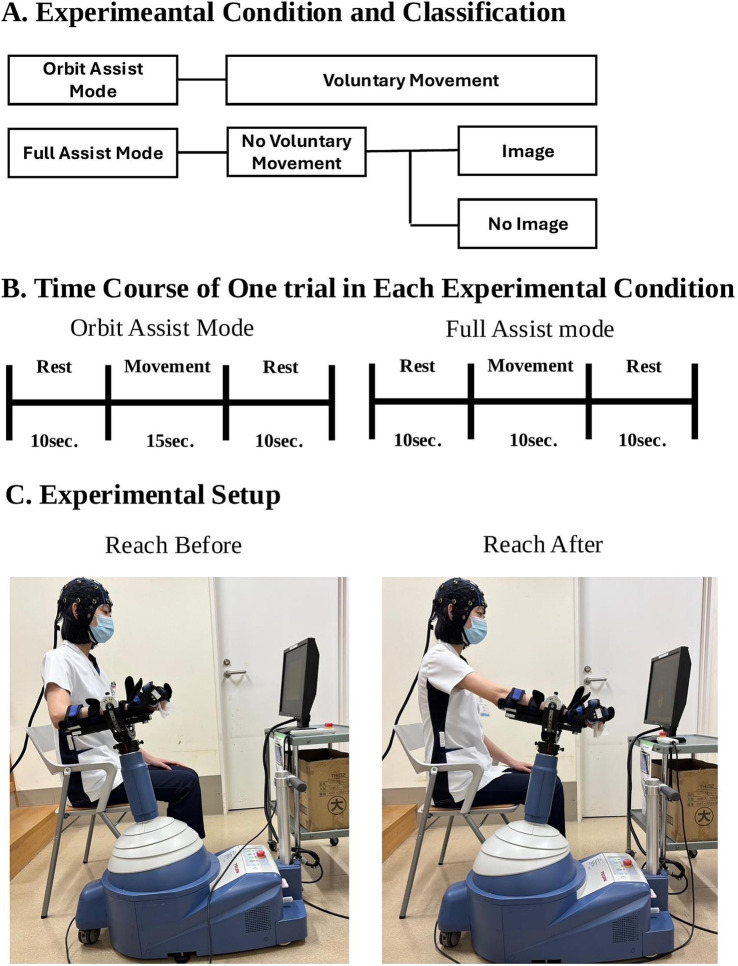
Introduction: Previous research has suggested that mu-event-related desynchronization (mu-ERD) reflects neural activity associated with motor observation and execution, primarily within the sensorimotor cortex. This study aimed to investigate the effects of combining robotic full-assist therapy with motor imagery on mu-ERD in healthy adults for potential application in stroke patients with severe upper limb paralysis.
Methods: Fifteen healthy adults were included in this study. Each participant performed three conditions using the ReoGo-J® robotic system: voluntary movement, full-assist robotic therapy without motor imagery, and full-assist robotic therapy with motor imagery. Electroencephalography (EEG) was used to measure mu-ERD, focusing on the 8-10 Hz and 10-13 Hz frequency bands at the C3, C4, Cz, and Pz electrodes.
Results: Significant differences in mu-ERD occurrence were observed at C3 (8-10 Hz) and C4 (10-13 Hz) between the conditions. The combination of motor imagery and robotic therapy demonstrated a higher frequency of mu-ERD occurrence than the other conditions, with moderate effect sizes. However, no significant differences in mu-ERD attenuation rates were found between the conditions. This suggests variability in individual responses.
Discussion: These findings highlight the potential of robotic full-assist therapy combined with motor imagery to stimulate neural mechanisms associated with motor recovery. Future studies should include a larger sample size and patients with stroke to validate these findings and explore their clinical applications.
Keywords: EEG; motor imagery; mu-ERD; robotic therapy; sensorimotor cortex; stroke rehabilitation.
Copyright © 2025 Yasuda, Ueda, Ueno, Naito, Ishii and Takebayashi.
Conflict of interest statement
The authors declare that the research was conducted in the absence of any commercial or financial relationships that could be construed as a potential conflict of interest. The author(s) declared that they were an editorial board member of Frontiers, at the time of submission. This had no impact on the peer review process and the final decision.
Figures
References
-
- Formaggio E., Storti S. F., Boscolo Galazzo I., Gandolfi M., Geroin C., Smania N., et al. (2013). Modulation of event-related desynchronization in robot-assisted hand performance: brain oscillatory changes in active, passive and imagined movements. J. Neuroeng. Rehabil. 10:24. doi: 10.1186/1743-0003-10-24, PMID: - DOI - PMC - PubMed
LinkOut - more resources
Full Text Sources
Research Materials
Miscellaneous
