


Comparing Intramedullary Nails versus Dynamic Hip Screws in the Treatment of Intertrochanteric Hip Fractures on Post-operative Rehabilitation Outcomes - A Systematic Review and Meta-Analysis
- PMID: 40535322
- PMCID: PMC12174732
- DOI: 10.1177/21514593251350490
Comparing Intramedullary Nails versus Dynamic Hip Screws in the Treatment of Intertrochanteric Hip Fractures on Post-operative Rehabilitation Outcomes - A Systematic Review and Meta-Analysis
Abstract
Objective: We conducted a systematic review and meta-analysis to compare post-operative rehabilitation outcomes between two common treatments in patients who have suffered an intertrochanteric hip fracture: intramedullary nails vs dynamic hip screws.
Methods: We searched MEDLINE, EMBASE, Cochrane Central Register of Controlled Trials, and Web of Science up to August 10, 2022. The inclusion criteria were defined as Population: adults (>18 years old); Interventions/Comparators: intramedullary nails and dynamic hip screws; Outcomes: function, quality of life and survival; and Study type: randomized controlled trials and non-randomized studies. A meta-analysis was performed, and the fixed-effect model was selected to pool the data for homogeneous studies (I2 < 50%) and the random effect model was selected for heterogeneity I2>50%. The P-value of less than 0.05 was considered statistically significant. A narrative synthesis was conducted on the remaining outcomes with insufficient data (ie, missing means, or standard deviations).
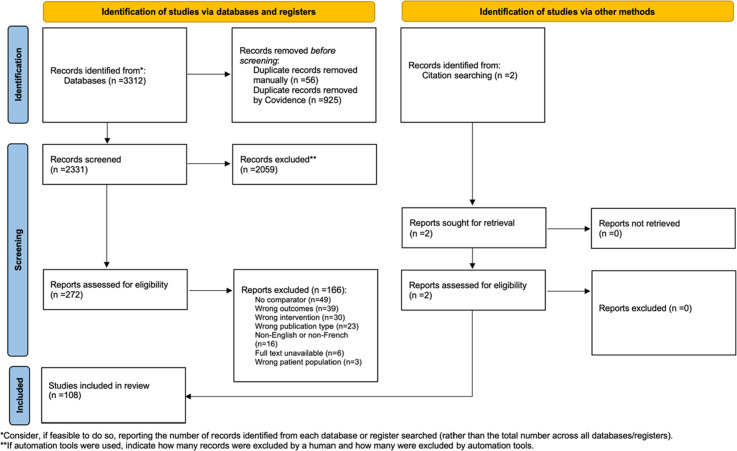
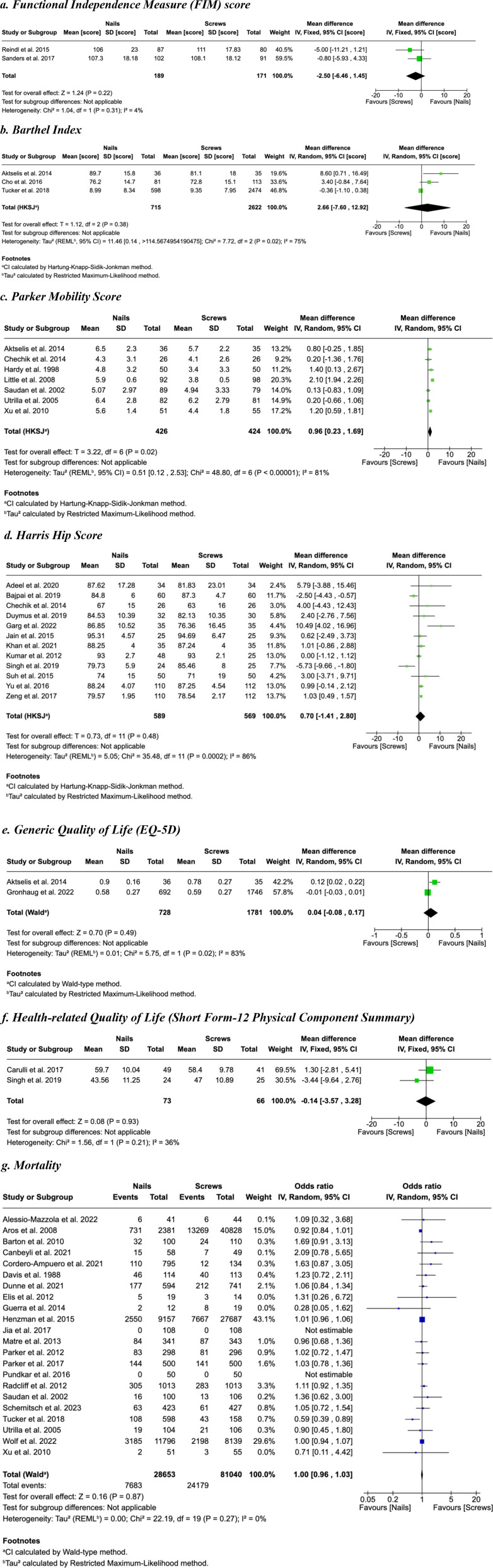
Results: 108 studies were included in the review. 42 studies had outcomes that were included in the meta-analysis. There were modest differences after sensitivity analysis for the Parker mobility score mean difference (MD) = 0.70, 95% CI [0.12, 1.28], T = 3.11, df = 5, P = 0.03, and Harris hip score (MD = 0.94, 95% CI [0.34, 1.54], T = 3.54, df = 9, P = 0.006) favoring the nails. There were no statistically significant differences in the Functional Independence Measure (FIM) (MD = -2.50, 95% CI [-6.46, 1.45], Z = 1.24, P = 0.22), the Barthel Index (MD = 2.66, 95% CI [-7.60, 12.92], T = 1,12, df = 2, P = 0.38), the generic quality of life (MD = 0.04, 95% CI [-0.08, 0.17], Z = 0.70, P = 0.49), the health-related quality of life (MD = -0.14, 95% CI [-3.57, 3.28], Z = 0.08, P = 0.93) or mortality (1.00, 95% CI [0.96, 1.03], Z = 0.16, P = 0.87) outcomes.
Conclusion: This review showed some differences in functional outcomes in the treatment of intertrochanteric fractures favoring intramedullary nails over dynamic hip screws. There were no differences between the groups for quality of life and mortality outcomes. The narrative synthesis showed additional outcomes that warrant further investigations.
Keywords: dynamic implants; functional outcomes; hip fracture; intertrochanteric hip fracture; intramedullary nails; rehabilitation.
© The Author(s) 2025.
Conflict of interest statement
The authors declared no potential conflicts of interest with respect to the research, authorship, and/or publication of this article.
Figures
References
-
- Dong Y, Zhang Y, Song K, Kang H, Ye D, Li F. What was the epidemiology and global burden of disease of hip fractures from 1990 to 2019? Results from and additional analysis of the global burden of disease study 2019. Clin Orthop. 2023;481(6):1209-1220. doi: 10.1097/CORR.0000000000002465 - DOI - PMC - PubMed
Publication types
LinkOut - more resources
Full Text Sources
Miscellaneous
