


Upper limit of normothermic machine preservation of liver grafts from donation after circulatory death yet to be defined
- PMID: 40535481
- PMCID: PMC11886305
- DOI: 10.5500/wjt.v15.i2.99170
Upper limit of normothermic machine preservation of liver grafts from donation after circulatory death yet to be defined
Abstract
Background: The normothermic machine perfusion pump (NMPP) could shape the future of transplantation. Providing ex-vivo optimization, NMPP attenuates ischemic insult while replenishing energy. An understanding of machine perfusion time (MPT) impact and potential clinical benefits is paramount and necessitates exploration.
Aim: To investigate the relationship between MPT and post-transplant graft function.
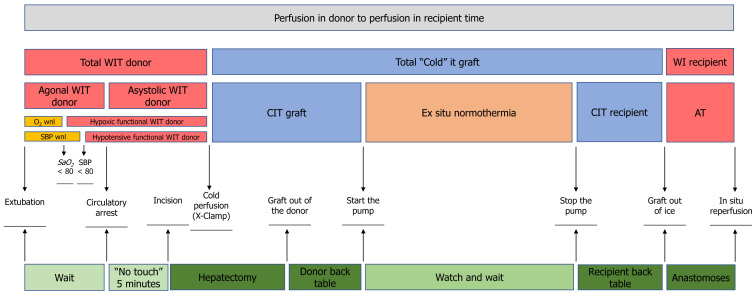
Methods: Retrospective review of the first 50 donation after circulatory death (DCD) grafts preserved using NMPP in a tertiary institution was performed. Essential preservation time points, graft parameters, recipient information, and postoperative outcomes were prospectively recorded. Early allograft dysfunction (EAD), L-Graft7 score and 90-day outcomes were collected for all grafts. The first 20 recipients were allocated into the early group, considered the learning curve population for the center. The subsequent 30 were allocated into the late group. Recipients were also stratified into cohorts depending on MPT, i.e., short (< 8 hours), medium (8-16 hours) and long (> 16 hours).
Results: NMPP operational parameters were not predictive of EAD, L-GrAFT7 or 90-day outcomes. The early group had significantly less MPT and cold ischemia time than the late group (553 minutes vs 850 minutes, P < 0.001) and (127.5 minutes vs 154 minutes, P = 0.025), respectively. MPT had no impact in either group.
Conclusion: Increased MPT of DCD liver grafts had no adverse recipient results for the times utilized in this population, indicating its upper limits, likely beyond 24 hours, are not demonstrated within this study. Future studies are necessary to determine whether longer MPT is beneficial or detrimental to graft function and, if the latter, what is the maximum safe duration. Further studies of the effect of normothermic machine perfusion pump duration on long-term outcomes are also needed.
Keywords: Donation after circulatory death; Ex-vivo perfusion; Ischemic cholangiopathy; Liver transplant; Normothermic machine pump perfusion.
©The Author(s) 2025. Published by Baishideng Publishing Group Inc. All rights reserved.
Conflict of interest statement
Conflict-of-interest statement: All authors declare no conflict of interest in publishing the manuscript.
Figures
References
-
- Dienstag JL, Cosimi AB. Liver transplantation--a vision realized. N Engl J Med. 2012;367:1483–1485. - PubMed
-
- Klassen DK, Edwards LB, Stewart DE, Glazier AK, Orlowski JP, Berg CL. The OPTN Deceased Donor Potential Study: Implications for Policy and Practice. Am J Transplant. 2016;16:1707–1714. - PubMed
-
- Selck FW, Grossman EB, Ratner LE, Renz JF. Utilization, outcomes, and retransplantation of liver allografts from donation after cardiac death: implications for further expansion of the deceased-donor pool. Ann Surg. 2008;248:599–607. - PubMed
-
- Kubal C, Roll GR, Ekser B, Muiesan P. Donation after circulatory death liver transplantation: What are the limits for an acceptable DCD graft? Int J Surg. 2020;82 S:36–43. - PubMed
LinkOut - more resources
Full Text Sources
