


Predictors of Longitudinal Viral Load count and Survival Time to Death Among Adult TB/HIV Coinfected Patients Treated at Two Selected Amhara Region Comprehensive Specialized Hospitals, Ethiopia
- PMID: 40535517
- PMCID: PMC12174616
- DOI: 10.1002/hsr2.70867
Predictors of Longitudinal Viral Load count and Survival Time to Death Among Adult TB/HIV Coinfected Patients Treated at Two Selected Amhara Region Comprehensive Specialized Hospitals, Ethiopia
Abstract
Background and aims: The most prevalent opportunistic illness among people living with HIV/AIDS is tuberculosis. The aim of this study was to determine predictors of longitudinal viral load and survival time to death among adult TB/HIV coinfected patients treated at two selected Amhara region Comprehensive Specialized Hospitals, Ethiopia.
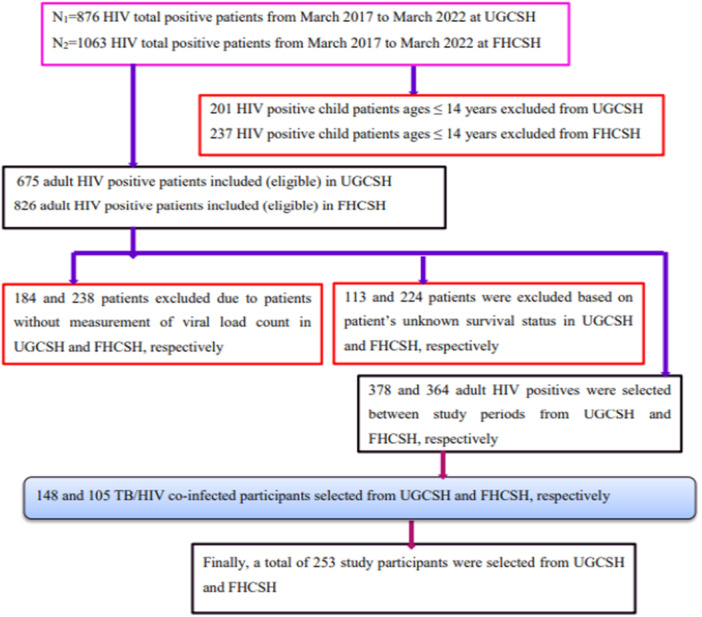
Methods: A retrospective follow-up study design was conducted from March 2018-2022 in the University of Gondar Comprehensive Specialized Hospital and Felege Hiwot Comprehensive Specialized Hospital. Descriptive statistics, separate Cox PH model, separate generalized linear mixed model, and joint model were employed to analyze the coinfected patient data.
Results: Among 253 TB/HIV coinfected participants, 26.5% mortality and the rest were censored. Random intercept and slope model for the longitudinal viral load count Cox PH model for time to death were selected based on AIC and BIC values. The estimate of the association parameter due to the slope ( and due to the viral load count variability through time is positive ( ).
Conclusions: These results concluded that the joint model is not only the simplest model, but also provided a better fit to the coinfected patients' data than the separate model. The parameter estimation under the joint model revealed that INH, residence, CD4 cell count, functional status, and BMI were considered as significant joint predictors of viral load count and time to death among TB/HIV coinfected patients. Furthermore, the results of the association parameter concluded that the higher the viral load count of the patient, the higher the chance of mortality, and correspondingly, patients with lower viral load count have a lower chance of mortality. In this study, important potential joint predictors should be given special attention by adult TB/HIV coinfected patients and health professionals to minimize viral load and risk of mortality.
Keywords: Bahir Dar; Gondar; HIV; TB; association; coinfected; death; predictors; viral load.
© 2025 The Author(s). Health Science Reports published by Wiley Periodicals LLC.
Conflict of interest statement
The authors declare no conflicts of interest.
Figures
References
-
- Pan American Health Organization , “TB/HIV Coinfection Regional Clinical Manual: 2017 Update,” published 2016, https://www.paho.org/en/node/58184.
LinkOut - more resources
Full Text Sources
Research Materials
