


Metagenomics reveals unique gut mycobiome biomarkers in major depressive disorder - a non-invasive method
- PMID: 40535544
- PMCID: PMC12174422
- DOI: 10.3389/fcimb.2025.1582522
Metagenomics reveals unique gut mycobiome biomarkers in major depressive disorder - a non-invasive method
Abstract
Background: An increasing amount of evidence suggests a potential link between alterations in the intestinal microbiota and the onset of various psychiatric disorders, including depression. Nevertheless, the precise nature of the link between depression and the intestinal microbiota remains largely unknown. A significant proportion of previous research has concentrated on the study of gut bacterial communities, with relatively little attention paid to the link between gut mycobiome and depression.
Methods: In this research, we analyzed the composition and differences of intestinal fungal communities between major depressive disorder (MDD) and healthy controls. Subsequently, we constructed a machine learning model using support vector machine-recursive feature elimination to search for potential fungal markers for MDD.
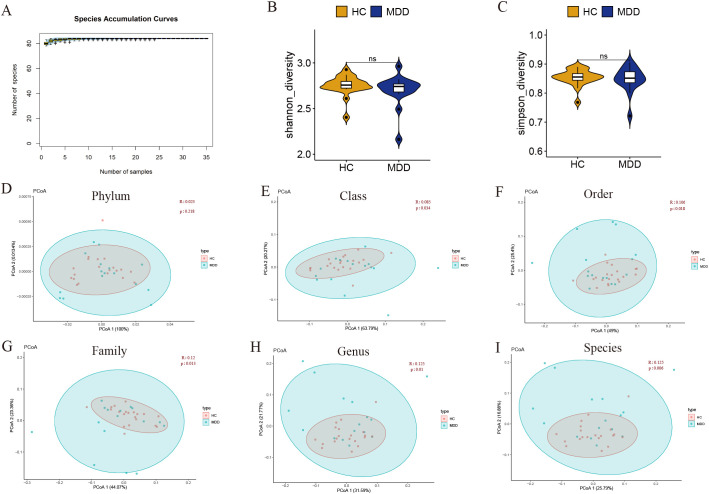
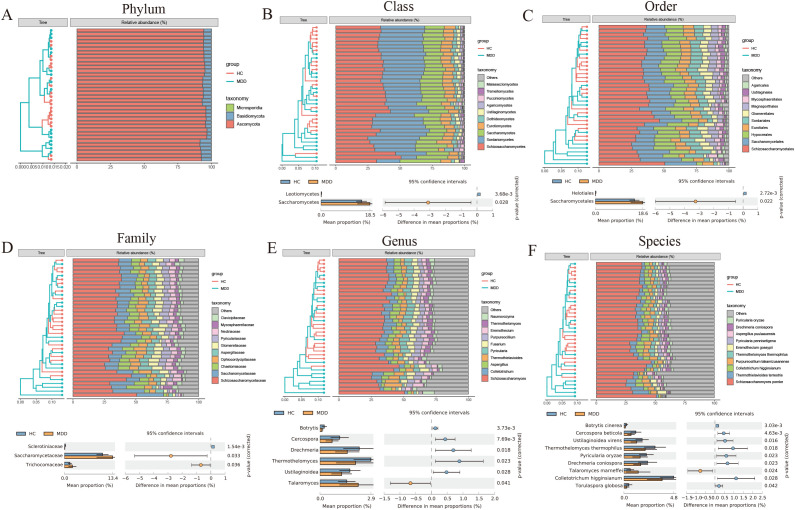
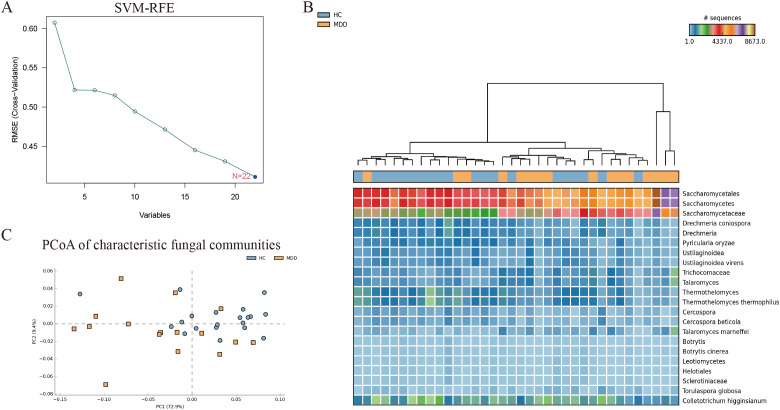
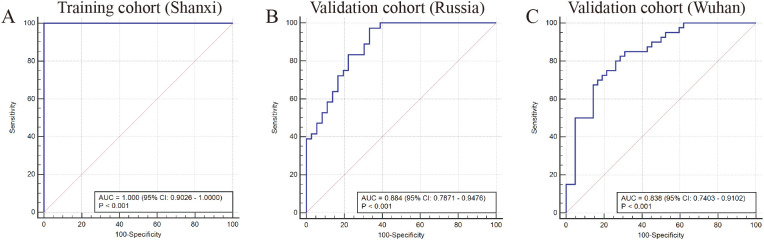
Results: Our findings indicated that the composition and beta diversity of intestinal fungal communities were significantly changed in MDD compared to the healthy controls. A total of 22 specific fungal community markers were screened out by machine learning, and the predictive model had promising performance in the prediction of MDD (area under the curve, AUC = 1.000). Additionally, the intestinal fungal communities demonstrated satisfactory performance in the validation cohort, with an AUC of 0.884 (95% CI: 0.7871-0.9476) in the Russian validation cohort, which consisted of 36 patients with MDD and 36 healthy individuals. The AUC for the Wuhan validation cohort was 0.838 (95% CI: 0.7403-0.9102), which included 40 patients with MDD and 42 healthy individuals.
Conclusion: To summarize, our research revealed the characterization of intestinal fungal communities in MDD and developed a prediction model based on specific intestinal fungal communities. Although MDD has well-established diagnostic criteria, the strategy based on the model of gut fungal communities may offer predictive biomarkers for MDD.
Keywords: biomarkers; gut mycobiome; machine learning; major depressive disorder; metagenome.
Copyright © 2025 Wang, Cao, Chen, Sun and Hu.
Conflict of interest statement
The authors declare that the research was conducted in the absence of any commercial or financial relationships that could be construed as a potential conflict of interest.
Figures
References
-
- Alli S. R., Gorbovskaya I., Liu J. C. W., Kolla N. J., Brown L., Müller D. J. (2022). The gut microbiome in depression and potential benefit of prebiotics, probiotics and synbiotics: A systematic review of clinical trials and observational studies. Int. J. Mol. Sci. 23, 4494. doi: 10.3390/ijms23094494 - DOI - PMC - PubMed
-
- Bukavina L., Prunty M., Isali I., Calaway A., Ginwala R., Sindhani M., et al. (2022). Human gut mycobiome and fungal community interaction: the unknown musketeer in the chemotherapy response status in bladder cancer. Eur. Urol. Open Sci. 43, 5–13. doi: 10.1016/j.euros.2022.06.005 - DOI - PMC - PubMed
MeSH terms
Substances
LinkOut - more resources
Full Text Sources
Medical
