


Clinical and prognostic significance of whole blood Epstein-Barr virus DNA in patients with primary hemophagocytic lymphohistiocytosis: a retrospective observational study from China
- PMID: 40536720
- PMCID: PMC12334372
- DOI: 10.1007/s00277-025-06447-2
Clinical and prognostic significance of whole blood Epstein-Barr virus DNA in patients with primary hemophagocytic lymphohistiocytosis: a retrospective observational study from China
Abstract
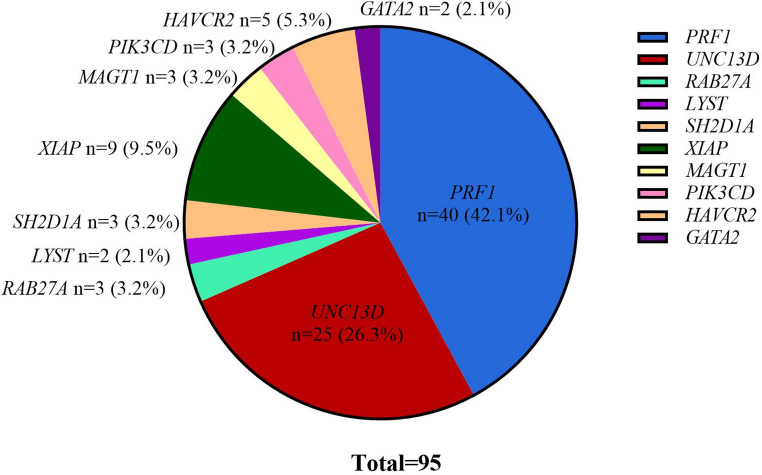
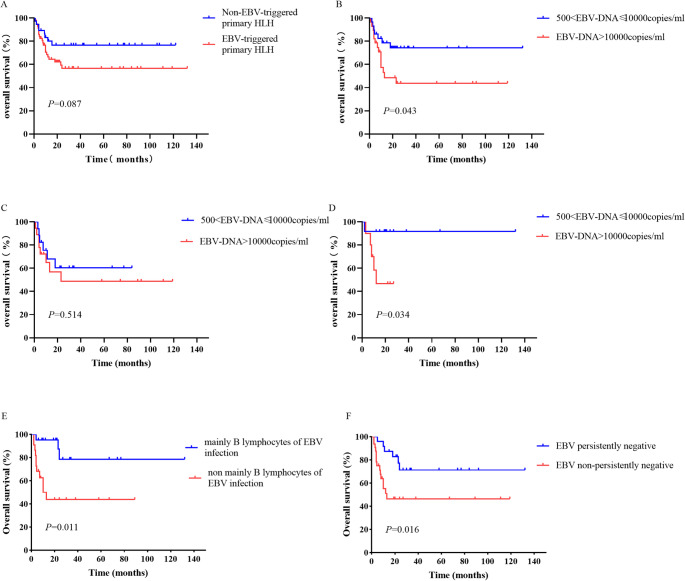
Hemophagocytic lymphohistiocytosis (HLH) has been described as a threshold disease depending on triggering factors and the residual cytotoxic capacity of NK cells. This study aimed to investigate the clinical characteristics of Epstein-Barr virus (EBV)-triggered primary HLH and the prognostic value of EBV-DNA load in EBV-triggered primary HLH cases. We retrospectively analyzed the clinical data of 95 patients with primary HLH treated between January 2013 and January 2024. Based on the peripheral blood EBV status at initial diagnosis, 57 patients were categorized into the EBV-triggered primary HLH group and 38 patients into the non-EBV-triggered primary HLH group. Clinical and functional characteristics, response to treatment, and prognosis were compared between the two groups. Among patients with EBV-triggered primary HLH, the proportion of patients with familial HLH type 2 (FHL2) was significantly lower (P = 0.011), whereas the proportion of patients with X-linked lymphoproliferative disorder (XLP) was higher (P = 0.037). Functional assays showed that in primary HLH patients with gene defects in cytotoxic degranulation, the proportion of EBV-triggered primary HLH patients with reduced NK cell activity and degranulation function was significantly higher (P = 0.026 and P = 0.030). Importantly, multivariate Cox regression analysis identified EBV-DNA > 10,000 copies/mL as an independent risk factor affecting the prognosis of patients with EBV-triggered primary HLH, particularly in non-FHL cases (P = 0.045). EBV-triggered primary HLH is more prevalent in patients with XLP but less frequent in FHL2 patients. High EBV-DNA load is an adverse prognostic factor in EBV-triggered primary HLH patients.
Keywords: Epstein-Barr virus; Overall survival; Primary hemophagocytic lymphohistiocytosis; Prognosis; Trigger.
© 2025. The Author(s).
Conflict of interest statement
Declarations. Competing interests: The authors declare no competing interests.
Figures
References
-
- Janka GE, Lehmberg K (2014) Hemophagocytic syndromes–an update. Blood Rev 28:135–142 - PubMed
-
- Allen CE, McClain KL (2015) Pathophysiology and epidemiology of hemophagocytic lymphohistiocytosis. Hematol Am Soc Hematol Educ Program 2015:177–82 - PubMed
-
- Janka GE (2012) Familial and acquired hemophagocytic lymphohistiocytosis. Annu Rev Med 63:233–246 - PubMed
-
- Chinn IK, Eckstein OS, Peckham-Gregory EC, Goldberg BR, Forbes LR, Nicholas SK, Mace EM, Vogel TP, Abhyankar HA, Diaz MI, Heslop HE, Krance RA, Martinez CA, Nguyen TC, Bashir DA, Goldman JR, Stray-Pedersen A, Pedroza LA, Poli MC, Aldave-Becerra JC, McGhee SA, Al-Herz W, Chamdin A, Coban-Akdemir ZH, Jhangiani SN, Muzny DM, Cao TN, Hong DN, Gibbs RA, Lupski JR, Orange JS, McClain KL, Allen CE (2018) Genetic and mechanistic diversity in pediatric hemophagocytic lymphohistiocytosis. Blood 132:89–100 - PMC - PubMed
Publication types
MeSH terms
Substances
Grants and funding
LinkOut - more resources
Full Text Sources
