. 2025 Jun;7(4):360-378.
doi: 10.1016/j.jaccao.2025.03.008.

Risk of Cardiovascular Disease in Cancer Survivors after Systemic Treatment: A Population-Based Cohort Study

Affiliations

Risk of Cardiovascular Disease in Cancer Survivors after Systemic Treatment: A Population-Based Cohort Study

Frits I Mulder et al. JACC CardioOncol. 2025 Jun.

Abstract

Background: Patients face an increased risk of cardiovascular disease shortly after a cancer diagnosis, but evidence on long-term risk among cancer survivors remains limited.

Objectives: In this study the authors sought to estimate the risk of cardiovascular disease in cancer survivors previously treated with systemic cancer therapy.

Methods: Using Danish population-based registries, we identified individuals who had received systemic cancer treatment and were free of both cancer and treatment 3 years after diagnosis (index date). For each cancer survivor, 5 cancer-free individuals from the general population were randomly selected, matched by birth year, sex, and calendar year. Participants were followed from the index date for up to 5 years. HRs were estimated using Cox regression, adjusted for potential confounders.

Results: Compared with 457,035 matched individuals, the 91,407 cancer survivors had an increased risk of heart failure or cardiomyopathy (HR: 1.08; 95% CI: 1.02-1.15), venous thromboembolism (HR: 1.50; 95% CI: 1.41-1.61), pericarditis, endocarditis, or myocarditis (HR: 1.30; 95% CI: 1.11-1.52), and kidney failure (HR: 1.17; 95% CI: 1.10-1.25), but not of ischemic heart disease, stroke, or atrial fibrillation. Estimates varied substantially by cancer type and treatment agent. For example, venous thromboembolism risk was consistently increased across nearly all cancer types, whereas hypertension risk was elevated for none. Ischemic heart disease risk was increased only among lung cancer survivors. Stroke was associated with platinum compounds but not with other systemic treatments.

Conclusions: Several cardiovascular disease risks were elevated among cancer survivors, with substantial variation by cancer type and treatment.

Keywords: acute coronary syndrome; arrhythmia; cancer; cancer survivorship; cohort study; epidemiology; kidney failure; myocardial infarction; neoplasm; stroke; venous thromboembolism.


Conflict of interest statement

Funding Support and Author Disclosures This study was supported by a research grant from the Karen Elise Jensen Foundation. Dr van Es is supported by an Amsterdam Cardiovascular Sciences MD/Postdoc grant. Dr Bhaskaran is supported by a Welcome Senior Research Fellowship (220283/Z/20/Z). The Department of Clinical Epidemiology at Aarhus University receives funding for other studies from companies in the form of research grants to (and administered by) Aarhus University. None of these studies has any relation to the present study. The authors have reported that they have no relationships relevant to the contents of this paper to disclose.

Figures

None
Graphical abstract
Figure 1
Figure 1
Flow Chart Among 471,569 cancer patients identified between 2004 and 2019, 206,452 received systemic cancer treatment within 12 months of diagnosis. Of these, 91,407 were alive 3 years later (the index date) and had no evidence of recent cancer treatment or relapse. At index date, each survivor was matched to 5 cancer-free individuals from the general population and followed for up to 5 years for study outcomes or censoring. ∗For breast and prostate cancer, systemic treatment included (anti)hormonal agents.
Figure 2
Figure 2
Outcomes in Cancer Survivors and Comparison Individuals, by Cancer Type Cardiovascular outcomes in cancer survivors and their matched cancer-free comparators during 5-year follow-up. Risks are shown as cumulative incidences and adjusted HRs with 95% CIs. Outcomes are stratified by cancer type at first cancer diagnosis. Results indicate that cardiovascular risk is increased in cancer survivors, with variations across cancer types. These include ischemic heart disease, heart failure, atrial fibrillation/flutter, peri-/endo-/ myocarditis, valvular heart disease, and other cardiac arrhythmias, as well as aortic aneurysm and dissection, stroke, venous thromboembolism, kidney failure, and hypertension.
Figure 2
Figure 2
Outcomes in Cancer Survivors and Comparison Individuals, by Cancer Type Cardiovascular outcomes in cancer survivors and their matched cancer-free comparators during 5-year follow-up. Risks are shown as cumulative incidences and adjusted HRs with 95% CIs. Outcomes are stratified by cancer type at first cancer diagnosis. Results indicate that cardiovascular risk is increased in cancer survivors, with variations across cancer types. These include ischemic heart disease, heart failure, atrial fibrillation/flutter, peri-/endo-/ myocarditis, valvular heart disease, and other cardiac arrhythmias, as well as aortic aneurysm and dissection, stroke, venous thromboembolism, kidney failure, and hypertension.
Figure 3
Figure 3
Outcomes in Cancer Survivors and Comparison Individuals, by Treatment Group Cardiovascular outcomes in cancer survivors and their matched cancer-free comparators during 5-year follow-up. Risks are shown as cumulative incidences and adjusted HRs with 95% CIs. Outcomes are stratified by cancer treatment received within the first 12 months after initial diagnosis. Results indicate that cardiovascular risk is increased in cancer survivors and varies by treatment type. (A) includes ischemic heart disease, heart failure, atrial fibrillation/flutter, and peri-/endo-/myocarditis. (B) includes stroke, venous thromboembolism, kidney failure, and hypertension. (C) includes valvular heart disease, other cardiac arrhythmias, aortic aneurysm/dissection. ∗Hormonal treatment was evaluated only in survivors of breast and prostate cancer. HER2 = human epidermal growth factor receptor 2.
Figure 3
Figure 3
Outcomes in Cancer Survivors and Comparison Individuals, by Treatment Group Cardiovascular outcomes in cancer survivors and their matched cancer-free comparators during 5-year follow-up. Risks are shown as cumulative incidences and adjusted HRs with 95% CIs. Outcomes are stratified by cancer treatment received within the first 12 months after initial diagnosis. Results indicate that cardiovascular risk is increased in cancer survivors and varies by treatment type. (A) includes ischemic heart disease, heart failure, atrial fibrillation/flutter, and peri-/endo-/myocarditis. (B) includes stroke, venous thromboembolism, kidney failure, and hypertension. (C) includes valvular heart disease, other cardiac arrhythmias, aortic aneurysm/dissection. ∗Hormonal treatment was evaluated only in survivors of breast and prostate cancer. HER2 = human epidermal growth factor receptor 2.
Figure 3
Figure 3
Outcomes in Cancer Survivors and Comparison Individuals, by Treatment Group Cardiovascular outcomes in cancer survivors and their matched cancer-free comparators during 5-year follow-up. Risks are shown as cumulative incidences and adjusted HRs with 95% CIs. Outcomes are stratified by cancer treatment received within the first 12 months after initial diagnosis. Results indicate that cardiovascular risk is increased in cancer survivors and varies by treatment type. (A) includes ischemic heart disease, heart failure, atrial fibrillation/flutter, and peri-/endo-/myocarditis. (B) includes stroke, venous thromboembolism, kidney failure, and hypertension. (C) includes valvular heart disease, other cardiac arrhythmias, aortic aneurysm/dissection. ∗Hormonal treatment was evaluated only in survivors of breast and prostate cancer. HER2 = human epidermal growth factor receptor 2.
Figure 4
Figure 4
Cumulative Incidence Curves for Selected Cancer Types Cumulative incidence curves for cardiovascular outcomes in cancer survivors and their matched cancer-free comparators during 5-year follow-up, stratified by 4 cancer types: breast cancer, colorectal cancer, hematological malignancies, and lung cancer. Results indicate that cardiovascular risk is increased in cancer survivors and varies by cancer types. These include ischemic heart disease, heart failure, atrial fibrillation/flutter, peri-/endo-/myocarditis, valvular heart disease, and other cardiac arrhythmias, as well as aortic aneurysm and dissection, stroke, venous thromboembolism, kidney failure, and hypertension.
Figure 4
Figure 4
Cumulative Incidence Curves for Selected Cancer Types Cumulative incidence curves for cardiovascular outcomes in cancer survivors and their matched cancer-free comparators during 5-year follow-up, stratified by 4 cancer types: breast cancer, colorectal cancer, hematological malignancies, and lung cancer. Results indicate that cardiovascular risk is increased in cancer survivors and varies by cancer types. These include ischemic heart disease, heart failure, atrial fibrillation/flutter, peri-/endo-/myocarditis, valvular heart disease, and other cardiac arrhythmias, as well as aortic aneurysm and dissection, stroke, venous thromboembolism, kidney failure, and hypertension.
Figure 5
Figure 5
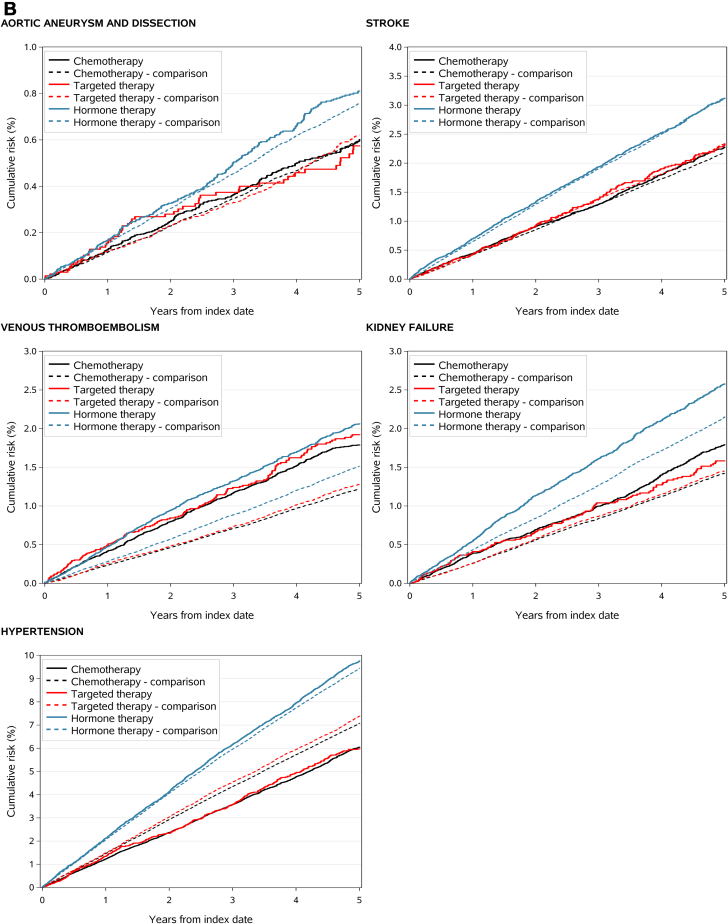
Cumulative Incidence Curves for Selected Treatment Groups Cumulative incidence curves for cardiovascular outcomes in cancer survivors and their matched cancer-free comparators during 5-year follow-up, stratified by treatment groups: chemotherapy, targeted therapy, and hormonal therapy. These include ischemic heart disease, heart failure, atrial fibrillation/flutter, peri-/endo-/myocarditis, valvular heart disease, and other cardiac arrhythmias, as well as aortic aneurysm/dissection, stroke, venous thromboembolism, kidney failure, and hypertension. ∗Hormonal treatment was evaluated only in survivors of breast and prostate cancer.
Figure 5
Figure 5
Cumulative Incidence Curves for Selected Treatment Groups Cumulative incidence curves for cardiovascular outcomes in cancer survivors and their matched cancer-free comparators during 5-year follow-up, stratified by treatment groups: chemotherapy, targeted therapy, and hormonal therapy. These include ischemic heart disease, heart failure, atrial fibrillation/flutter, peri-/endo-/myocarditis, valvular heart disease, and other cardiac arrhythmias, as well as aortic aneurysm/dissection, stroke, venous thromboembolism, kidney failure, and hypertension. ∗Hormonal treatment was evaluated only in survivors of breast and prostate cancer.
Central Illustration
Cardiovascular Risk in Cancer Survivors A total of 91,407 cancer survivors with no signs of active disease were matched to 457,035 cancer-free individuals from the general population. During the 5-year of follow-up, cancer survivors had increased risk of several cardiovascular diseases, with substantial variation by cancer type and prior cancer treatment.

References

    1. Shapiro C.L. Cancer survivorship. N Engl J Med. 2018;379(25):2438–2450. doi: 10.1056/NEJMra1712502. - DOI - PubMed
    1. Miller K.D., Nogueira L., Mariotto A.B., et al. Cancer treatment and survivorship statistics, 2019. CA Cancer J Clin. 2019;69(5):363–385. doi: 10.3322/caac.21565. - DOI - PubMed
    1. Zamorano J.L., Lancellotti P., Rodriguez Muñoz D., et al. 2016 ESC Position Paper on cancer treatments and cardiovascular toxicity developed under the auspices of the ESC Committee for Practice Guidelines. Eur Heart J. 2016;37(36):2768–2801. doi: 10.1093/eurheartj/ehw211. - DOI - PubMed
    1. Mulder F.I., Horváth-Puhó E., van Es N., et al. Arterial thromboembolism in cancer patients. JACC CardioOncol. 2021;3(2):205–218. doi: 10.1016/j.jaccao.2021.02.007. - DOI - PMC - PubMed
    1. Mulder F.I., Horvàth-Puhó E., van Es N., et al. Venous thromboembolism in cancer patients: a population-based cohort study. Blood. 2021;137(14):1959–1969. doi: 10.1182/blood.2020007338. - DOI - PubMed

LinkOut - more resources