


New insights and a computational model for understanding induced motion revealed through novel variants of the Flying Bluebottle Illusion
- PMID: 40538449
- PMCID: PMC12177812
- DOI: 10.1177/20416695251344457
New insights and a computational model for understanding induced motion revealed through novel variants of the Flying Bluebottle Illusion
Abstract
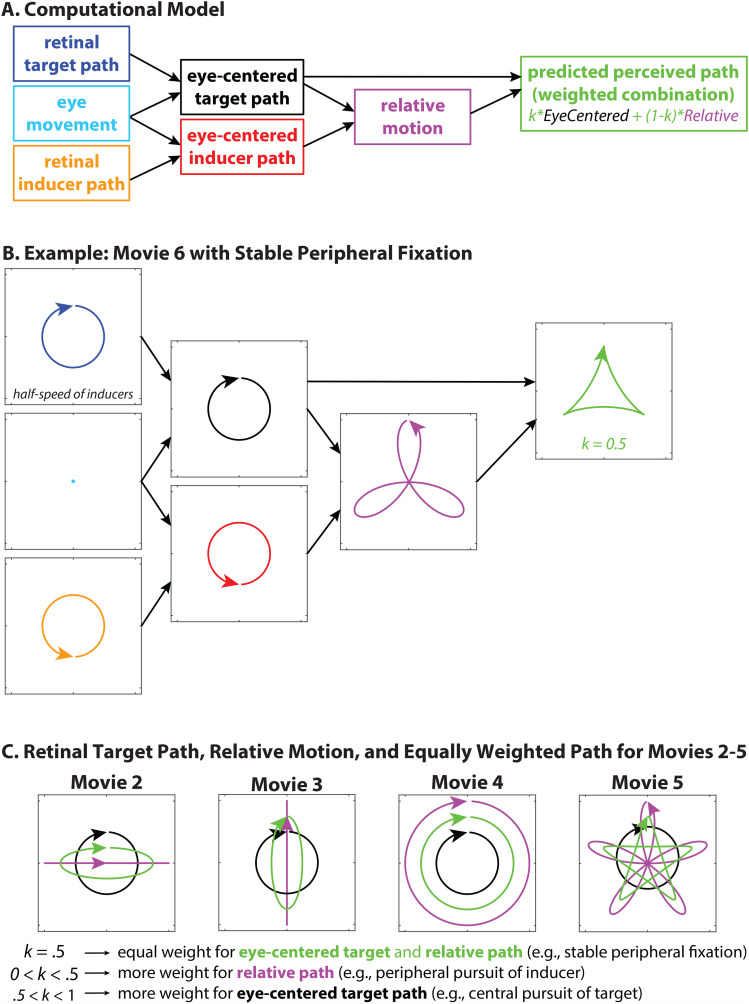
The Flying Bluebottle Illusion is a compelling example of how the perceived trajectory of moving objects can be greatly influenced by other motion sources in the visual scene. In this article, we present a series of simplified variants of the Flying Bluebottle Illusion in which the true motion of a target is a circular orbit around a central point. However, when a similar but offset orbiting motion trajectory is added to a set of surrounding inducers, the perceived trajectory of the target is drastically altered in both extent and direction. In other words, the perceived orbiting motion of the target is "pulled" and distorted by the orbiting motion of the inducers. For simplicity's sake, we refer to the illusory effect revealed by these dueling orbits as the Dueling Orbit Illusion. These simplified variants lend themselves to empirical study with resultant effects that can be readily modeled. Here, we present a series of case examples for how the parameters of the stimuli may be varied to yield predictable effects, describe a straightforward computational model for quantifying the magnitude of the contextual influence, and discuss how the model may be leveraged to gain insight into the phenomenon of induced motion across a range of within and between observer domains.
Keywords: induced motion; motion contrast; motion perception; relative motion; visual illusion.
© The Author(s) 2025.
Conflict of interest statement
The authors declared no potential conflicts of interest with respect to the research, authorship, and/or publication of this article.
Figures

References
-
- Duncker K. (1938). Induced motion (W. D. Ellis, trans.). In Ellis W. D. (Ed.), A source book of gestalt psychology (pp. 161–172). Routledge and Kegan Paul. (Original work published 1929).
LinkOut - more resources
Full Text Sources
