


Analysis of key factors and equity in influenza vaccination among Chinese adults-evidence from a large national cross-sectional survey
- PMID: 40538690
- PMCID: PMC12176740
- DOI: 10.3389/fpubh.2025.1601577
Analysis of key factors and equity in influenza vaccination among Chinese adults-evidence from a large national cross-sectional survey
Abstract
Introduction: Influenza is prevalent globally, leading to severe morbidity and mortality. Vaccination remains a critical strategy for influenza prevention. Although previous studies in China have primarily focused on influenza vaccination among children, limited research has addressed the key determinants and equity issues concerning adult influenza vaccination.The purpose of this study was to investigate the key factors influencing influenza vaccination and its equity among Chinese adults.
Methods: The study uses data from the 2021 Chinese General Social Survey (CGSS) (N = 2695).Initially, differences in influenza vaccination among adults with various baseline characteristics were analyzed using the chi-square test. Subsequently, the importance of influencing factors was assessed through a random forest model, with LASSO used for variable selection. Following this, weighted logistic regression analysis was applied to quantify the significant influencing factors. Finally, the concentration index was employed to identify and determine the contribution of important variables to influenza vaccination.
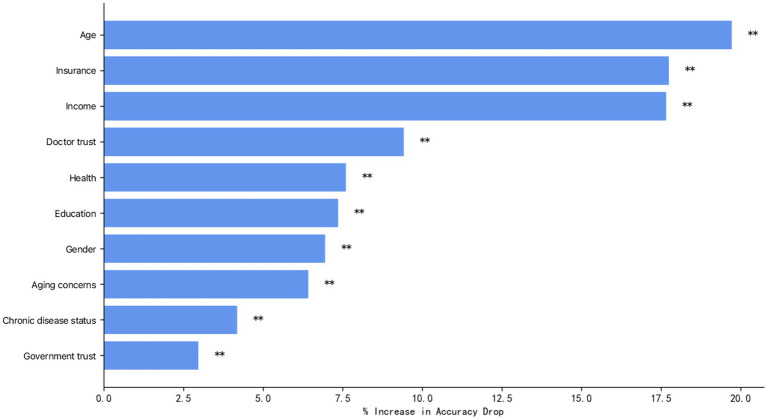
Results: The influenza vaccination rate among Chinese adults is low (6.75%). Key factors identified as influencing adult vaccination include government trust, physician trust, income, aging concerns, health insurance, age, education, and health status. These factors not only have independent effects but also interact to influence vaccination behavior. Regarding individual effects, government trust, physician trust, income, and aging concerns showed positive associations with vaccination rates. Conversely, health insurance status, age, educational attainment, and health status demonstrated negative associations. Regarding the interaction terms, there were positive associations between health insurance and government trust, education and government trust, health and physician trust, government trust, as well as education level and age with the target variables. In contrast, interactions between income and health insurance, as well as income and physician trust negatively influenced vaccination rates. The concentration index for adult influenza vaccination was 0.092. There was inequity in vaccination, with the distribution of vaccinations being skewed toward higher-income individuals. Decomposition analysis further revealed that the primary contributors to vaccination inequity, in descending order of magnitude, were income (32.6%), government trust (9.1%), education (8.7%), age (8.2%), and aging concerns (2.6%).
Discussion: This is the first study to leverage a large micro-survey database in China to analyze the key factors affecting adult influenza vaccination and its equity. By providing new evidence on influenza vaccination among Chinese adults, the findings may inform the optimization of adult immunization policies. To further increase influenza vaccination rates and promote equity among Chinese adults, future policy improvements could consider emphasizing the role of trust in vaccination uptake, subsidizing vaccination costs, and fully utilizing comprehensive intervention strategies to enhance adult influenza vaccination coverage and equity.
Keywords: adults; equity; influenza; key factors; vaccination.
Copyright © 2025 Dong, Xu, Tang, Jiang, Lei and Han.
Conflict of interest statement
The authors declare that the research was conducted in the absence of any commercial or financial relationships that could be construed as a potential conflict of interest.
Figures




References
-
- Zhang ZG, Wang LL, Li Q. Interpretation of the technical guidelines for influenza vaccination in China (2022–2023). J Hebei Med Univ. (2019) 44:373–375+391. doi: 10.3969/j.issn.1007-3205.2023.04.001 - DOI
-
- World Health Organization . Vaccines against influenza: WHO position paper-may 2022. (2022). Available online at: https://www.who.int/wer (accessed January 20, 2025)
MeSH terms
Substances
LinkOut - more resources
Full Text Sources
Medical
