


Attrition in the Training Programs of the University of the Philippines-Philippine General Hospital (UP-PGH): A 5-year Review of Trends and Reasons from 2018-2022
- PMID: 40538906
- PMCID: PMC12174645
- DOI: 10.47895/amp.vi0.9376
Attrition in the Training Programs of the University of the Philippines-Philippine General Hospital (UP-PGH): A 5-year Review of Trends and Reasons from 2018-2022
Abstract
Background and objective: Attrition in the medical training programs not only affects the specialty but also the hospital, the trainee's career path, and the provision of care to patients. This study aims to determine the trends, annual rates, and reasons of attrition at the University of the Philippines-Philippine General Hospital (UP-PGH) from 2018-2022.
Methods: The study was carried out in two stages. A retrospective review of trainees' records from the Office of the Deputy Director of Health Operations (ODDHO) and Human Resource Department (HRD) was initially done followed by a survey of the resident training officers (RTOs). Associations between physician and program attributes to attrition were analyzed using t-test and Chi-square at p <0.05 level of significance.
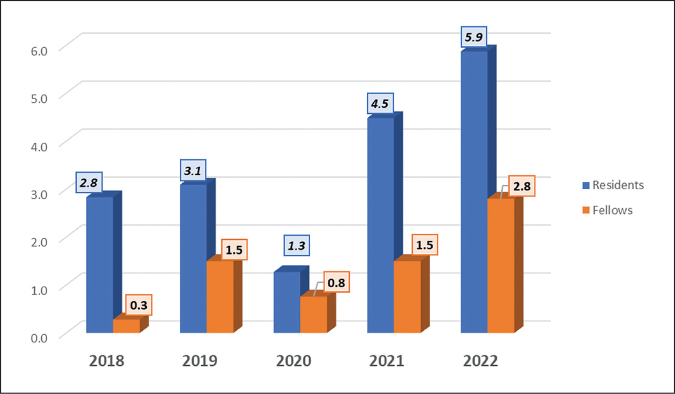
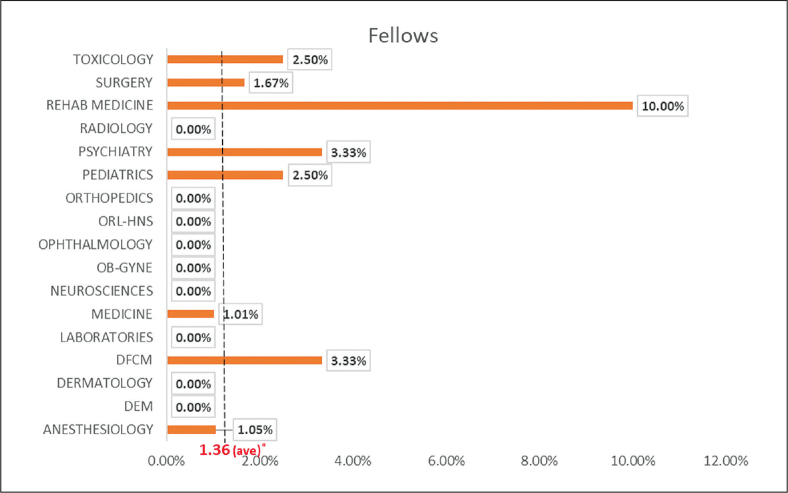
Results: There were 141 resignations recorded during the 5-year review (residents=113, fellows=28). The mean age for residents was 28.76 years ± 3.05, 55.75% were females, 59.29% graduated from non-UP College of Medicine (UPCM) schools, and 92.92% were single. Most left during their first year (53.98%); Ob-Gyne (n=20) and Anesthesiology (n=18) had the most number of drop-outs. For fellows, the mean age was 32.73 years ± 2.70, most were female (60.71%), single (71.43%), from non-UPCM schools (71.43%), left during their 1st year (78.57%) and not from PGH residency (78.57%). Pediatrics (n=13) and Internal Medicine (n=9) had the highest numbers of fellow resignations. The reasons cited were mental health, unmet expectation, change in specialty, and sickness. The mean resident attrition rate was 3.51% while for fellows it was 1.36%, an evident rise was seen during the COVID-19 years.
Conclusion: The decision to take postgraduate training is a personal journey for medical graduates. It is important to focus on strategies in identifying modifiable stressors during demanding times and be more receptive in addressing anxiety and mental health issues. Adjustments in the selection process must give applicants the real-world feel of the training environment, so a more realistic expectation will be met.
Keywords: attrition rate; fellows; post-graduate training; residents.
© The Author(s) 2025.
Conflict of interest statement
One of the authors is the PGH Coordinator for Training, who implements the rules and policies of the different training programs of the hospital. She did not participate in the data gathering; no other conflict of interest is declared.
Figures



References
-
- Lee JC, Kee JX, Ogilvie SW, Chern B, Chin CY. What drives attrition amongst obstetrics and gynaecology residents in Singapore. The Asia Pacific Scholar. 2019;4(1):34-41. doi: 10.29060/TAPS.2019-4-1/OA2005. - DOI
-
- Avery DMJ, Harrell AG, Wallace JC, Burkhardt J, Bell JV, Geno CE, et al. Why do residents quit general surgery residencies? A study of 789 graduates from 3 campuses who matched into general surgery over 40 years: 1974 to 2015. Clin Surg. 2017;2(1):1-5.doi: 10.33582/2639-9229/1003. - DOI
-
- Moo D, Siow WS, Ong ET. Why residents quit: Prevalence of and reasons for attrition among anaesthesia residents in a single sponsoring institution. Proceedings of Singapore Healthcare. 2020;29(2):94-103. doi: 10.1177/2010105820908296. - DOI
LinkOut - more resources
Full Text Sources
Miscellaneous