


Telehealth and Health Care Contact Days Among Patients With Advanced Cancer After COVID-19
- PMID: 40540268
- PMCID: PMC12181790
- DOI: 10.1001/jamanetworkopen.2025.16762
Telehealth and Health Care Contact Days Among Patients With Advanced Cancer After COVID-19
Abstract
Importance: The COVID-19 pandemic led to widespread telemedicine adoption, but its impact on time toxicity, ie, the time burden of interacting with the health care system, among patients with advanced cancer remains unclear.
Objective: To evaluate the association of the COVID-19 pandemic with time toxicity for patients with advanced cancer who died within 1 year of diagnosis, focusing on changes in health care use, including telehealth.
Design, setting, and participants: This retrospective cohort study included patients with stage 4 cancer who died within 1 year of diagnosis, with follow-up limited to 1 year. Patient data were provided by an integrated value-based health care system across Kaiser Permanente Northern California. Patients were grouped by diagnosis date into a pre-COVID-19 group (January 1, 2015, to February 29, 2020) and a post-COVID-19 group (March 1, 2020, to June 30, 2022, followed up through June 2023).
Exposure: Health care use before and after the onset of the COVID-19 pandemic.
Main outcomes and measures: Time toxicity was measured as the percentage of health care contact days over survival days. Types of health care use included outpatient visits (in-person and telehealth), emergency department visits, and hospitalizations. Multivariable negative binomial regression was performed to assess use changes by care type.
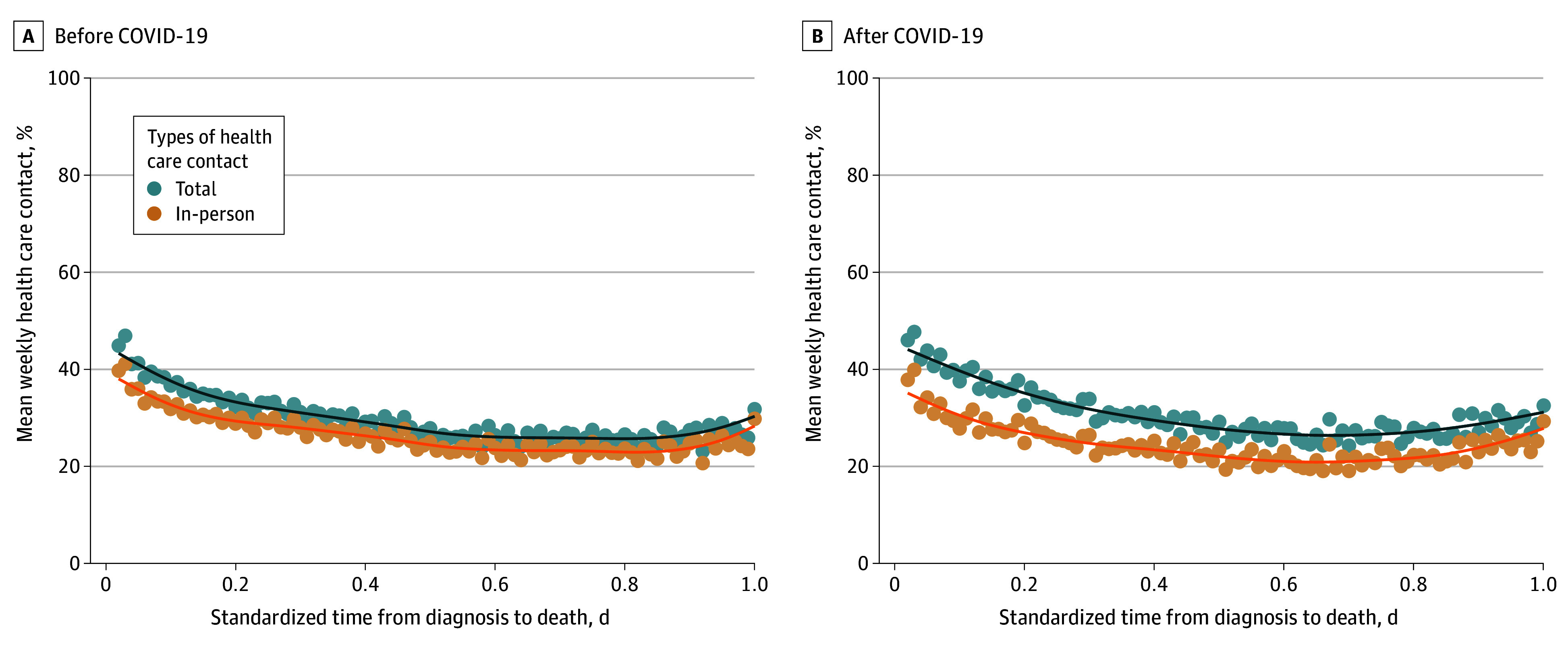
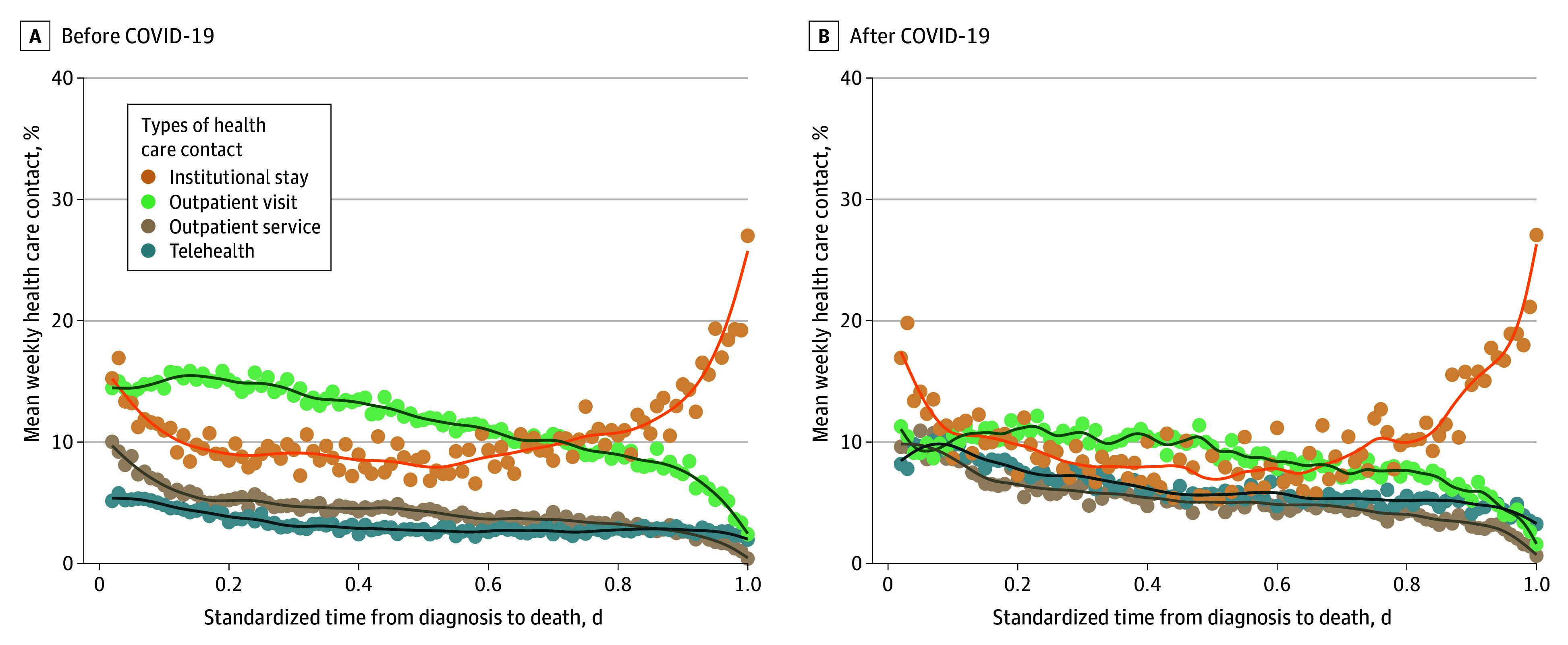
Results: The study included 9643 patients (median [IQR] age, 74 [66-81] years; 5119 men [53.1%]), with 6558 in the pre-COVID-19 group and 3085 in the post-COVID-19 group. Patients spent a median 32.5% (IQR, 21%-50.0%) of their days in contact with the health care system. In the post-COVID-19 group, in-person outpatient visits decreased (adjusted prevalence ratio [APR], 0.71; 95% CI, 0.69-0.74), while telehealth increased (APR, 2.01; 95% CI, 1.94-2.07). Overall contact days increased slightly (APR, 1.04; 95% CI, 1.02-1.07), as did emergency department and/or acute inpatient days (APR, 1.09; 95% CI, 1.04-1.15).
Conclusions and relevance: In this cohort study of patients with advanced cancer, time toxicity remained high in the postpandemic era. Although telehealth increased, so did emergency department visits and hospitalizations. These findings highlight the need to integrate telehealth into time toxicity assessments to optimize patient-centered end-of-life care.
Conflict of interest statement
Figures
Comment in
References
Publication types
MeSH terms
LinkOut - more resources
Full Text Sources
Medical
Miscellaneous
