


Desiccation tolerant yet short-lived seeds: A conundrum for post-harvest handling of a high restoration value bunchgrass?
- PMID: 40540466
- PMCID: PMC12180627
- DOI: 10.1371/journal.pone.0326596
Desiccation tolerant yet short-lived seeds: A conundrum for post-harvest handling of a high restoration value bunchgrass?
Abstract
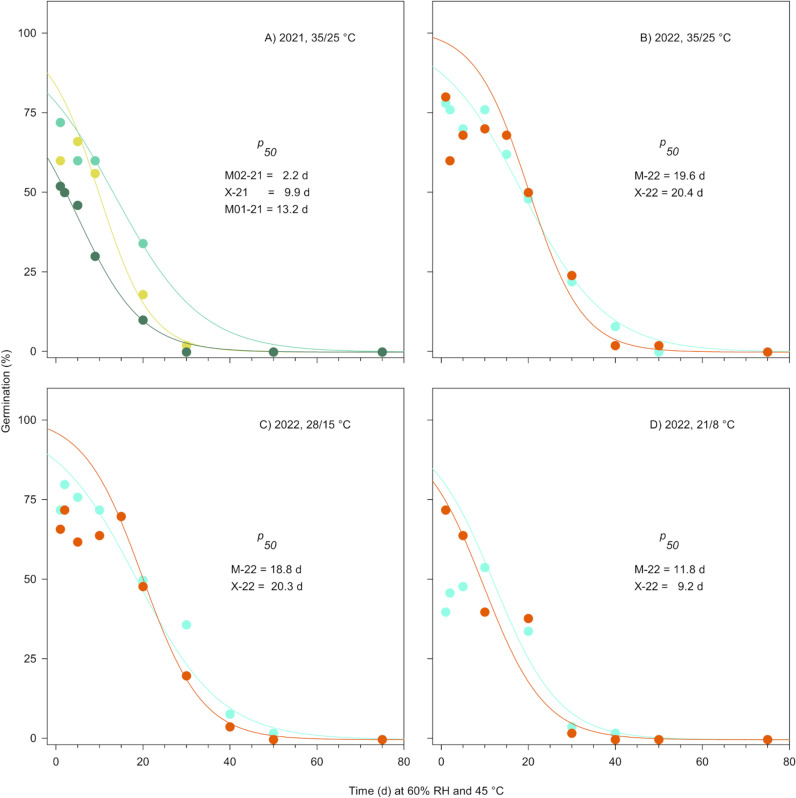
The successful preservation of seeds for future use depends on factors that maintain or limit seed viability. Yet, seed biology knowledge that would facilitate seed storage of most wild species used in ecosystem restoration is absent. This study characterized changes in seed water content, germination, desiccation tolerance, and relative storage longevity of Aristida beyrichiana (wiregrass), a focal restoration species, with respect to habitat of collection. We collected mature seeds from mesic and xeric habitats over two years then exposed these to desiccation stress sufficient for germplasm storage and aging stress (60% relative humidity, 45°C). We followed each method with germination assays at simulated seasonal temperatures. We analyzed germination responses along with production of normal and abnormal seedlings. We then modeled potential seed longevity and compared this against longevity of reference species. We found that wiregrass seeds display sufficient desiccation tolerance for ex situ storage and germinate preferentially under spring or fall and summer temperature conditions. The negligible to small effects of ecotype on these responses do not support the hypothesis that habitat of occurrence represents an adequate predictor of desiccation tolerance or germination response. However, seeds from both xeric and mesic habitats are estimated to be short-lived in storage. The contradiction between high desiccation tolerance yet short-lived nature of seeds implies that proper post-harvest seed handling, particularly regarding seed moisture management, is critical for maintaining seed viability. Further implications of this interesting seed physiology are discussed in the context of restoration.
Copyright: © 2025 Tevlin et al. This is an open access article distributed under the terms of the Creative Commons Attribution License, which permits unrestricted use, distribution, and reproduction in any medium, provided the original author and source are credited.
Conflict of interest statement
The authors have declared that no competing interests exist.
Figures
References
-
- Breed M, Stead M, Ottewell K, Gardner M, Lowe A. Which provenance and where? Seed sourcing strategies for revegetation in a changing environment. Conserv Genet. 2013;14:1–10.
-
- Hufford KM, Mazer SJ. Plant ecotypes: genetic differentiation in the age of ecological restoration. Trends in Ecology & Evolution. 2003;18(3):147–55. doi: 10.1016/s0169-5347(03)00002-8 - DOI
-
- McKay JK, Christian CE, Harrison S, Rice KJ. “How Local Is Local?”—A Review of Practical and Conceptual Issues in the Genetics of Restoration. Restor Ecol. 2005;13(3):432–40. doi: 10.1111/j.1526-100x.2005.00058.x - DOI
-
- DeVitis M, Hay F, Dickie J, Trivedi C, Choi J, Fiegener R. Seed storage: maintaining seed viability and vigor for restoration use. Restor Ecol. 2020;28:S249–55.
MeSH terms
Substances
LinkOut - more resources
Full Text Sources
