


Efficient endogenous protein labelling in Dictyostelium using CRISPR/Cas9 knock-in and split fluorescent proteins
- PMID: 40540504
- PMCID: PMC12180633
- DOI: 10.1371/journal.pone.0326577
Efficient endogenous protein labelling in Dictyostelium using CRISPR/Cas9 knock-in and split fluorescent proteins
Abstract
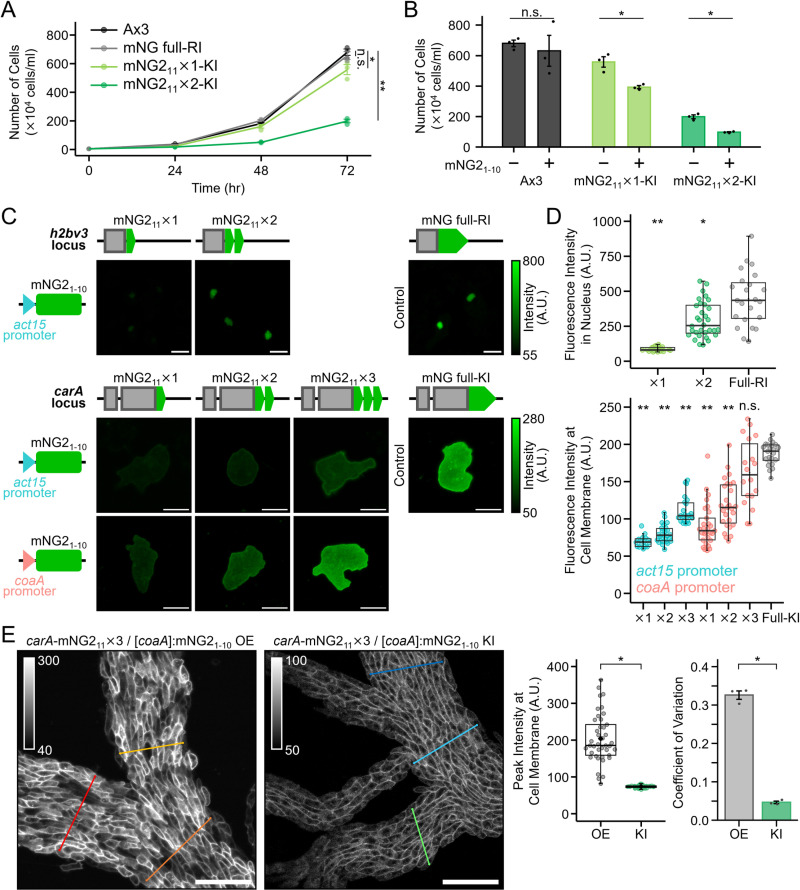
Fluorescent protein tagging is a powerful technique for visualising protein dynamics; however, full-length fluorescent protein knock-in can be inefficient at certain genomic loci, making it challenging to achieve stable and uniform expression. To address this issue, we used CRISPR/Cas9-mediated knock-in strategies with split fluorescent proteins in Dictyostelium discoideum. This approach enabled efficient integration of the short mNeonGreen2 (mNG2) fragment, mNG211, particularly at functionally critical loci such as major histone h2bv3, where full-length tagging was unsuccessful. Our analysis revealed that inserting tandem repeats of mNG211 at the h2bv3 locus progressively impaired cell proliferation, indicating that functional disruption depends on insert size. These findings suggest that using short tags like mNG211 minimises functional interference and facilitates knock-in at sensitive loci. We further optimised the fluorescence intensity by fine-tuning the expression of the long fragment, mNG21-10, and introducing tandem repeats of mNG211. This approach provides a reliable method for precise and stable endogenous protein labelling, facilitating live-cell imaging and functional studies in D. discoideum.
Copyright: © 2025 Yamashita, Muramoto. This is an open access article distributed under the terms of the Creative Commons Attribution License, which permits unrestricted use, distribution, and reproduction in any medium, provided the original author and source are credited.
Conflict of interest statement
The authors have declared that no competing interests exist.
Figures
References
MeSH terms
Substances
LinkOut - more resources
Full Text Sources
