


Participatory Intervention Development of a Peer-Guided Self-Help App for Anxiety Disorders: Mixed Methods Study
- PMID: 40540739
- PMCID: PMC12228002
- DOI: 10.2196/62781
Participatory Intervention Development of a Peer-Guided Self-Help App for Anxiety Disorders: Mixed Methods Study
Abstract
Background: Anxiety disorders affect approximately 27% of the global population, posing a major mental health challenge. Limited access to treatment due to resource constraints highlights the need for scalable solutions. Web-based self-help programs provide low-threshold access to evidence-based strategies. When guided by peers, these programs enhance engagement and acceptability by merging autonomy with support. Peer-guided self-help apps offer a cost-effective alternative to traditional care, reaching those who might otherwise remain untreated.
Objective: This study aims to describe the development of a peer-guided self-help app for anxiety, incorporating input from individuals with lived experience. It assesses user feedback on usability and helpfulness during the development process.
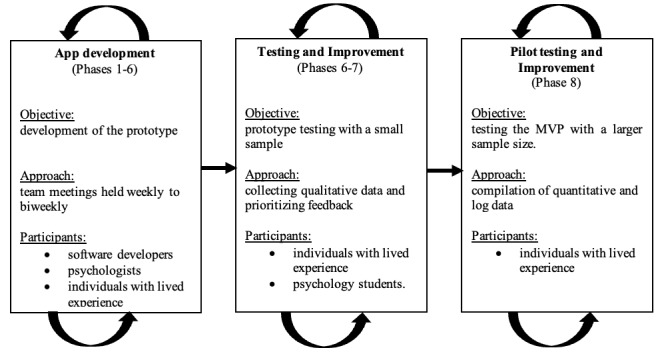
Methods: The intervention was developed in 3 iterative stages using the integrate, design, assess, and share framework. In stage 1, a prototype was cocreated by employees of a German self-help organization with lived experience, software engineers, and psychologists. In stage 2, qualitative feedback was collected from a focus group (n=5) and interviews (n=4), with participants recruited through group leaders of the organization. The research team directly contacted the participants. Qualitative data were analyzed with inductive and deductive content analysis (interrater reliability Cohen κ=0.88), which informed the minimum viable product (MVP) development. In stage 3, the MVP was pilot-tested with a larger online sample (N=126) recruited via the organization's website, accessible to all. Anxiety (Generalized Anxiety Disorder-7) and well-being (the World Health Organization-Five Well-Being Index) were assessed at baseline, 4, 8, and 12 weeks. Use metrics (eg, log-ins, time spent, and feature use) were recorded automatically. Quantitative data were analyzed descriptively.
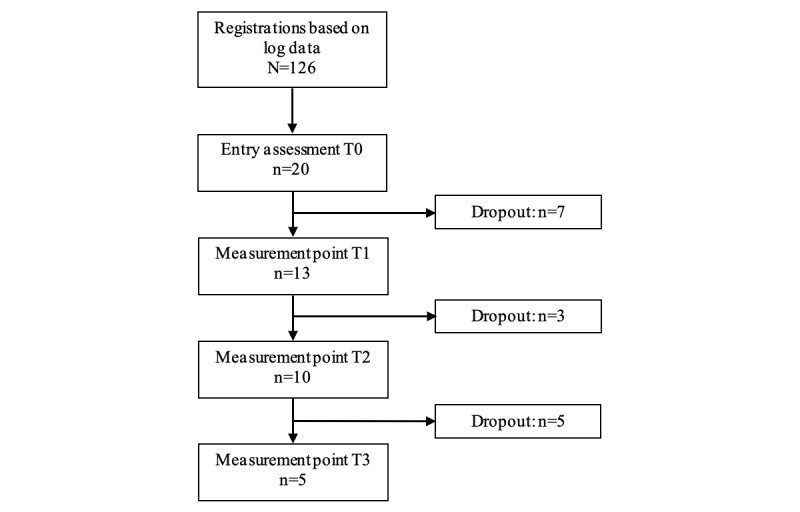
Results: Stage 1 produced no data. In stage 2, feedback revealed unclear functionality, confusion in peer interaction, and safety concerns, leading to MVP revisions. In stage 3 (N=126), engagement was low-average log-ins were 3.15 (SD 14.37), with only 20 (SD 15.9) participants completing follow-ups. While many joined exposure (79/126, 62.7%) or activity scheduling groups (104/126, 82.5%), 123 (98.4%) did not send messages, undermining peer support goals. Baseline scores showed moderate anxiety (Generalized Anxiety Disorder-7: mean 10.52, SD 5.15), low well-being (World Health Organization-Five Well-Being Index: mean 15.80, SD 6.17), and low social support (Oslo Social Support Scale-3: mean 7.25, SD 2.68), consistent with the target group. Low engagement and high attrition indicated usability problems and limited perceived value.
Conclusions: Despite rapid sign-ups, user engagement was low and dropout rates high, indicating poor acceptance. Key barriers included user confusion, underused peer features, and technical issues. Future development should include structured onboarding for better clarity. Peer engagement be improved with prompts and enhanced safety perception. The participatory approach was challenging and fell short of expectations. Smaller testing phases with regular user feedback will ensure user-centered refinement. Insights from successful peer communities can inform a more intuitive, engaging design.
Keywords: anxiety self-management; digital mental health intervention; integrate, design, assess, and share framework; participatory design; peer-guided self-help; qualitative usability study; user engagement.
©Laura Duddeck, Timo Stolz, Christian Zottl, Thomas Berger, Johanna Boettcher. Originally published in JMIR Formative Research (https://formative.jmir.org), 20.06.2025.
Conflict of interest statement
Conflicts of Interest: TS owns the software development company responsible for the app’s technical development. He acknowledges a potential conflict of interest due to personal and financial stakes in the product’s commercialization and sale. To ensure the integrity and objectivity of the research, TS did not participate in evaluating the study results. This measure was taken to minimize potential biases and maintain the scientific validity of the findings. The development and analysis phases were conducted with a commitment to transparency, aiming to disclose any factors that could influence the interpretation of the data or the recommendations provided. While future commercialization remains a possibility, the primary motivation behind this work is to enhance scientific understanding and improve mental health treatment options. TS has voluntarily refrained from any commercial use of the researched minimum viable product. All other authors declare no conflicts of interest.
Figures
Similar articles
-
Participation in environmental enhancement and conservation activities for health and well-being in adults: a review of quantitative and qualitative evidence.Cochrane Database Syst Rev. 2016 May 21;2016(5):CD010351. doi: 10.1002/14651858.CD010351.pub2. Cochrane Database Syst Rev. 2016. PMID: 27207731 Free PMC article.
-
Computer and mobile technology interventions for self-management in chronic obstructive pulmonary disease.Cochrane Database Syst Rev. 2017 May 23;5(5):CD011425. doi: 10.1002/14651858.CD011425.pub2. Cochrane Database Syst Rev. 2017. PMID: 28535331 Free PMC article.
-
Needs and Expectations for the myNewWay Blended Digital and Face-to-Face Psychotherapy Model of Care for Depression and Anxiety (Part 1): Participatory Design Study including People with Lived and Living Experience.JMIR Hum Factors. 2025 Jun 11;12:e69499. doi: 10.2196/69499. JMIR Hum Factors. 2025. PMID: 40499157 Free PMC article.
-
An Image-Recognition Dietary Assessment App for Adolescents With Obesity: Pilot Randomized Controlled Trial.JMIR Form Res. 2024 Dec 2;8:e58682. doi: 10.2196/58682. JMIR Form Res. 2024. PMID: 39621405 Free PMC article. Clinical Trial.
-
A Mobile App (Joint Effort) to Support Cannabis Use Self-Management and Reinforce the Use of Protective Behavioral Strategies: Development Process and Usability Testing.JMIR Form Res. 2025 Jun 23;9:e71924. doi: 10.2196/71924. JMIR Form Res. 2025. PMID: 40550117 Free PMC article.
References
-
- Nochaiwong S, Ruengorn C, Thavorn K, Hutton B, Awiphan R, Phosuya C, Ruanta Y, Wongpakaran N, Wongpakaran T. Global prevalence of mental health issues among the general population during the coronavirus disease-2019 pandemic: a systematic review and meta-analysis. Scientific Reports. 2021 May 13;11(1):10173. doi: 10.1038/s41598-021-89700-8. https://doi.org/10.1038/s41598-021-89700-8 10.1038/s41598-021-89700-8 - DOI - DOI - PMC - PubMed
-
- BPtK - Newsletter. Bundes Psychotherapeuten Kammer. 2022. Feb, [2022-10-05]. https://api.bptk.de/uploads/B_Pt_K_Newsletter_02_2022_615a6efb95.pdf .
-
- Burke E, Pyle M, Machin K, Varese F, Morrison AP. The effects of peer support on empowerment, self-efficacy, and internalized stigma: a narrative synthesis and meta-analysis. Stigma Health. 2019 Aug;4(3):337–56. doi: 10.1037/sah0000148. - DOI
MeSH terms
LinkOut - more resources
Full Text Sources
Medical
Miscellaneous
