


Comparison of periarticular injection and low-concentration high-volume suprainguinal fascia Iliaca plane block in total knee arthroplasty: a randomized prospective study
- PMID: 40542872
- PMCID: PMC12182502
- DOI: 10.1007/s00402-025-05962-1
Comparison of periarticular injection and low-concentration high-volume suprainguinal fascia Iliaca plane block in total knee arthroplasty: a randomized prospective study
Abstract
Background: The suprainguinal fascia iliaca plane block (SFIPB) has been used effectively for postoperative analgesia in hip surgeries due to its extensive dermatomal coverage. This technique may also serve as an alternative in knee surgeries. However, studies investigating the use of SFIPB in total knee arthroplasty (TKA) are limited. This study evaluates the efficacy of SFIPB compared to periarticular infiltration (PAI) in TKA, focusing on postoperative opioid consumption, pain scores, motor function, and rehabilitation outcomes.
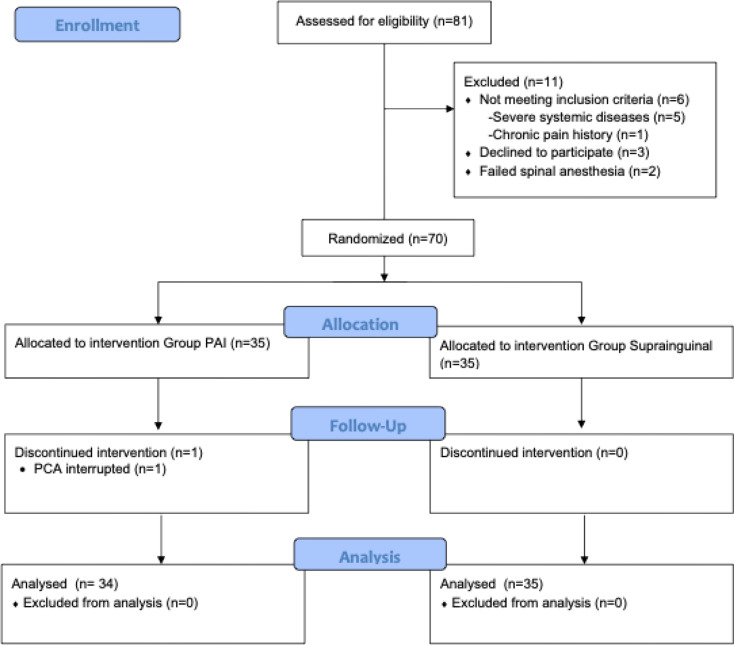
Methods: This randomized controlled trial included 70 patients undergoing TKA, allocated to either the SFIPB group or the PAI group. Postoperative pain management was standardized across groups using patient-controlled fentanyl analgesia. Primary outcomes included opioid consumption over 48 h, and secondary outcomes assessed pain scores, quadriceps strength, mobilization times, range of motion (ROM), and rehabilitation test results.
Results: SFIPB resulted in significantly reduced opioid consumption at 24 and 48 h compared to PAI (p < 0.001). Pain scores assessed via visual analogue scale (VAS) were lower in the SFIPB group, particularly for anterior knee pain during rest and movement (p < 0.05). SFIPB also demonstrated superior rehabilitation outcomes, with improved quadriceps strength (p = 0.002) and better performance on the Time Up and Go (TUG) test. Both groups reported minimal side effects, but opioid-related nausea and vomiting were less frequent in the SFIPB group.
Conclusion: The use of SFIPB with a dilute, high-volume local anesthetic was superior to PAI by reducing opioid consumption and opioid-related side effects without impairing motor function or patient mobilization. This highlights its potential as an effective analgesic technique in TKA.
Keywords: Periarticular infiltration; Suprainguinal fascia Iliaca plane block; Total knee arthroplasty.
© 2025. The Author(s).
Conflict of interest statement
Declarations. Competing interests: The authors declare no competing interests.
Figures
References
-
- Kumar K, Pandey RK, Bhalla AP, Kashyap L, Garg R, Darlong V et al (2015) Comparison of conventional infrainguinal versus modified proximal suprainguinal approach of fascia Iliaca compartment block for postoperative analgesia in total hip arthroplasty. A prospective randomized study. Acta Anaesthesiol Belg 66:95–100 - PubMed
-
- Kefeli Çelik H, Tulgar S, Güler S, Koç K, Küçükordulu BB, Ferli RB et al (2023) Evaluation of postoperative analgesic efficacy of Ultrasound-Guided suprainguinal fascia Iliaca block in knee arthroplasty: prospective, randomized, feasibility study. J Clin Med. 10.3390/jcm12186076 - DOI - PMC - PubMed
Publication types
MeSH terms
Substances
LinkOut - more resources
Full Text Sources
Medical
