


Association of sleep duration and sleep quality with cognitive frailty in Chinese older adults
- PMID: 40547463
- PMCID: PMC12178879
- DOI: 10.3389/fpubh.2025.1596965
Association of sleep duration and sleep quality with cognitive frailty in Chinese older adults
Abstract
Objective: To explore the relationship between sleep duration, sleep quality and the occurrence of cognitive frailty in the older adults.
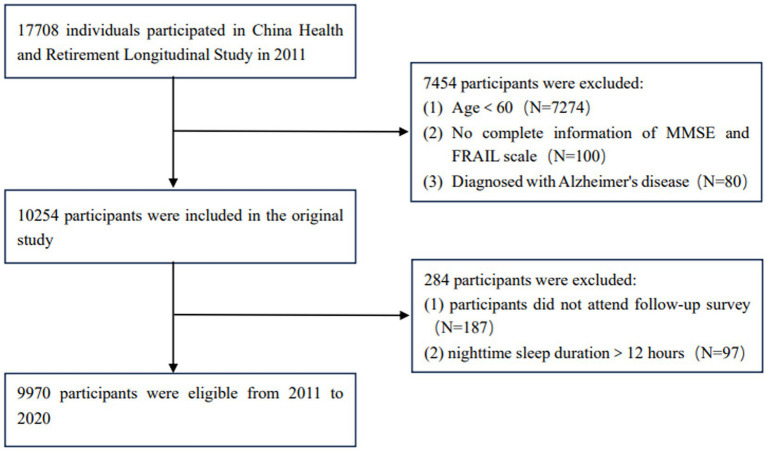
Methods: A total of 9,970 participates were screened in China over the past 9 years. They were divided into cognitive frailty group and non-cognitive frailty groups, and they were evaluated for sleep duration and sleep quality and their relationship with cognitive frailty was analyzed. If interactions are found, further hierarchical analysis is conducted.
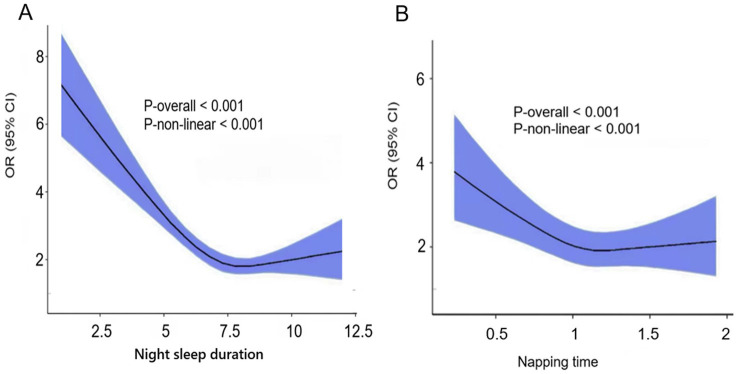
Results: One thousand six hundred eighty-four participants (16.89%) were diagnosed with cognitive frailty. Participants with cognitive frailty were more likely to be "unmarried," live in rural areas, and were female, with no social activity in the last month. Poor sleep quality, short sleep duration, no napping, and excessive napping are at high risk of cognitive frailty. There was a significant interaction between daytime napping and sleep duration and sleep quality. Among participants with good sleep quality, those who took excessive naps had a 123% increased risk of developing cognitive frailty, with an OR of 2.23 (95% CI: 1.72, 2.86). In the subgroup with sleep duration > 9 h, participants who napped excessively had a significantly increased risk of cognitive frailty (OR = 1.62, 95% CI 1.14-2.30, p < 0.001).
Conclusion: Chinese older adults with poor sleep quality are at a 67% higher risk of cognitive weakness, and individuals with less than 6 h of sleep are at a 48% higher risk of cognitive weakness; No napping and excessive napping, the risk of cognitive debilitation increased by 23 and 69%, respectively. There is an additive interaction between sleep duration and quality and daytime napping on cognitive frailty in the older adults.
Keywords: cognitive frailty; napping time; risk factor; sleep duration; sleep quality.
Copyright © 2025 Qian, Yu and Zhang.
Conflict of interest statement
The authors declare that the research was conducted in the absence of any commercial or financial relationships that could be construed as a potential conflict of interest.
Figures
References
-
- Foreman KJ, Marquez N, Dolgert A. Forecasting life expectancy, years of life lost, and all-cause and cause-specific mortality for 250 causes of death: reference and alternative scenarios for 2016-40 for 195 countries and territories. Lancet. (2018) 392:2052–90. doi: 10.1016/S0140-6736(18)31694-5, PMID: - DOI - PMC - PubMed
-
- Office of the Leading Group for the Seventh National Population Census of the State Council . Main data of the 7th National Population Census in 2020. Beijing: China Statistics Press; (2021).
-
- Avila-Funes JA, Amieva H, Barberger-Gateau P, Le Goff M, Raoux N, Ritchie K, et al. Cognitive impairment improves the predictive validity of the phenotype of frailty for adverse health outcomes: the three-city study. J Am Geriatr Soc. (2009) 57:453–61. doi: 10.1111/j.1532-5415.2008.02136.x, PMID: - DOI - PubMed
MeSH terms
Supplementary concepts
LinkOut - more resources
Full Text Sources
Medical
Miscellaneous
