


Impact of social isolation on mental health changes by socio-economic status: A moderated mediation analysis among non-migrant, migrant, and refugee subpopulations in Germany, 2016-2020
- PMID: 40547598
- PMCID: PMC12182342
- DOI: 10.1016/j.ssmph.2025.101822
Impact of social isolation on mental health changes by socio-economic status: A moderated mediation analysis among non-migrant, migrant, and refugee subpopulations in Germany, 2016-2020
Abstract
Background: Populations experiencing precarity face heightened mental health inequities, especially during crises. In this regard, it is established that socio-economic status (SES) and social isolation are critical factors influencing mental health outcomes, which interact syndemically. Understanding their interrelated mechanisms is crucial for developing effective public health strategies to support populations experiencing precarity in future crises.
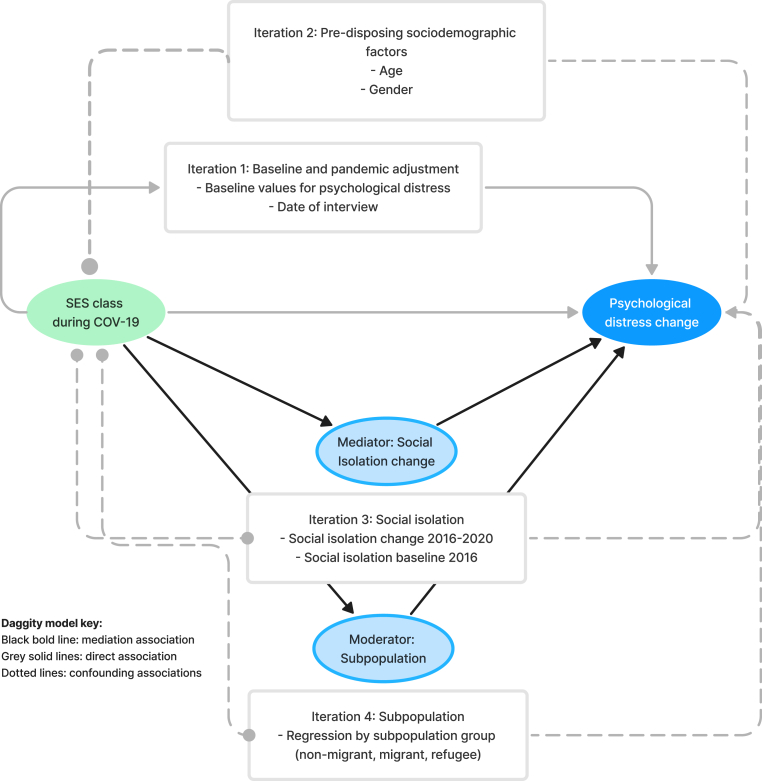
Methods: Data from the German Socio-Economic Panel (2016-2020) were analysed in a longitudinal design. A moderated mediation analysis examined the effect of SES on mental health (PHQ4) prior to and during the pandemic, with social isolation change as mediator and migration status as moderator, distinguishing non-migrant (n = 3841), migrant (n = 766), and refugee (n = 331) subpopulations. The model was adjusted using month of interview, baseline PHQ-4 scores, age, gender, and baseline social isolation.
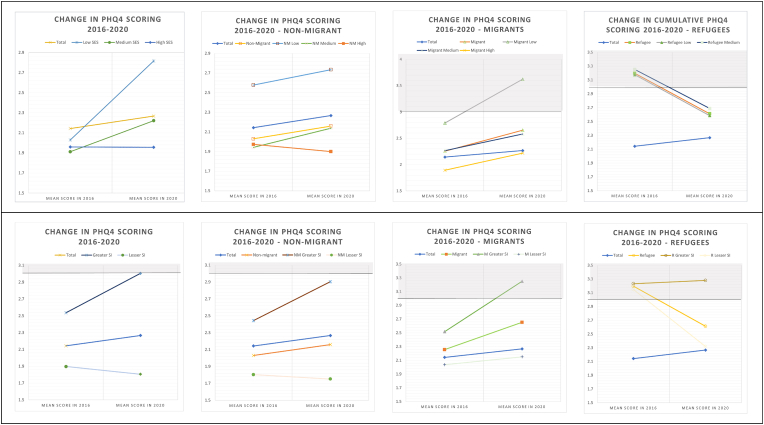
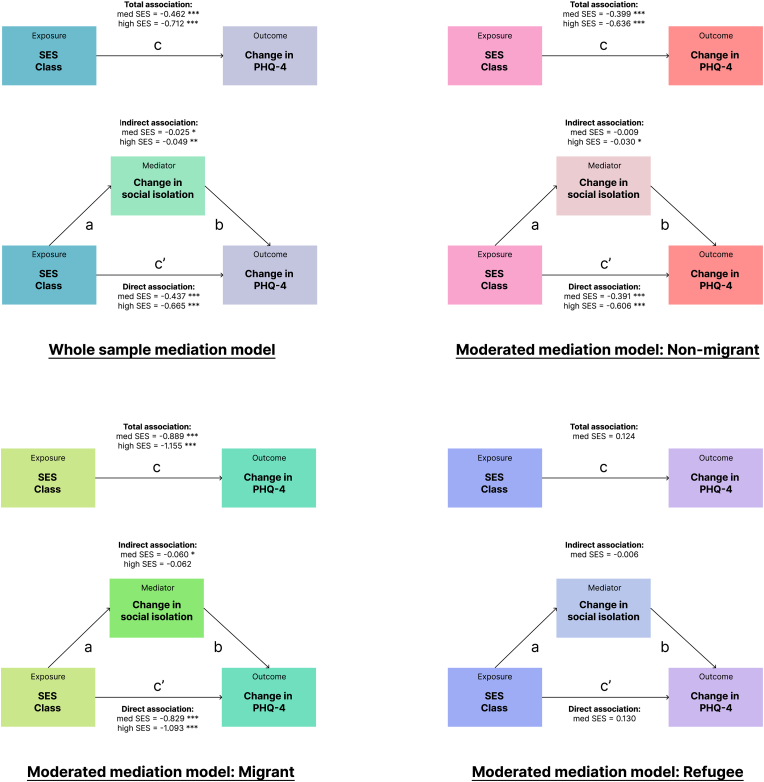
Results: High SES was linked to smaller mental health declines compared to low SES (β = -0.635, 95 % CI: -0.822, -0.447). This effect was partially mediated by change in social isolation (-0.049, 95 % CI: -0.082, -0.015). The mediation effect was weaker in non-migrant (-0.030, 95 % CI: -0.066, 0.005) and non-significant in migrant subpopulations (-0.062, 95 % CI: -0.157, 0.034). For refugees, SES effects were non-significant, with baseline and changes in social isolation playing a more critical role.
Findings: SES and social isolation critically influenced mental health changes, with substantial variability across subpopulations. Targeted interventions addressing SES inequities and fostering social connections are essential for mitigating mental health disparities, particularly among low SES groups, migrants, and refugees.
Keywords: COVID-19; Mental health; Migration status; Social isolation; Socio-economic status.
© 2025 The Authors.
Conflict of interest statement
The authors have no conflicts of interest to declare.
Figures

Similar articles
-
Home treatment for mental health problems: a systematic review.Health Technol Assess. 2001;5(15):1-139. doi: 10.3310/hta5150. Health Technol Assess. 2001. PMID: 11532236
-
Psychosocial interventions for supporting women to stop smoking in pregnancy.Cochrane Database Syst Rev. 2017 Feb 14;2(2):CD001055. doi: 10.1002/14651858.CD001055.pub5. Cochrane Database Syst Rev. 2017. PMID: 28196405 Free PMC article.
-
Measures implemented in the school setting to contain the COVID-19 pandemic.Cochrane Database Syst Rev. 2022 Jan 17;1(1):CD015029. doi: 10.1002/14651858.CD015029. Cochrane Database Syst Rev. 2022. Update in: Cochrane Database Syst Rev. 2024 May 2;5:CD015029. doi: 10.1002/14651858.CD015029.pub2. PMID: 35037252 Free PMC article. Updated.
-
Economic Deterioration and Social Factors Affecting Mental Health During the COVID-19 Pandemic in Japan: Web-Based Cross-Sectional Survey.JMIR Form Res. 2025 Jun 10;9:e65204. doi: 10.2196/65204. JMIR Form Res. 2025. PMID: 40493773 Free PMC article.
-
Barriers and facilitators to access mental health services among refugee women in high-income countries: a systematic review.Syst Rev. 2022 Apr 6;11(1):62. doi: 10.1186/s13643-022-01936-1. Syst Rev. 2022. PMID: 35387680 Free PMC article.
References
-
- Alarcão V., Virgolino A., Stefanovska-Petkovska M., Neves J. Exploring the effects of the COVID-19 pandemic on mental health and well-being of migrant populations in europe: An equity-focused scoping review. Behavioral Sciences. 2022;12(10):393. doi: 10.3390/bs12100393. [Online] - DOI - PMC - PubMed
-
- Benke C., Asselmann E., Entringer T.M., Pané-Farré C.A. The role of pre-pandemic depression for changes in depression, anxiety, and loneliness during the COVID-19 pandemic: Results from a longitudinal probability sample of adults from Germany. European Psychiatry. 2022;65(1):e76. doi: 10.1192/j.eurpsy.2022.2339. [Online] - DOI - PMC - PubMed
LinkOut - more resources
Full Text Sources
