


Carbohydrate-Deficient Transferrin Evaluation Over Time Has Usefulness for Confirming Sobriety of Alcohol Rehabilitation Program Patients
- PMID: 40547817
- PMCID: PMC12179798
- DOI: 10.1002/jgh3.70185
Carbohydrate-Deficient Transferrin Evaluation Over Time Has Usefulness for Confirming Sobriety of Alcohol Rehabilitation Program Patients
Abstract
Background: For treating severe alcohol-related liver disease (ALD), abstinence from alcohol is essential. Because underreporting can occur, abstinence biomarkers are necessary during hepatology outpatient service. This study assesses whether serial changes of the serum carbohydrate-deficient transferrin to transferrin ratio (%CDT) reflect patient abstinence.
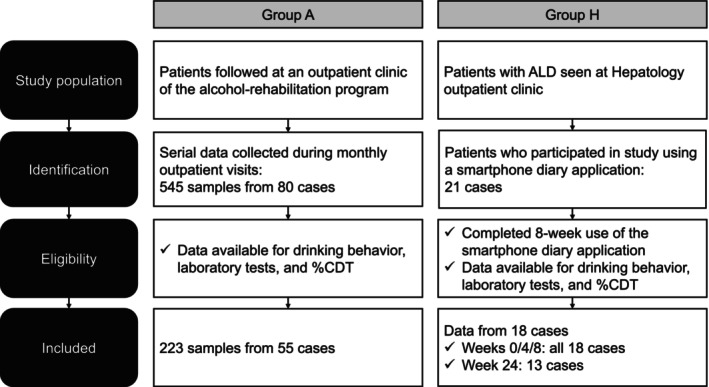
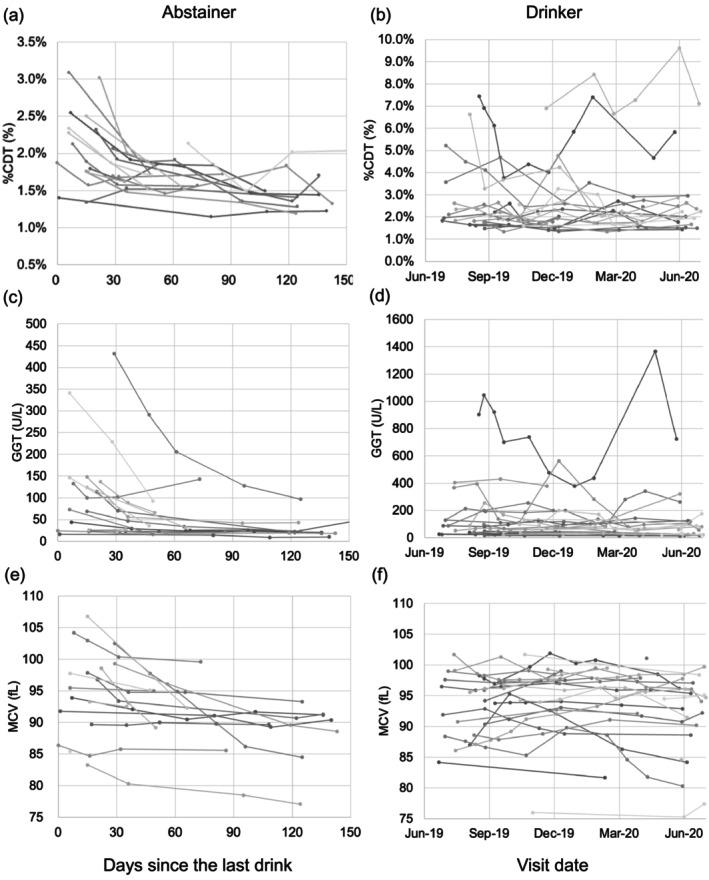
Methods: We retrospectively investigated serial %CDT measurements and laboratory data from two outpatient settings: patients in an alcohol rehabilitation program (A), and ALD patients at a hepatology clinic (H) who attempted abstinence with self-diary monitoring. Using group A data, correlation coefficients were determined between the number of days from the last drink (abstinence days) and laboratory data. Linear approximation was applied for significant coefficients. Using these results, %CDT was validated for group H.
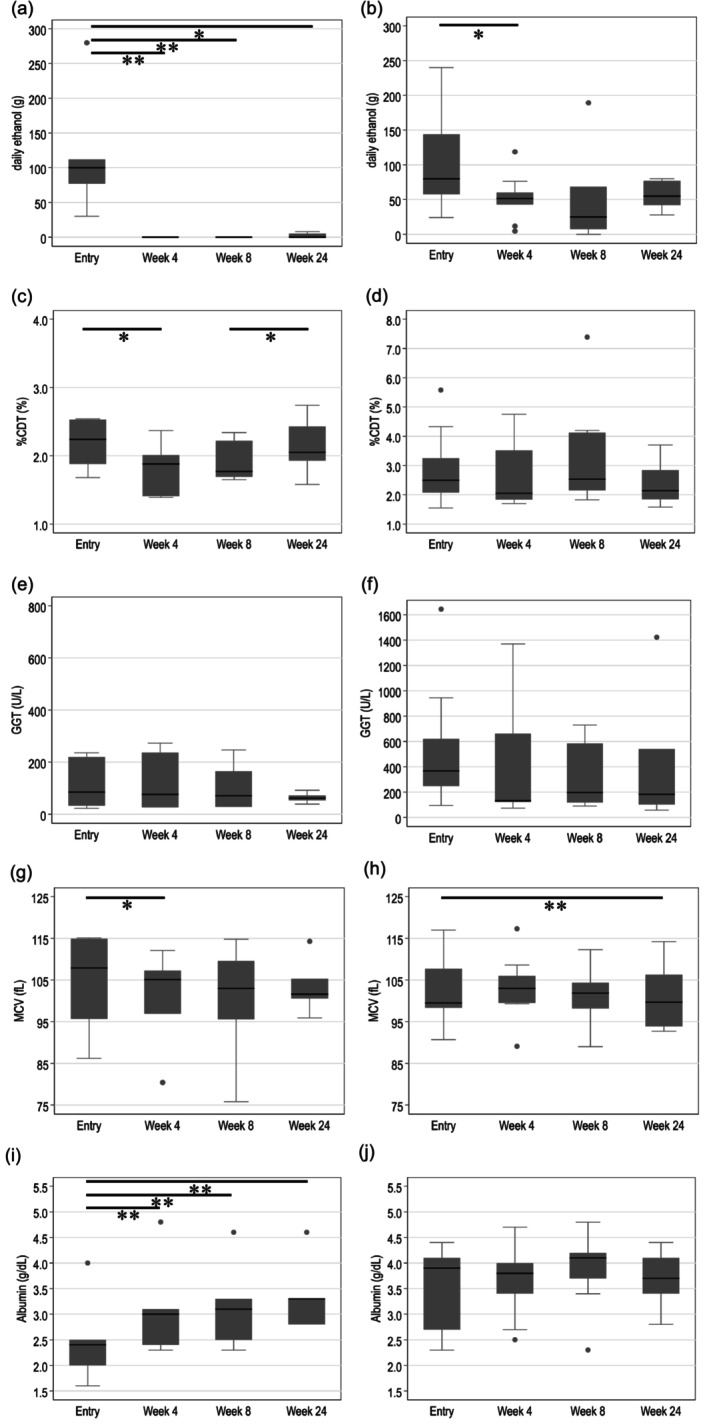
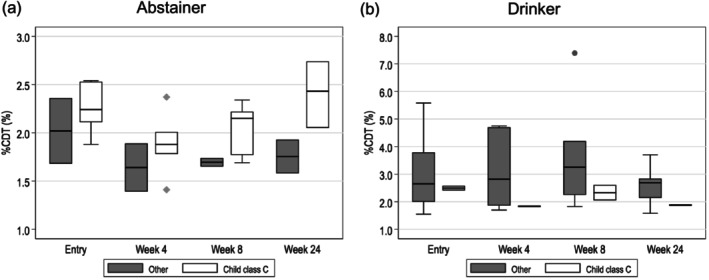
Results: Group A data were 223 data samples from 55 cases with abstinence days. Four (7%) were diagnosed as having cirrhosis. Eighteen patients continued abstinence over 30 days. %CDT (Rho = -0.50, p < 0.001) and GGT (Rho = -0.34, p < 0.01) were negatively correlated with abstinence days. For %CDT, negative linear approximation was maintained with the number of days (y = 2.01-0.004 x).Group H data were 18 cases, of which 12 (66%) were diagnosed as cirrhosis cases. Seven patients reported continued abstinence for 8 weeks, during which time %CDT values dropped significantly. The group H %CDT was higher than the group A %CDT, perhaps because of severer liver disease.
Conclusion: The %CDT trend assessment is useful to support continued, multi-month self-reported abstinence from alcohol, but it must be interpreted carefully in severe liver disorder cases.
Keywords: alcohol use disorder; ambulatory care; liver cirrhosis.
© 2025 The Author(s). JGH Open published by Journal of Gastroenterology and Hepatology Foundation and John Wiley & Sons Australia, Ltd.
Conflict of interest statement
The authors declare no conflicts of interest.
Figures

References
-
- Umeshita K., Eguchi S., Egawa H., et al., “Liver Transplantation in Japan: Registry by the Japanese Liver Transplantation Society,” Hepatology Research 49, no. 9 (2019): 964–980. - PubMed
-
- Younossi Z. M., Wong G., Anstee Q. M., and Henry L., “The Global Burden of Liver Disease,” Clinical Gastroenterology and Hepatology 21, no. 8 (2023): 1978–1991. - PubMed
LinkOut - more resources
Full Text Sources
Miscellaneous
