


Correlation between serum advanced glycation end-products and their receptor-mediated oxidative stress and perinatal outcomes in gestational diabetes mellitus
- PMID: 40548277
- PMCID: PMC12179900
- DOI: 10.4239/wjd.v16.i6.104177
Correlation between serum advanced glycation end-products and their receptor-mediated oxidative stress and perinatal outcomes in gestational diabetes mellitus
Abstract
Background: Gestational diabetes mellitus (GDM) is one of the most prevalent metabolic disorders of pregnancy. Advanced glycation end-products (AGEs) are a complex and highly heterogeneous group of compounds formed from amino acids and reducing sugars. High-AGE diet exposure during pregnancy may cause adverse effects.
Aim: To investigate the expression levels of AGE and AGE receptor (RAGE) in the serum and placenta of pregnant women with GDM and to assess the association of their mediated oxidative stress response with perinatal outcomes.
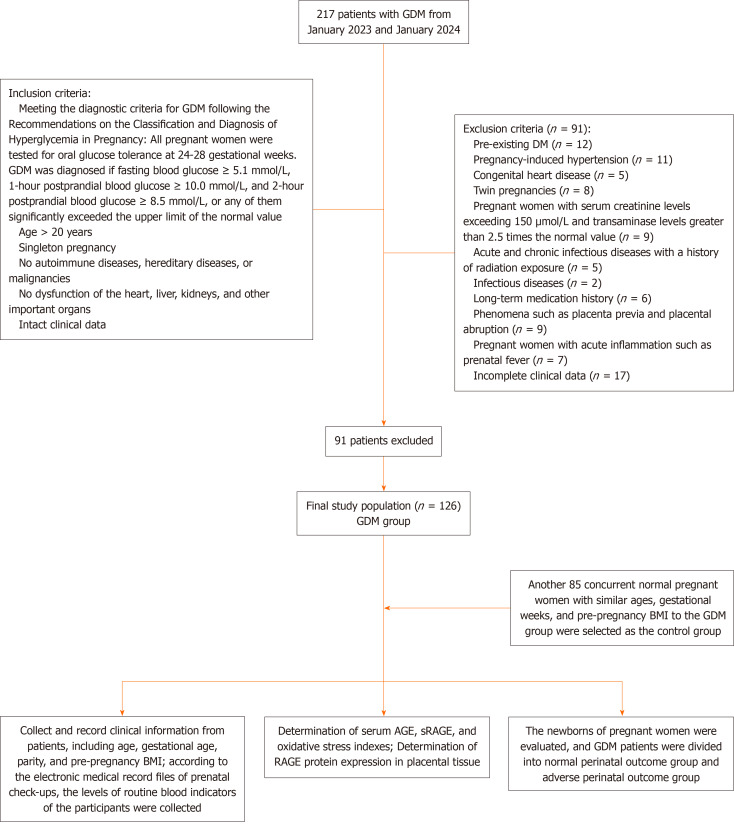
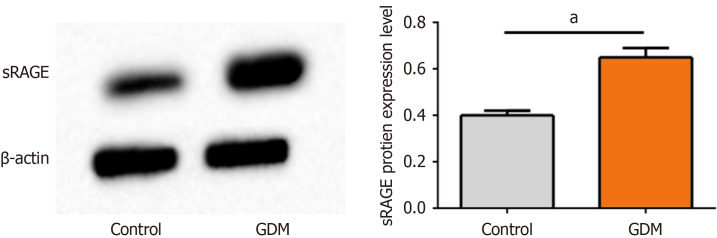
Methods: This study retrospectively analyzed the clinical data of 126 pregnant women with GDM who gave birth in the Obstetrics Department of Obstetrics and Gynecology Hospital of Fudan University from January 2023 to January 2024. A total of 85 pregnant women of similar age without GDM during the same period were selected as the control group. Fasting blood glucose, glycated hemoglobin, AGEs, soluble RAGE (sRAGE), and oxidative stress were compared in both groups. Postpartum placental tissue was collected to identify RAGE protein expression. Participants with GDM were categorized based on perinatal outcomes into normal (n = 89) and adverse perinatal outcome groups (n = 37), and differences in serum AGE-RAGE levels and oxidative stress were analyzed. The influencing factors of adverse perinatal outcomes were analyzed using logistic regression.
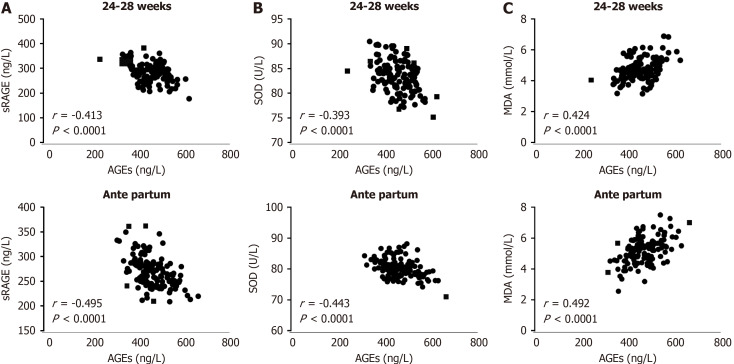
Results: The GDM group demonstrated notably higher serum AGE (t = 8.955) and malondialdehyde (MDA) levels (t = 14.14) and lower sRAGE (t = 16.37) and superoxide dismutase (SOD) levels (t = 18.50) than the control group at 24-28 weeks of gestation and before delivery (P < 0.0001). Serum AGE levels were positively correlated with MDA and negatively related to SOD at 24-28 weeks of pregnancy (SOD: r = 0.393, MDA: r = 0.424, P < 0.0001) and before delivery (SOD: r = 0.443, MDA: r = 0.492, P < 0.0001), whereas AGE was inversely associated with sRAGE in the GDM group (r = -0.495, P < 0.0001). Serum AGE levels were significantly higher (t = 9.225, P < 0.0001) and the sRAGE level (r = 3.563, P < 0.0001) was significantly lower in participants with adverse perinatal outcomes than those with normal perinatal outcomes in the GDM group. Logistic regression analysis revealed AGE level as a risk factor (OR = 1.056, P < 0.0001) and sRAGE level (OR = 0.949, P < 0.0001) as a protective factor for adverse perinatal outcomes in GDM.
Conclusion: High serum AGE level is a risk factor for adverse perinatal outcomes in GDM, whereas high sRAGE levels are protective. AGEs and RAGE may be associated with oxidative stress in pregnant women with GDM.
Keywords: Advanced glycation end-products; Fasting blood glucose; Gestational diabetes mellitus; Hemoglobin; Perinatal outcomes.
©The Author(s) 2025. Published by Baishideng Publishing Group Inc. All rights reserved.
Conflict of interest statement
Conflict-of-interest statement: There is no conflict of interest.
Figures
Similar articles
-
Screening for gestational diabetes mellitus based on different risk profiles and settings for improving maternal and infant health.Cochrane Database Syst Rev. 2017 Aug 3;8(8):CD007222. doi: 10.1002/14651858.CD007222.pub4. Cochrane Database Syst Rev. 2017. PMID: 28771289 Free PMC article.
-
Techniques of monitoring blood glucose during pregnancy for women with pre-existing diabetes.Cochrane Database Syst Rev. 2017 Jun 11;6(6):CD009613. doi: 10.1002/14651858.CD009613.pub3. Cochrane Database Syst Rev. 2017. Update in: Cochrane Database Syst Rev. 2019 May 23;5:CD009613. doi: 10.1002/14651858.CD009613.pub4. PMID: 28602020 Free PMC article. Updated.
-
Dietary advice interventions in pregnancy for preventing gestational diabetes mellitus.Cochrane Database Syst Rev. 2017 Jan 3;1(1):CD006674. doi: 10.1002/14651858.CD006674.pub3. Cochrane Database Syst Rev. 2017. PMID: 28046205 Free PMC article.
-
Lifestyle interventions for the treatment of women with gestational diabetes.Cochrane Database Syst Rev. 2017 May 4;5(5):CD011970. doi: 10.1002/14651858.CD011970.pub2. Cochrane Database Syst Rev. 2017. PMID: 28472859 Free PMC article.
-
Combined diet and exercise interventions for preventing gestational diabetes mellitus.Cochrane Database Syst Rev. 2017 Nov 13;11(11):CD010443. doi: 10.1002/14651858.CD010443.pub3. Cochrane Database Syst Rev. 2017. PMID: 29129039 Free PMC article.
References
-
- Saeedi M, Cao Y, Fadl H, Gustafson H, Simmons D. Increasing prevalence of gestational diabetes mellitus when implementing the IADPSG criteria: A systematic review and meta-analysis. Diabetes Res Clin Pract. 2021;172:108642. - PubMed
-
- Canday M. Identifying gestational diabetes mellitus and assessing risk factors in affected women: a comprehensive study. Eur Rev Med Pharmacol Sci. 2024;28:734–746. - PubMed
-
- Dewi RS, Isfandiari MA, Martini S, Chung YL. Prevalence and risk factors of gestational diabetes mellitus in Asia: a review. J Public Health Afr. 2023;14:7.
LinkOut - more resources
Full Text Sources
