Optic Nerve Invasion in Retinoblastoma: Impact of Eye Salvage and Adjuvant Chemotherapy
- PMID: 40548635
- PMCID: PMC12186835
- DOI: 10.1167/iovs.66.6.65
Optic Nerve Invasion in Retinoblastoma: Impact of Eye Salvage and Adjuvant Chemotherapy
Abstract
Purpose: Optic nerve invasion (ONI) is an important risk factor for extraocular metastasis in retinoblastoma. This study evaluates the impact of pre-enucleation chemotherapy, delayed enucleation, and adjuvant chemotherapy on survival in patients with varying degree of ONI on histopathology.
Methods: A retrospective review of consecutive enucleated eyes with any degree of ONI from 29 Chinese treatment centers 2012-2017. Children with other high-risk histopathological features, extraocular disease at diagnosis or bilateral enucleation were excluded.
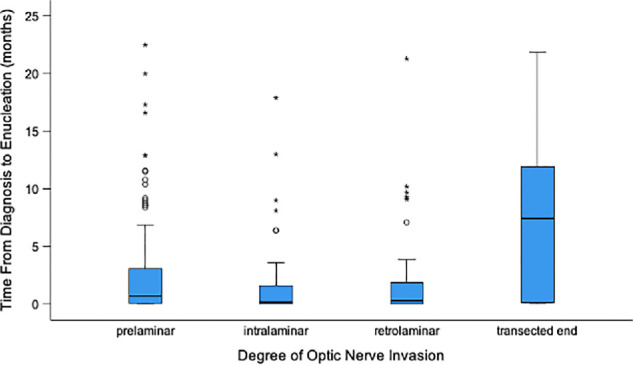
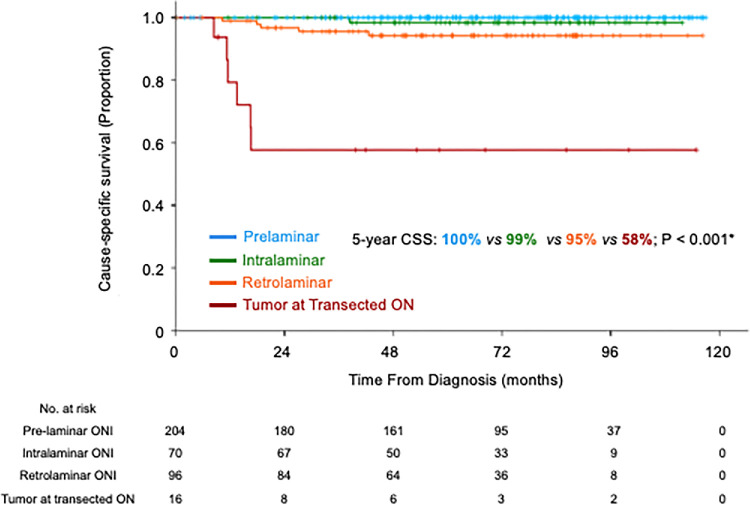
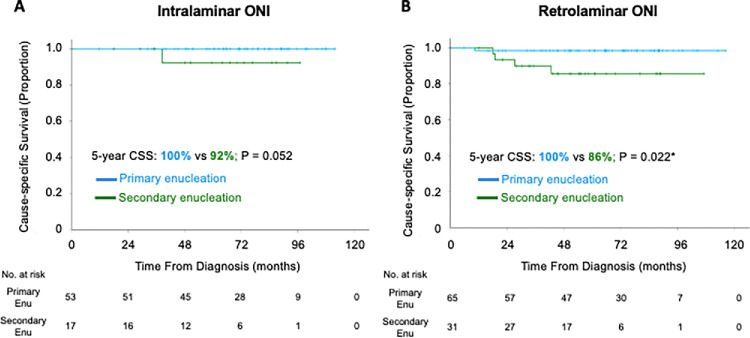
Results: Among 2500 enucleated eyes, 386 eyes with isolated ONI (one eye per child) met the inclusion criteria: prelaminar (n = 204), intralaminar (n = 70), retrolaminar without tumor at transected optic nerve (n = 96), or retrolaminar with tumor at transected end (n = 16). Primary enucleation was performed in 59% of cases, whereas 41% underwent secondary enucleation after eye salvage therapies. Delayed enucleation beyond six months from diagnosis significantly increased the likelihood of tumor at optic nerve transection (21% vs. 2%; P < 0.001). The five-year cause-specific survival (CSS) was 96.7% overall: prelaminar (100%), intralaminar (98%), retrolaminar without transected end involvement (94%), or tumor at transected optic nerve (58%). Secondarily enucleated eyes with retrolaminar ONI without transected end involvement had lower CSS than those primarily enucleated (85.6% vs. 100%; P = 0.022). The five-year CSS was higher but not statistically significant, for eyes treated with or without adjuvant chemotherapy: intralaminar ONI (100% vs. 95.7%; P = 0.193), retrolaminar ONI without tumor at transected end (100% vs. 93.5; P = 0.413), and tumor at the transected end (80.0% vs. 45.0%; P = 0.192).
Conclusions: Timely enucleation reduces the risk of tumor involvement at optic nerve transection. Delay in enucleation by pre-enucleation chemotherapy may reduce the effectiveness of subsequent adjuvant chemotherapy.
Conflict of interest statement
Disclosure:
Figures
References
-
- Magramm I, Abramson DH, Ellsworth RM.. Optic nerve involvement in retinoblastoma. Ophthalmology . 1989; 96: 217–222. - PubMed
-
- Shields CL, Shields JA, Baez K, Cater JR, De-Potter P.. Optic nerve invasion of retinoblastoma. Metastatic potential and clinical risk factors. Cancer . 1994; 73: 692–698. - PubMed
-
- Mallipatna A, Gallie BL, Chévez-Barrios P, et al.. Retinoblastoma. In: Amin MB, Edge SB, Greene FL, eds. AJCC Cancer Staging Manual . 8th ed. New York: Springer; 2017: 819–831.
Publication types
MeSH terms
LinkOut - more resources
Full Text Sources
Miscellaneous