


Wastewater monitoring allows the detection of uncommon and highly pathogenic enterovirus types
- PMID: 40548730
- PMCID: PMC12285228
- DOI: 10.1128/aem.00534-25
Wastewater monitoring allows the detection of uncommon and highly pathogenic enterovirus types
Abstract
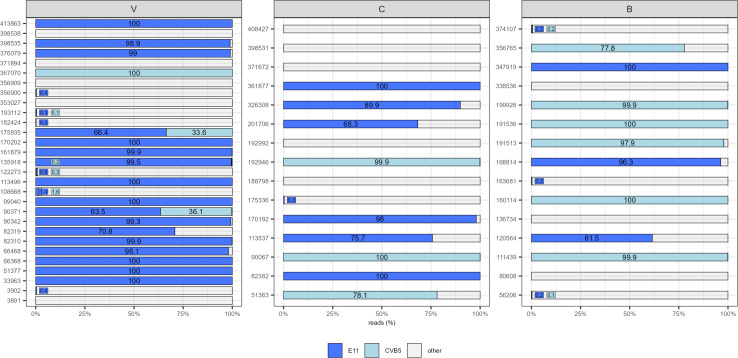
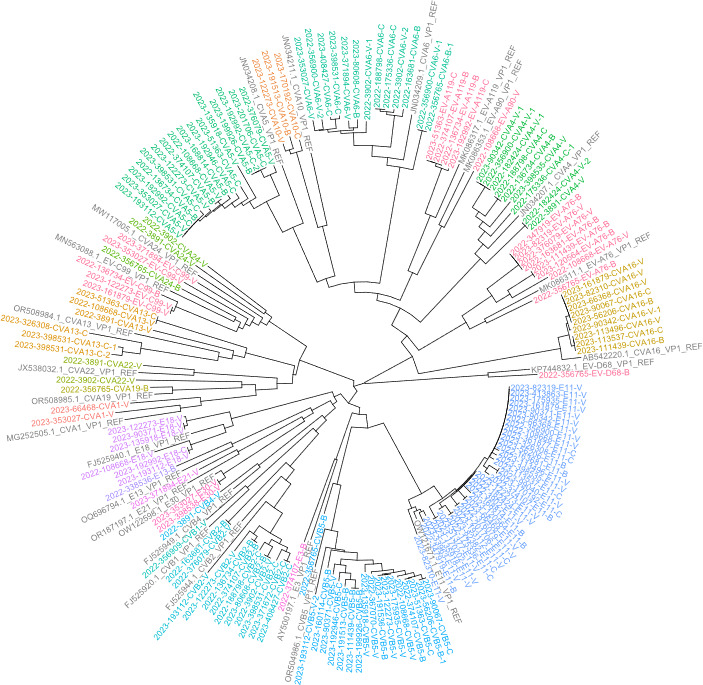
The genus Enterovirus (EV) includes small ubiquitous viruses with a single-stranded positive-RNA genome. Most EV infections are asymptomatic, but pathogenic EVs are responsible for a wide range of diseases and occasionally epidemics. The aim of the work was to monitor the distribution of EVs present in wastewater collected during the 2 year study period (2022-2023). Three hundred ninety-nine samples were received from three wastewater treatment plants of the Brescia, Cremona, and Bergamo provinces, Lombardy, Italy. One-step real-time reverse transcription-PCR screening showed positivity in 107 samples. Of these, 67 were successfully genotyped: 8 by Sanger sequencing only, 7 by next-generation sequencing metabarcoding only, and 52 by both methods. The most detected species was Enterovirus B, followed by Enterovirus A, Enterovirus C, and Enterovirus D. As many as 26 different types of non-polio EVs were identified, of which the most frequently detected were two Enterovirus B: echovirus 11 (E11) and coxsackievirus B5 (CVB5). Among Enterovirus A, the predominant types were CVA16 and CVA6. As for Enterovirus C, the types with the highest frequency were CVA13 and EV-C99; in addition, CVA24, which has been associated with outbreaks of acute hemorrhagic conjunctivitis, was found in two samples from Verziano (Brescia) and one from Bergamo. The Enterovirus D species was represented only by type EV-D68, which has recently been related to outbreaks in Europe and the United States. This study reveals a wide EV presence in urban wastewater in the considered area.IMPORTANCEWastewater-based epidemiology uses urban wastewater as a source of dynamic observation for monitoring the circulation of pathogens. A major strength of this surveillance approach is its ability to detect both symptomatic and asymptomatic infections. Through molecular characterization, it was possible to identify uncommon EVs that may lead to serious complications. Furthermore, next-generation sequencing metabarcoding allowed the identification of multiple EV types within a single sample. Wastewater monitoring could therefore be further leveraged as a complementary tool to support the monitoring of severe non-polio EV-related diseases.
Keywords: enterovirus; environment; metabarcoding; monitoring; wastewater.
Conflict of interest statement
The authors declare no conflict of interest.
Figures




References
-
- World Health Organization (WHO) . 2015. Enterovirus surveillance guidelines - guidelines for enterovirus surveillance in support of the polio eradication initiative. World Health Organization Regional Office for Europe.
-
- Iaconelli M, Muscillo M, Della Libera S, Fratini M, Meucci L, De Ceglia M, Giacosa D, La Rosa G. 2017. One-year surveillance of human enteric viruses in raw and treated wastewaters, downstream river waters, and drinking waters. Food Environ Virol 9:79–88. doi: 10.1007/s12560-016-9263-3 - DOI - PubMed
-
- Greninger AL, Naccache SN, Messacar K, Clayton A, Yu G, Somasekar S, Federman S, Stryke D, Anderson C, Yagi S, Messenger S, Wadford D, Xia D, Watt JP, Van Haren K, Dominguez SR, Glaser C, Aldrovandi G, Chiu CY. 2015. A novel outbreak enterovirus D68 strain associated with acute flaccid myelitis cases in the USA (2012–14): a retrospective cohort study. Lancet Infect Dis 15:671–682. doi: 10.1016/S1473-3099(15)70093-9 - DOI - PMC - PubMed
MeSH terms
Substances
LinkOut - more resources
Full Text Sources
Research Materials
