Non-human primates can flexibly learn serial sequences and reorder context-dependent object sequences
- PMID: 40549822
- PMCID: PMC12208462
- DOI: 10.1371/journal.pbio.3003255
Non-human primates can flexibly learn serial sequences and reorder context-dependent object sequences
Abstract
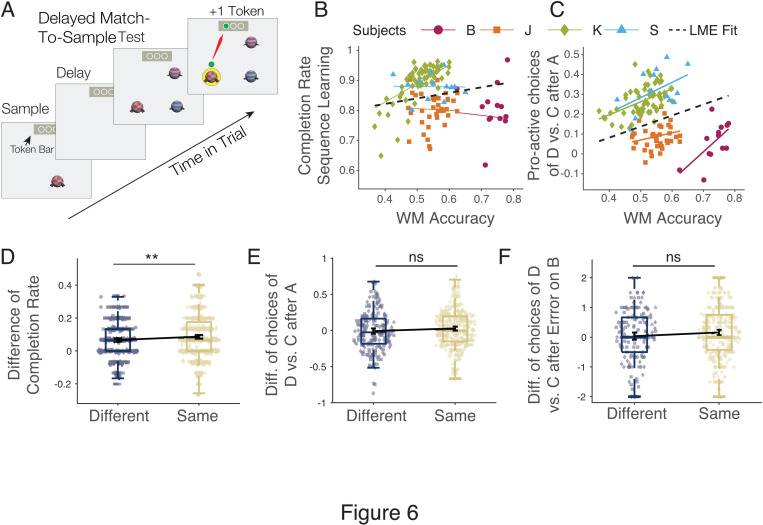
Intelligent behavior involves mentally arranging learned information in novel ways and is particularly well developed in humans. While nonhuman primates (NHP) will learn to arrange new items in serial order and re-arrange neighboring items within that order, it has remained contentious whether they are capable to re-assign items more flexibly to non-adjacent serial positions. Such mental re-indexing is facilitated by inferring the sequential structure of experiences as opposed to learning serial chains of item-item associations. Here, we tested the ability for flexible mental re-indexing in rhesus macaques. Subjects learned to choose five objects in a predetermined sequential order. A change of the background context indicated when the object order changed, probing the subjects to mentally re-arrange objects to non-adjacent positions of the learned serial structure. Subjects successfully used the context cue to pro-actively re-index items to new, non-adjacent positions. Mental re-indexing was more likely when the initial order had been learned at a higher level, improved with more experience of the re-indexing rule and correlated with working memory performance in a delayed match-to-sample task. These findings suggest that NHPs inferred the sequential structure of experiences beyond a chaining of item-item associations and mentally re-arrange items within that structure. The pattern of results indicates that NHPs form non-spatial cognitive maps of their experiences, which is a hallmark for flexible mental operations in many serially ordered behaviors including communication, counting or foraging.
Copyright: © 2025 Wen et al. This is an open access article distributed under the terms of the Creative Commons Attribution License, which permits unrestricted use, distribution, and reproduction in any medium, provided the original author and source are credited.
Conflict of interest statement
The authors have declared that no competing interests exist.
Figures


References
-
- Davis H, Pérusse R. Numerical competence in animals: Definitional issues, current evidence, and a new research agenda. Behav Brain Sci. 1988;11(4):561–79. doi: 10.1017/s0140525x00053437 - DOI
-
- Passingham RE. Understanding the Prefrontal Cortex: Selective Advantage, Connectivity, and Neural Operations. Oxford University Press; 2021.
-
- Dehaene S. How we learn: Why brains learn better than any machine. for now. Penguin; 2021.
MeSH terms
Grants and funding
LinkOut - more resources
Full Text Sources