


Success of airway management in out-of-hospital cardiac arrest using different devices - a prospective, single-center, observational study comparing professions
- PMID: 40551144
- PMCID: PMC12183896
- DOI: 10.1186/s13049-025-01422-2
Success of airway management in out-of-hospital cardiac arrest using different devices - a prospective, single-center, observational study comparing professions
Abstract
Background: Endotracheal intubation is the gold standard for airway management in out-of-hospital cardiopulmonary resuscitation (CPR) but requires practice, especially in difficult conditions. To facilitate this, video laryngoscopy (VL) is increasingly used. The extent to which it is actually used in practice by paramedics or emergency physicians (EPs) and its effectiveness remain unclear. This prospective observational study investigates these aspects.
Methods: From January 2020 to June 2024, we surveyed emergency physicians and paramedics in a German county about out-of-hospital resuscitations. The questionnaire covered qualifications, airway devices, attempts, and complications. Data was analyzed descriptively and statistically. The significance level was set at alpha ≤ 0.05.
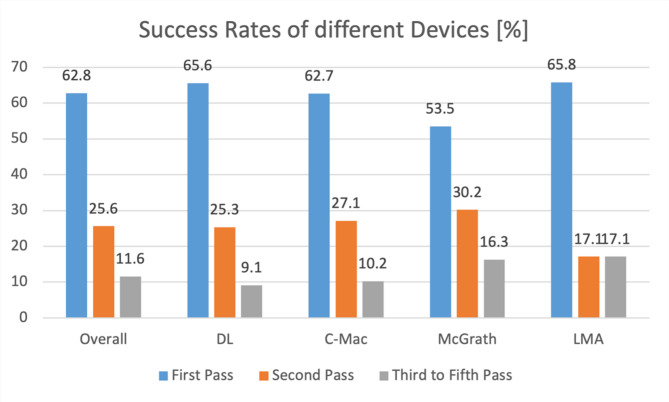
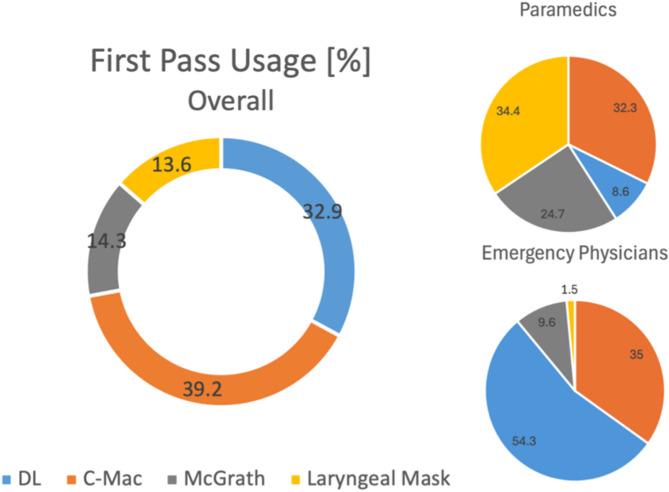
Results: 301 questionnaires were analyzed, with an overall first pass success (FPS) rate of 62.8%. No significant difference was found between direct laryngoscopy (DL) and video laryngoscopy (VL), though VL with McGrath performed worse than DL and VL with C-Mac. FPS rates did not differ significantly between emergency physicians and paramedics. Both achieved better results with their regularly used device. Paramedics used laryngeal masks more frequently (34% vs. 1.5%, p < 0.001). Among emergency physicians, anesthetists had the lowest FPS using DL (p < 0.001).
Interpretation: The FPS rate did not differ between DL and VL but was low overall. This low rate, as well as the fact that emergency physicians and paramedics achieved comparable results in intubation, might indicate an increased need for training and further education in the area of airway management for emergency personnel. However, it can also be questioned to what extent ETI can be recommended at all, with supraglottic devices being an alternative. A possible benefit of more training can be seen in the higher success rates with the more frequently used devices in both professions. An uncertainty of paramedics regarding endotracheal intubation is also reflected in an more frequent use of laryngeal masks. The fact that internists who used VL more frequently had better FPS rates than anesthetists who intubated conventionally more often shows the potential of VL, especially under difficult out-of-hospital intubation conditions.
Trial registration: The study was registered in the German Clinical Trials Register (DRKS ID: DRKS00021821, 12.06.2020).
Keywords: Airway management; Emergency medical services; Endotracheal intubation; Out-of-hospital cardiac arrest; Video laryngoscopy.
© 2025. The Author(s).
Conflict of interest statement
Declarations. Ethical approval: Positive vote of the ethics board of the Philipps University of Marburg, Germany from 02/09/2019 (Ethics Committee processing number: 134/19). Consent for publication: Not applicable. Competing interests: The authors declare no competing interests.
Figures
References
-
- Fischer M, Wnent J, Gräsner J-T, Seewald S, Rück L, Hoffmann H, Bein B, Ramshorn-Zimmer A, Bohn A. & Die teilnehmenden rettungsdienste im, Deutschen reanimationsregister. Öffentlicher Jahresbericht 2023 des Deutschen Reanimationsregisters: Außerklinische Reanimation 2023 [Internet]. 2024. Verfügbar unter: https://www.reanimationsregister.de/downloads/oeffentliche-jahresbericht...
-
- Murphy DL, Bulger NE, Harrington BM, Skerchak JA, Counts CR, Latimer AJ. u. A. Fewer tracheal intubation A.tempts A.e A.sociated with improved neurologically intact survival following out-of-hospital cardiac A.rest. Resusc Oktober. 2021;167:289–96. - PubMed
-
- Timmermann A. S1-Leitlinie: prähospitales atemwegsmanagement (Kurzfassung). Timmermann böttiger BW Byhahn C Dörges V Eich C Gräsner JT al S1-Leitlin prähospitales atemwegsmanagement Kurzfass. 7 Juni 2019;(6–2019):316–36.
Publication types
MeSH terms
LinkOut - more resources
Full Text Sources
Medical
Miscellaneous
