Perturbation of the MetJ regulon impacts the consequences of 2-aminoacrylate stress in Salmonella enterica
- PMID: 40552973
- PMCID: PMC12188003
- DOI: 10.1099/mic.0.001572
Perturbation of the MetJ regulon impacts the consequences of 2-aminoacrylate stress in Salmonella enterica
Abstract
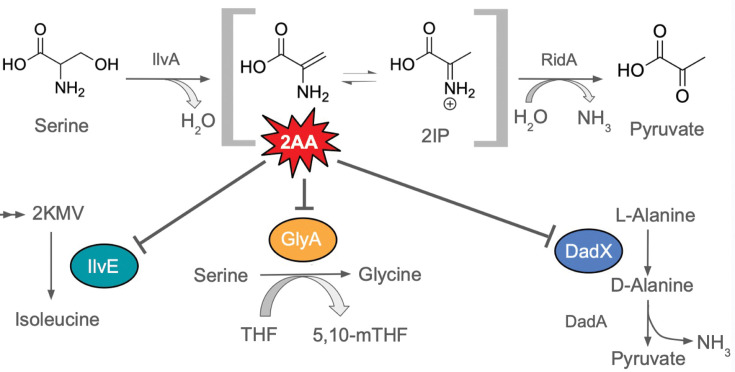
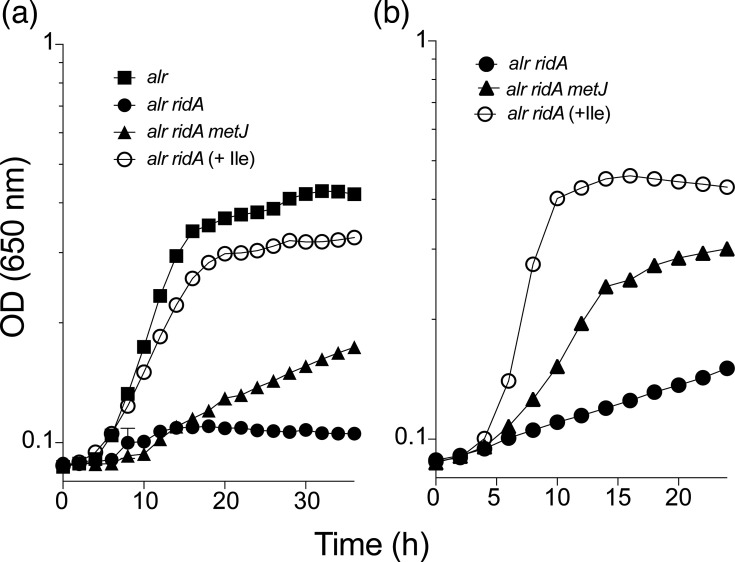
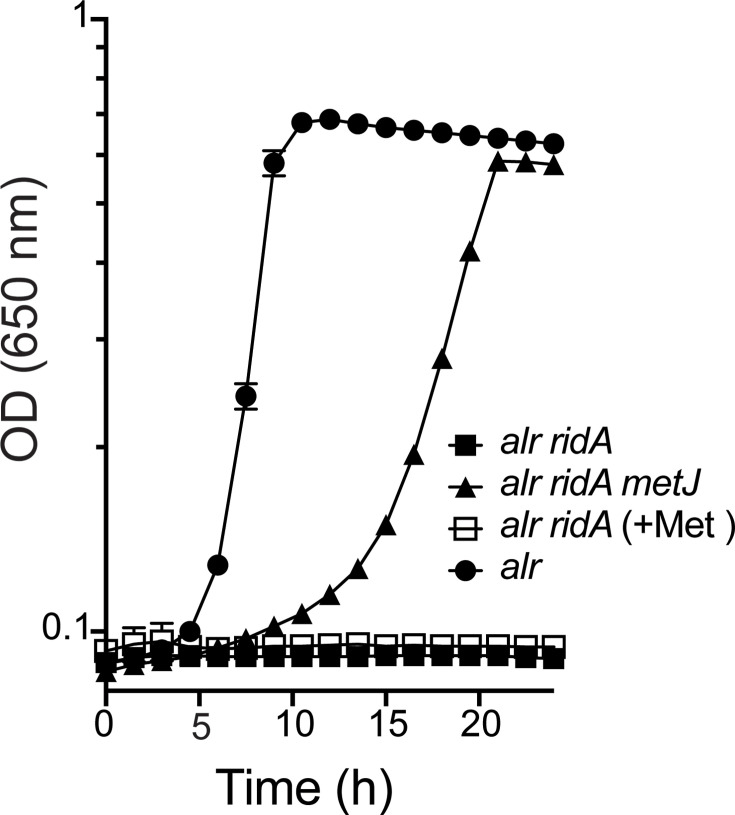
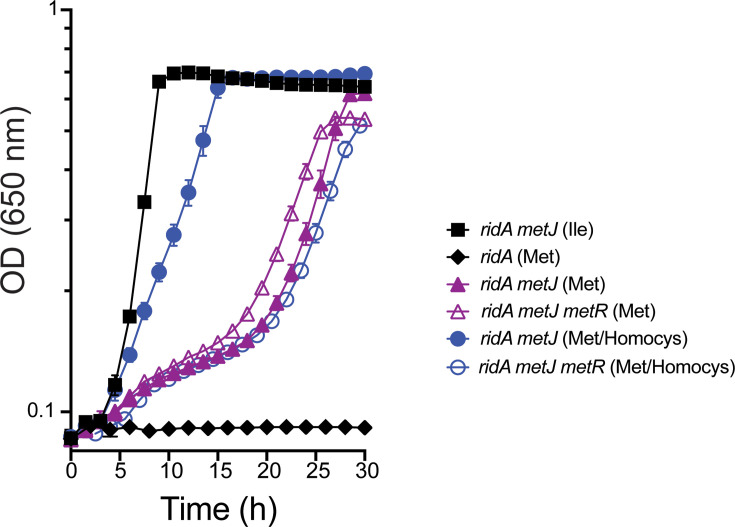
In the absence of the broadly conserved deaminase RidA (Reactive intermediate deaminase A), Salmonella enterica and other organisms accumulate the reactive enamine species 2-aminoacrylate (2AA). Free 2AA, generated from serine by the serine/threonine dehydratase IlvA, reacts with and covalently inactivates a subset of pyridoxal 5'-phosphate-dependent enzymes. The metabolic stress caused by 2AA generates growth defects in S. enterica, including (i) when l-alanine is used as a nitrogen source, (ii) when pyruvate is used as a carbon source or (iii) in the presence of exogenous serine. Although the enzymatic targets of 2AA are consistent between growth conditions, the consequences of 2AA-dependent damage differ depending on the distribution of metabolic flux required in different conditions. Analysing the suppressors of a ridA mutant has furthered our understanding of the RidA stress paradigm and, more generally, how a metabolic network responds to perturbation. Many such suppressors modulate the metabolic network to eliminate 2AA production by IlvA. Here, we describe that eliminating the MetJ transcriptional repressor allows a ridA mutant to grow in the presence of 2AA stress in each of the three conditions. The mechanisms by which a ΔmetJ suppresses a ridA mutant are nuanced and medium-dependent, emphasizing that consequences of 2AA stress differ based on environmental and metabolic context.
Keywords: 2-aminoacrylate stress; MetJ; MetR; RidA.
Conflict of interest statement
The authors declare that there are no conflicts of interest.
Figures
References
MeSH terms
Substances
Grants and funding
LinkOut - more resources
Full Text Sources
Miscellaneous