


Intermittent fasting for weight loss in night shift workers: a three-arm, superiority randomised clinical trial
- PMID: 40554393
- PMCID: PMC12219368
- DOI: 10.1016/j.ebiom.2025.105803
Intermittent fasting for weight loss in night shift workers: a three-arm, superiority randomised clinical trial
Abstract
Background: Weight gain and an increased risk of developing type 2 diabetes are recognised consequences of night shift work. We tested the effectiveness of two modified intermittent fasting (IF) strategies compared with continuous energy restriction (CER) on weight loss and improvements in insulin resistance in night shift workers.
Methods: A parallel group, three-arm randomised superiority clinical trial (Melbourne and Adelaide) recruited night shift workers (aged ≥ 25 and ≤ 65 years) with overweight/obesity. Participants were randomised by minimisation (site, age, gender) 1:1:1 to CER or one of two modified IF strategies. For 24 weeks participants followed a diet of 2100 kJ/d for two days of the week (modified IF) either on days off/day shift (IF:2D) or whilst on night shift (IF:2N) and followed their usual diet on the remaining five days. Co-primary outcomes were body weight and insulin resistance measured by the Homeostatic Model Assessment for Insulin Resistance (HOMA-IR) at 24-weeks. Participants and those assessing weight outcomes were not blinded to group assignment. Researchers assessing biochemical outcomes and study statistician were blinded to group assignment. Between-group differences were calculated using mixed-effects regression models.
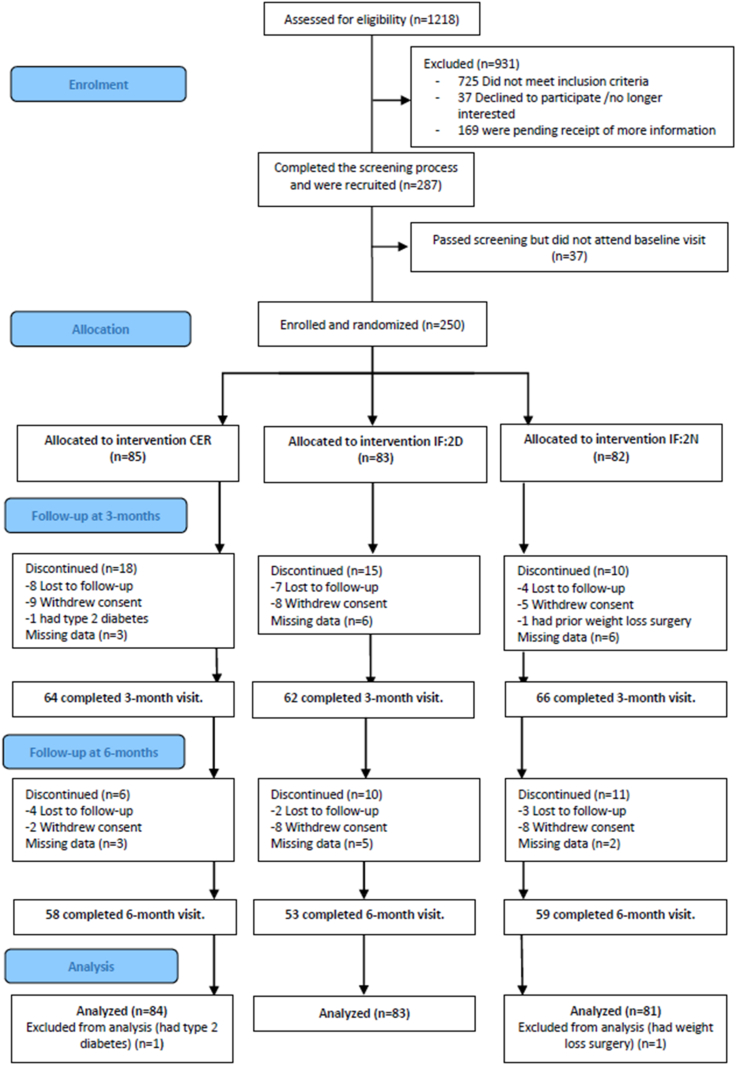
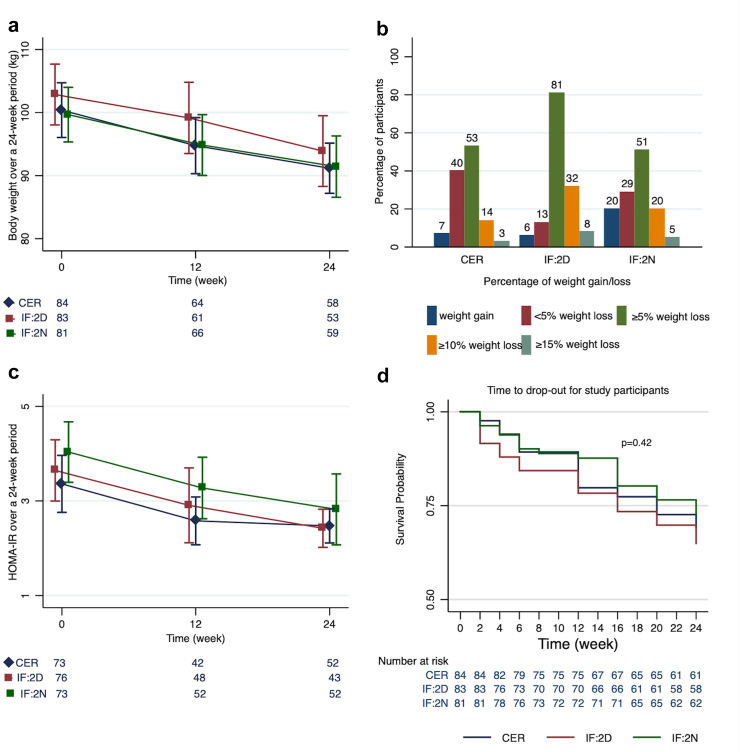
Findings: From October 2019 to February 2022, 250 participants (CER = 85; IF:2D = 83; IF:2N = 82) were randomised (mean (SD) age 46.8 (9.8) years; 133 women (53.2%)), with 170 (68%) completing. No significant difference between either modified IF strategy and CER for body weight; IF:2D vs CER (mean difference (MD) = -0.2 kg [95% CI -6.4 to 5.9]) and IF:2N vs CER (MD = -0.6 kg [95% CI -6.8 to 5.6]) and insulin resistance; IF:2D vs CER (MD = -0.1 [95% CI -1.0 to 0.8]) and IF:2N vs CER (MD = -0.3 [95% CI -0.5 to 1.2]) were observed. For secondary outcomes, those randomised to IF:2D had lower total and LDL cholesterol compared to CER ((MD = -23.2 mg/dL [95% CI -34.8 to -11.6]) and (MD = -19.3 mg/dL [95% CI -30.9 to -7.7]) respectively). In a completer's analysis, favourable changes in body weight, insulin resistance, body composition, blood pressure, and cardiometabolic markers were observed within all groups. No serious trial related adverse events were reported.
Interpretation: At 24 weeks, weight and HOMA-IR were not different between the modified IF groups compared with CER. Clinically significant improvements in weight and metabolic health were achieved for the majority of night shift workers who remained in the intervention at 24 weeks.
Funding: National Health and Medical Research Council (APP1159762). ANZCTR registry, ACTRN-12619001035112.
Keywords: Continuous energy restriction; Diet intervention; Intermittent fasting; Obesity; Shift work; Weight loss.
Copyright © 2025 The Authors. Published by Elsevier B.V. All rights reserved.
Conflict of interest statement
Declaration of interests All authors have completed the ICMJE uniform disclosure form at http://www.icmje.org/disclosure-of-interest/ and declare: no support from any organisation for the submitted work; TLS is a consultant for Vanda Pharmaceuticals, unrelated to this work; no other relationships or activities that could appear to have influenced the submitted work.
Figures
References
-
- Sun M., Feng W., Wang F., et al. Meta-analysis on shift work and risks of specific obesity types. Obes Rev. 2018;19(1):28–40. - PubMed
-
- Torquati L., Mielke G.I., Brown W.J., Kolbe-Alexander T. Shift work and the risk of cardiovascular disease. A systematic review and meta-analysis including dose-response relationship. Scand J Work Environ Health. 2018;44(3):229–238. - PubMed
-
- Cordina-Duverger E., Menegaux F., Popa A., et al. Night shift work and breast cancer: a pooled analysis of population-based case-control studies with complete work history. Eur J Epidemiol. 2018;33(4):369–379. - PubMed
-
- Behrens T., Rabstein S., Wichert K., et al. Shift work and the incidence of prostate cancer: a 10-year follow-up of a German population-based cohort study. Scand J Work Environ Health. 2017;43(6):560–568. - PubMed
Publication types
MeSH terms
LinkOut - more resources
Full Text Sources
Medical
