


Misrepresentation of Overall and By-Gender Mortality Causes in Film Using Online, Crowd-Sourced Data: Quantitative Analysis
- PMID: 40554798
- PMCID: PMC12212890
- DOI: 10.2196/70853
Misrepresentation of Overall and By-Gender Mortality Causes in Film Using Online, Crowd-Sourced Data: Quantitative Analysis
Abstract
Background: The common phrase "representation matters" asserts that media has a measurable and important impact on civic society's perception of self and others. The representation of health in media, in particular, may reflect and perpetuate a society's disease burden.
Objective: In this study, for the top 10 major causes of death in the United States, we aimed to examine how cinematic representation overall and by-gender mortality diverges from reality.
Methods: Using crowd-sourced data on over 68,000 film deaths from Cinemorgue Wiki, we employ natural language processing techniques to analyze shifts in representation of deaths in movies versus the 2021 National Vital Statistics Survey top 10 mortality causes. We parsed, stemmed, and classified each film death database entry, and then categorized film deaths by gender using a specifically trained gender text classifier.
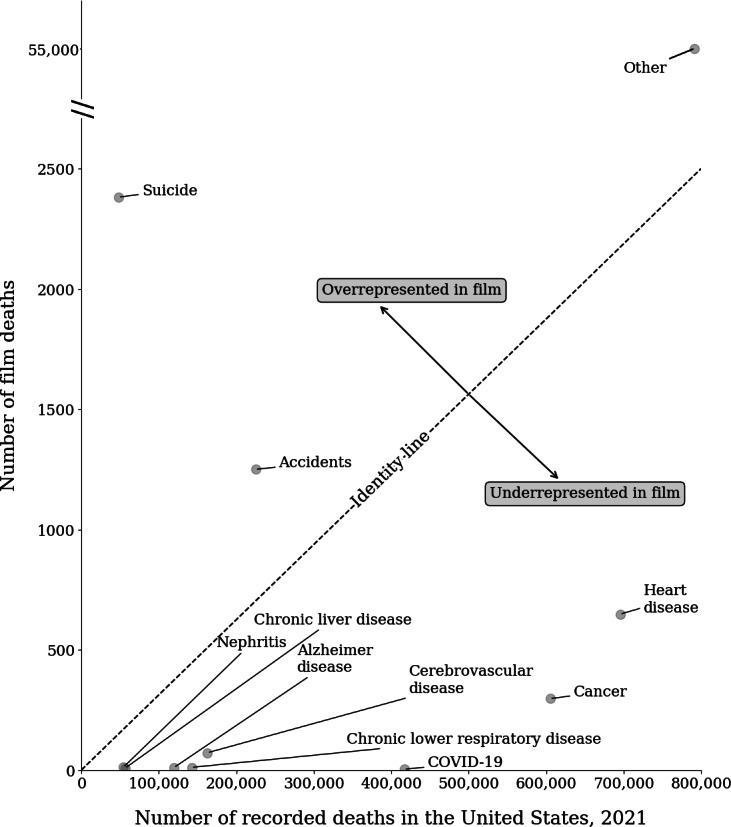
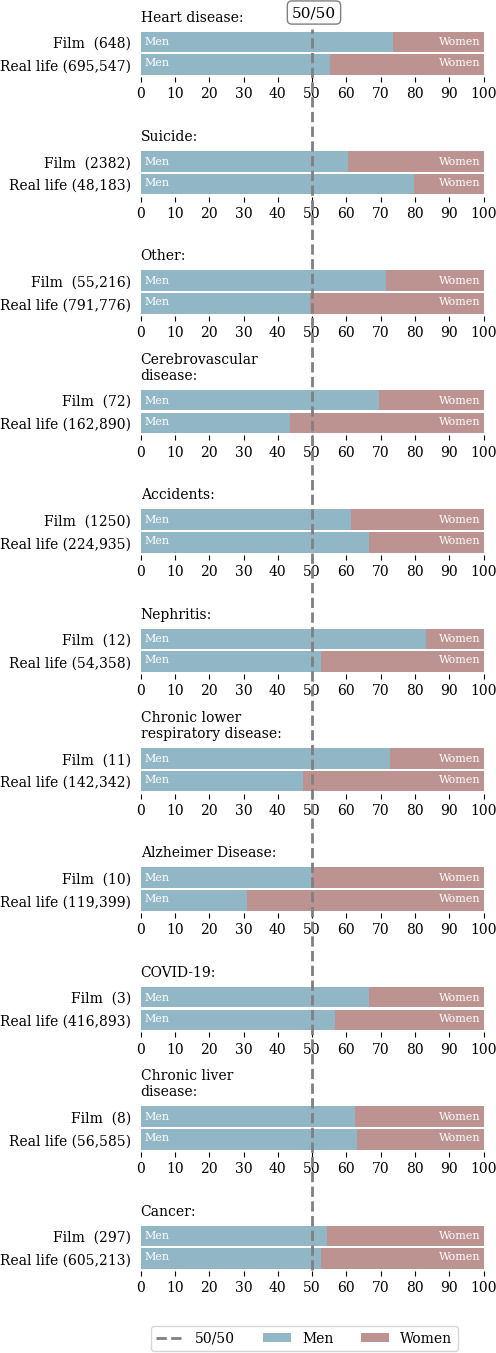
Results: Overall, movies strongly overrepresent suicide and, to a lesser degree, accidents. In terms of gender, movies overrepresent men and underrepresent women for nearly every major mortality cause, including heart disease and cerebrovascular disease (chi-square test, P<.001); 73.6% (477/648) of film deaths from heart disease were men (vs 384,866/695,547, 55.4% in real life) and 69.4% (50/72) of film deaths from cerebrovascular disease were men (vs 70,852/162,890, 43.5% in real life). The 2 exceptions for which women were overrepresented are suicide and accidents (chi-square test, P<.001), with 39.7% (945/2382) deaths from suicide in film being women (vs 9825/48,183, 20.4% in real life) and 38.8% (485/1250) deaths from accidents in film being women (vs 75,333/225,935, 33.5% in real life).
Conclusions: We discuss the implications of under- and overrepresenting causes of death overall and by gender, as well as areas of future research.
Keywords: NLP; data science; gender; media representation; mortality; natural language processing.
© Calla Glavin Beauregard, Christopher M Danforth, Peter Sheridan Dodds. Originally published in JMIR Formative Research (https://formative.jmir.org).
Conflict of interest statement
Figures
References
-
- Curtin SC, Tejada-Vera B, Bastian BA. Deaths: leading causes for 2021. [29-05-2025];Natl Vital Stat Rep. 2024 73(4) https://www.cdc.gov/nchs/data/nvsr/nvsr73/nvsr73-04.pdf URL. Accessed. - PubMed
-
- Isakadze N, Mehta PK, Law K, Dolan M, Lundberg GP. Addressing the gap in physician preparedness to assess cardiovascular risk in women: a comprehensive approach to cardiovascular risk assessment in women. Curr Treat Options Cardiovasc Med. 2019 Jul 29;21(9):47. doi: 10.1007/s11936-019-0753-0. doi. Medline. - DOI - PubMed
-
- Wenger NK, Lloyd-Jones DM, Elkind MSV, et al. Call to action for cardiovascular disease in women: epidemiology, awareness, access, and delivery of equitable health care: a Presidential Advisory from the American Heart Association. Circulation. 2022 Jun 7;145(23):e1059–e1071. doi: 10.1161/CIR.0000000000001071. doi. Medline. - DOI - PMC - PubMed
-
- Brooks D, Hébert L. The SAGE Handbook of Gender and Communication. SAGE Publications; 2006. Gender, race, and media representation. doi. - DOI
-
- Dill‐Shackleford KE, Vinney C, Hopper‐Losenicky K. Connecting the dots between fantasy and reality: the social psychology of our engagement with fictional narrative and its functional value. Social & Personality Psych. 2016 Nov;10(11):634–646. doi: 10.1111/spc3.12274. doi. - DOI
MeSH terms
LinkOut - more resources
Full Text Sources
