


Integrated community-based HIV and sexual and reproductive health services for youth: a cluster-randomized trial
- PMID: 40555749
- PMCID: PMC7617871
- DOI: 10.1038/s41591-025-03762-z
Integrated community-based HIV and sexual and reproductive health services for youth: a cluster-randomized trial
Abstract
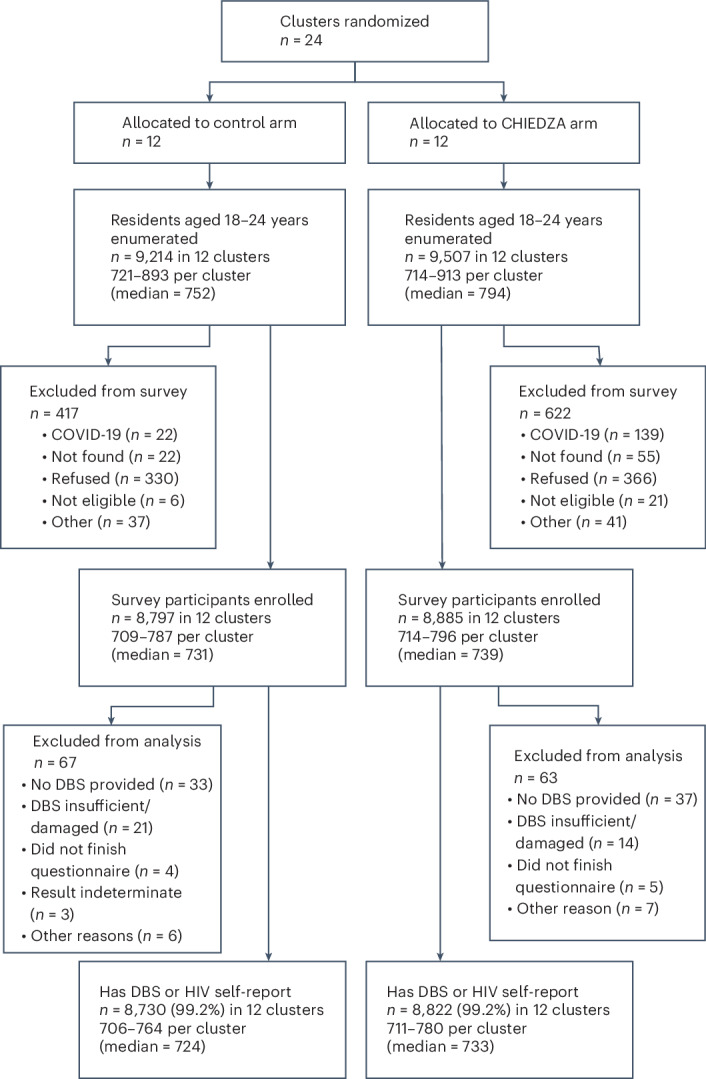
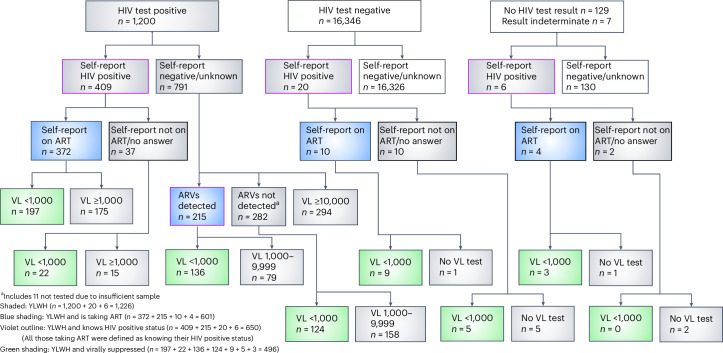
Human immunodeficiency virus (HIV) viral suppression rates are disproportionately worse in youth compared to other age groups, and improving this will require addressing the whole HIV cascade, including HIV testing, linkage to care and support to maintain viral suppression. We conducted a cluster-randomized trial of community-based services incorporating HIV testing, treatment and adherence support integrated with sexual and reproductive health (SRH) services for youth (16-24 years) in Zimbabwe. Our hypothesis was that integrated services in community-based settings would increase demand and access. In total, 24 clusters (geographically demarcated areas) were randomized 1:1 to intervention or control (existing services). Primary outcome was virological suppression (defined as HIV viral load <1,000 copies per ml) among youth with HIV (YWH), ascertained through a population-level outcome survey of 17,682 youth (18-24 years). Secondary outcomes, corresponding to UNAIDS 90-90-90 targets, were the proportion of YWH who knew their HIV status, the proportion of YWH who knew their HIV status who were taking antiretroviral therapy (ART) and the proportion of YWH taking ART who achieved viral suppression (HIV viral load <1,000 copies per ml). There was no difference by arm in primary outcome (mean cluster prevalence-41.3% (intervention) versus 38.3% (control); risk ratio (RR)-1.07 (95% confidence interval (CI), 0.88-1.30)) or in proportion of YWH who were diagnosed. In the intervention arm, a lower proportion of diagnosed YWH were taking treatment (RR = 0.91 (95% CI, 0.83-0.99)), but a higher proportion of those on ART had viral suppression (RR = 1.18 (95% CI, 1.02-1.37)). The intervention did not impact the proportion of youth with undiagnosed HIV, which explains the lack of effect on the primary outcome. Among those taking treatment, the intervention improved viral suppression. Delivery of integrated HIV and SRH services was feasible and facilitated uptake by youth of essential services beyond HIV, addressing an important programmatic gap. Trial registration number: NCT03719521 .
© 2025. The Author(s).
Conflict of interest statement
Competing interests: The authors declare no competing interests.
Figures
References
-
- Seizing the Moment: Tackling Entrenched Inequalities to End Epidemics (UNAIDS, 2020); https://www.unaids.org/sites/default/files/media_asset/2020_global-aids-...
-
- Zimbabwe Population-Based HIV Impact Assessment (ZIMPHIA) 2015–2016: Final Report (Ministry of Health and Child Care, 2019); https://phia.icap.columbia.edu/wp-content/uploads/2020/02/ZIMPHIA-Final-...
-
- Malawi Population-Based HIV Impact Assessment (MPHIA) 2015–2016: Final Report (Ministry of Health, 2018); https://phia.icap.columbia.edu/wp-content/uploads/2020/02/MPHIA-Final-Re...
-
- Zambia Population-Based HIV Impact Assessment (ZAMPHIA) 2016: Final Report (Ministry of Health, 2019); https://phia.icap.columbia.edu/wp-content/uploads/2019/03/ZAMPHIA-Final-...
Publication types
MeSH terms
Associated data
Grants and funding
LinkOut - more resources
Full Text Sources
Medical
Miscellaneous
