


Effect of deterioration of swallowing functions on the frailty status in older adults: a longitudinal cohort study
- PMID: 40556004
- PMCID: PMC12186369
- DOI: 10.1186/s12877-025-05896-8
Effect of deterioration of swallowing functions on the frailty status in older adults: a longitudinal cohort study
Abstract
Background: Deterioration of swallowing function (DSF) is common among aging adults and can lead to negative health outcomes such as increased risk of malnutrition. However, the longitudinal relationship between the DSF and frailty status remains unclear. This study aimed to investigate whether declining swallowing function is linked to frailty progression in independent older adults.
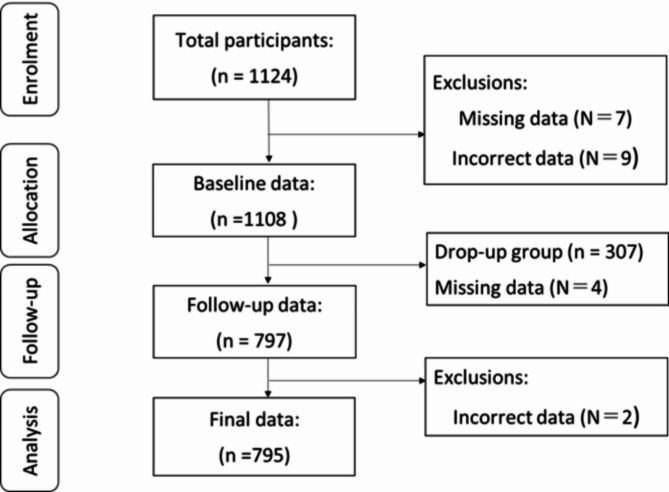
Methods: This study included 795 community-dwelling Japanese individuals aged ≥ 65 years who participated in two surveys: one at baseline and one after two years. Swallowing function was evaluated using the repetitive saliva swallowing test, tongue pressure test, and questionnaire. DSF was identified by meeting more than one of three criteria: Repeated Saliva Swallow Test below 3, tongue pressure under 27.4 kPa for men and 26.5 kPa for women, and a "yes" response to the questionnaire. Frailty status was assessed using the Kihon Checklist, with participants showing a decline categorized into the "aggravation group." Oral function (number of teeth, occlusal force, masticatory performance, and oral dryness) and physical function (body mass index, gait speed, grip strength, and skeletal muscle mass index) were evaluated. Comparisons between the two groups were made using the Student's t-test or the χ2 test. Differences among the three groups were assessed using the one-way analysis of variance or the χ2 test. Significant differences in continuous variables were analyzed using the Least Significant Difference method, with P-values adjusted using the Bonferroni correction.
Results: Initially, 87 (10.9%) participants were frail. By follow-up, 149 participants (37.9%) had progressed to frailty, 83 of whom (55.7%) exhibited impaired swallowing function at baseline. At baseline, frailty was significantly associated with age, gait speed, decreased swallowing function, number of functional teeth, occlusal force, and masticatory performance. None of the three swallowing function assessment methods were significantly associated with the progression of frailty. In contrast, logistic regression analysis of frailty progression showed that impaired swallowing function was a significant explanatory variable (OR, 1.53; 95% CI: 1.04-2.21).
Conclusion: This study found a significant association between frailty and multiple factors, particularly oral function. Specifically, diminished swallowing function has emerged as a notable independent predictor of frailty progression.
Keywords: Dysphagia; Frailty; Older adults; Oral hypofunction; Swallowing.
© 2025. The Author(s).
Conflict of interest statement
Declarations: We confirm that we have obtained an appropriate license to utilize this study’s Mini-Mental State Examination scale, ensuring compliance with all applicable regulations and permissions. Ethics approval and consent to participate: This study was conducted in accordance with the World Medical Association Declaration of Helsinki and approved by the Institutional Review Board of Hyogo Medical University (No. Rinhi 0342) and Niigata University (No. G2021–0027). Each participant was provided with a comprehensive briefing and asked to provide written informed consent. Consent for publication: Not applicable. Competing interests: The authors declare no competing interests.
Figures
References
-
- Serra-Prat M, Palomera M, Gomez C, Sar-Shalom D, Saiz A, Montoya JG, Navajas M, Palomera E, Clavé P. Oropharyngeal dysphagia as a risk factor for malnutrition and lower respiratory tract infection in independently living older persons: a population-based prospective study. Age Aging. 2012;41(3):376–81. - DOI - PubMed
MeSH terms
Grants and funding
LinkOut - more resources
Full Text Sources
Medical
