


Predicted Sensory Modality Determines the Timing and Topographies of Omitted Stimulus Potentials
- PMID: 40556508
- PMCID: PMC12188284
- DOI: 10.1111/psyp.70097
Predicted Sensory Modality Determines the Timing and Topographies of Omitted Stimulus Potentials
Abstract
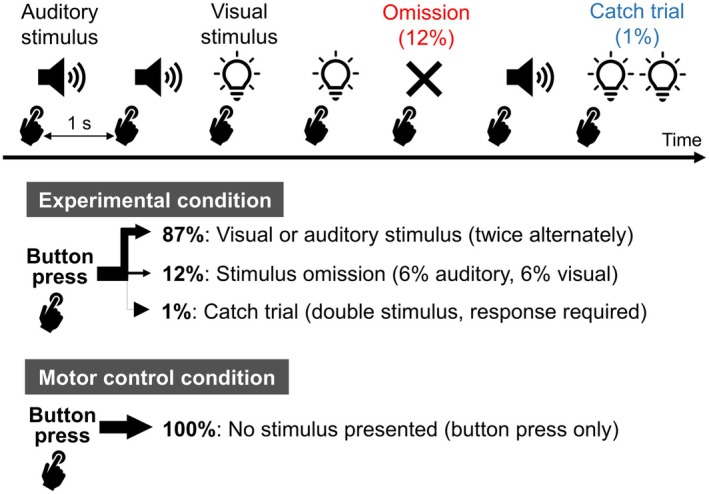
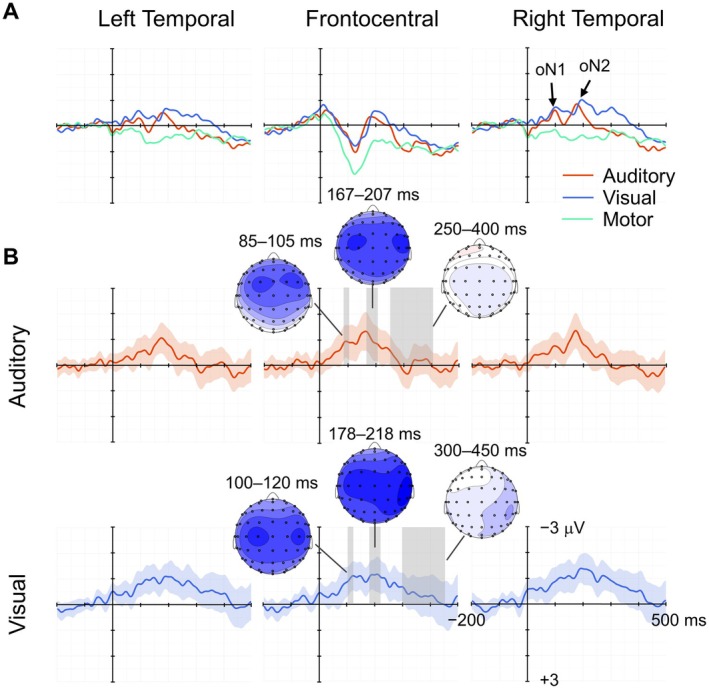
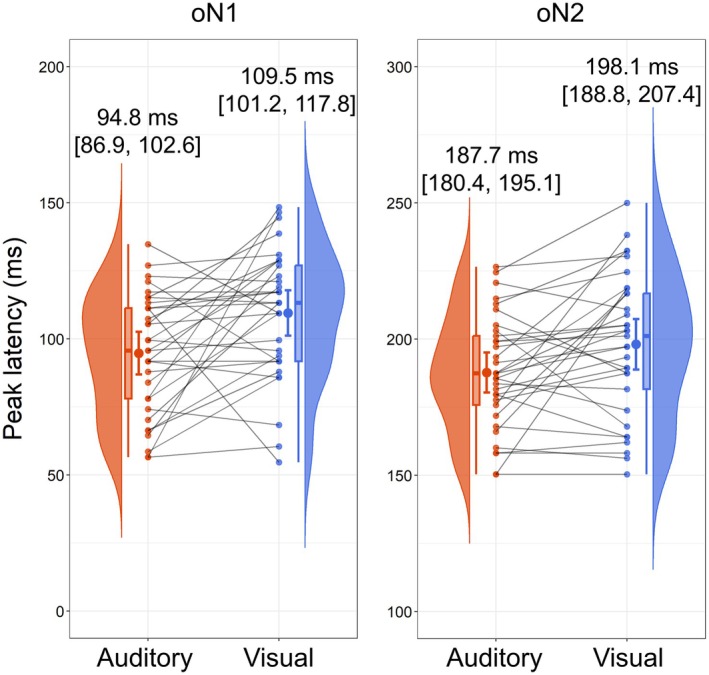
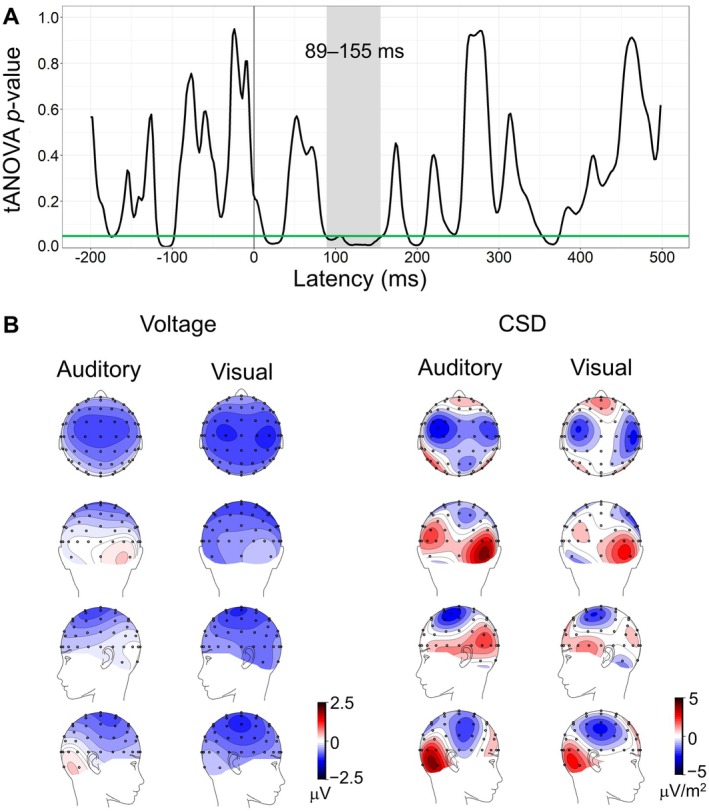
It is thought that our brains actively predict what will happen next in the environment, but it remains unclear how specific the prediction of an upcoming event is. This study investigated whether the prediction about the sensory modality of the upcoming stimulus modulates neural responses to unexpected omissions of stimuli. Previous research has reported that the peak latencies of omitted stimulus potentials (OSPs) are shorter in the auditory modality than in the visual modality when tested in separate blocks. In this study, we presented auditory and visual stimuli in a fixed alternating pattern to examine whether modality-specific OSPs occur even within a single block. Participants (N = 33) were asked to press a mouse button at a constant interval of 1 s. Each button press triggered either an auditory or visual stimulus, and these were presented twice in an alternating pattern (A, A, V, V, A, A, etc.). The stimuli were omitted in 12% of the trials. This method ensured each type of omission (of either auditory or visual stimuli) to be preceded equally often by either an auditory or a visual stimulus, thereby controlling for late event-related potential components of the preceding stimulus, if any. The results showed that auditory OSPs had shorter peak latencies than visual OSPs and that their scalp topographies differed; auditory OSPs had more anterior and central distributions than visual OSPs. These findings suggest that OSPs occur in a modality-specific manner according to the predicted sensory modality of the upcoming stimulus.
Keywords: event‐related potential; omission; prediction; predictive coding; self‐generation; sensory modality.
© 2025 The Author(s). Psychophysiology published by Wiley Periodicals LLC on behalf of Society for Psychophysiological Research.
Conflict of interest statement
The authors declare no conflicts of interest.
Figures
References
-
- Barascud, N. , Pearce M. T., Griffiths T. D., Friston K. J., and Chait M.. 2016. “Brain Responses in Humans Reveal Ideal Observer‐Like Sensitivity to Complex Acoustic Patterns.” Proceedings of the National Academy of Sciences of the United States of America 113, no. 5: E616–E625. 10.1073/pnas.1508523113. - DOI - PMC - PubMed
MeSH terms
LinkOut - more resources
Full Text Sources
