


Current Clinical Laboratory Challenges to Widespread Adoption of Phage Therapy in the United States
- PMID: 40558145
- PMCID: PMC12189272
- DOI: 10.3390/antibiotics14060553
Current Clinical Laboratory Challenges to Widespread Adoption of Phage Therapy in the United States
Abstract
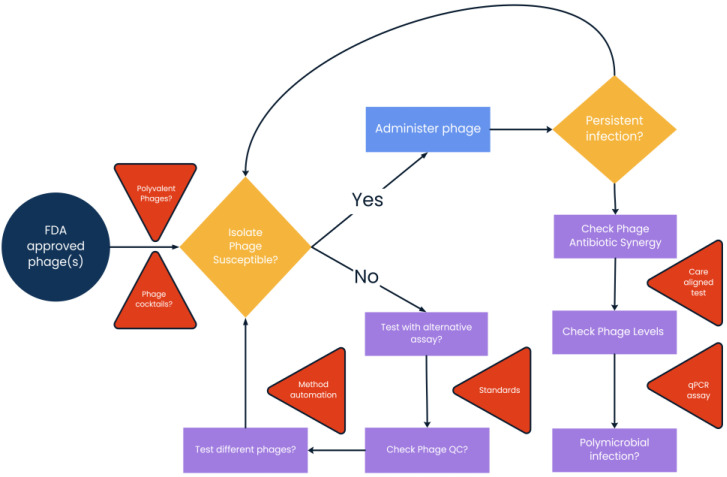
The resurgence of phage therapy in Western societies has been in direct response to recent increases in antimicrobial resistance (AMR) that have ravaged many societies. While phage therapy as a concept has been around for over 100 years, it has largely been replaced by antibiotics due to their relative ease of use and their predictability in spectrum of activity. Now that antibiotics have become less reliable due to greater antibiotic resistance and microbiome disruption, phage therapy has once again become a viable and promising alternative, but it is not without its challenges. Much like the development of antibiotics, with deployment of phage therapeutics there will be a simultaneous need for diagnostics in the clinical laboratory. This review provides an overview of current challenges to widespread adoption of phage therapy with a focus on adoption in the clinical diagnostic laboratory. Current barriers include a lack of standard methodology and quality controls for phage susceptibility testing and selection, the absence of phage-antibiotic synergy testing, and the absence of standard methods to assay phage activity on biofilms. Additionally, there are a number of lab-specific administrative and regulatory barriers to widespread phage therapy adoption including the need for pharmacokinetic (PK) and pharmacodynamic (PD) assays, methods to account for changes in phages after passaging, an absence of regulatory guidance on what will be required for agency approvals of phages and how broad that approval will apply, and the increased need for lab personnel or automation to account for the work of testing large phage libraries against bacteria isolates.
Keywords: antibiotic alternatives; antibiotic–phage synergy; bacteriophage therapy; clinical microbiology laboratory; synergy testing.
Conflict of interest statement
A.G.C.G., J.Y., and D.P. are members of the Center for Innovative Phage Applications and Therapeutics at the University of California San Diego. D.V.T. is a member of the Center for Innovative Antimicrobial Therapy at the University of Pittsburgh. C.G. is the Founder and CEO of Bioharmony, Inc.
Figures
References
-
- d’Hérelles F. BACTERIOPHAGE: Sur un Microbe Invisible Antagoniste des Bacilles Dysentériques. Volume 165 Gauthier-Villars; Paris, France: 1917. Comptes Rendus Hebdomadaires des Séances de l’Académie des Sciences.
-
- Chanishvili N. Chapter 1—Phage Therapy—History from Twort and d’Herelle Through Soviet Experience to Current Approaches. In: Łobocka M., Szybalski W., editors. Advances in Virus Research. Volume 83. Academic Press; Cambridge, MA, USA: 2012. pp. 3–40. - PubMed
Publication types
LinkOut - more resources
Full Text Sources
Miscellaneous
